



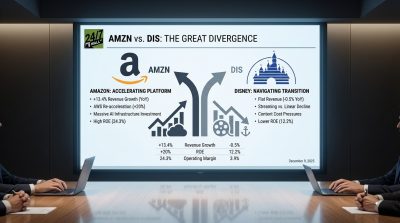
Disney (NYSE: DIS | DIS Price Prediction) beat earnings expectations this morning but missed on revenue, a split result that underscores the tension between the company’s recovery momentum and its struggle to grow the top line. Adjusted EPS came in at $1.11 versus the $1.06 estimate, while revenue landed at $22.46 billion against a $22.98 billion expectation. The stock was trading near $116 at filing.
Parks Surge While Entertainment Stumbles
The bright spot was Parks and Experiences, where operating income climbed 13% year over year on strong domestic and international performance. That segment continues to anchor Disney’s profitability and cash generation. Direct-to-Consumer revenue also expanded 8%, reflecting subscription growth across streaming properties. These two segments are carrying the company’s near-term narrative.
Entertainment operating income, however, fell 35% year over year. Content Sales and Licensing weakness and Linear Networks pressure dragged the division down. This is the segment that’s supposed to benefit from the company’s $24 billion content investment commitment, yet it’s the one showing the most visible strain.
EPS Growth Masks Revenue Stagnation
Total segment operating income declined 5% year over year to $3.48 billion. Net income reached $2.55 billion, and free cash flow came in at $739 million. The EPS beat reflects share buybacks and operational leverage more than genuine revenue expansion. Year-to-date revenue growth sits at just 2.1%, a figure that lags both historical Disney performance and peer growth rates.
This matters because earnings beats built on buyback programs and cost control are sustainable only if the underlying business eventually returns to organic growth. For now, Disney is in a transition phase where financial engineering is masking slower top-line momentum.
Capital Allocation Signals Confidence
Management doubled the share buyback target to $7 billion for the fiscal year, up from $3.5 billion previously. The company also announced a $1.50 per share annual dividend, to be paid in two installments of $0.75 on December 15, 2025 and January 15, 2026. These moves suggest leadership views the stock as attractively valued at current levels and intends to return capital aggressively to shareholders.
CEO Robert A. Iger struck a cautiously optimistic tone, stating the company has “strengthened the company by leveraging the value of our creative and brand assets and continued to make meaningful progress in our direct-to-consumer businesses.” The focus remained on DTC progress and strategic portfolio strength rather than near-term headwinds.
Forward Guidance Points to Recovery
Disney guided for double-digit percentage growth in adjusted EPS for fiscal 2026, with Entertainment segment operating income expected to grow (weighted toward the second half of the year). The company reiterated its $24 billion content investment commitment across Entertainment and Sports, signaling continued commitment to streaming and traditional content despite current Entertainment segment weakness.
Analysts remain constructive. The consensus target price is $134.22, implying roughly 14.5% upside from current levels. Buy ratings outnumber holds and sells by a significant margin, reflecting confidence in the recovery narrative even as near-term execution questions persist.
What Investors Should Monitor
The earnings call this morning will likely focus on two areas: the timeline for Entertainment segment recovery and the sustainability of DTC growth against competitive pressure from Netflix and other streamers. Disney’s 8% DTC growth lags Netflix’s 17%, a gap that investors will want to understand better. Additionally, management commentary on content spending efficiency and near-term margin trajectory will shape the stock’s next move.
The revenue miss is the headline to watch. Until Disney can demonstrate that DTC expansion and Parks strength translate into meaningful top-line growth, the EPS recovery remains dependent on financial engineering rather than fundamental business acceleration.












 Top Gaining Stocks
 Top Losing Stocks