


Walt Disney Company (NYSE: DIS | DIS Price Prediction) and Netflix Inc (NASDAQ: NFLX) reported quarterly earnings that exposed two entertainment giants moving in opposite directions. Disney beat EPS estimates at $1.11 versus $1.05 expected but missed on revenue at $22.46 billion against $22.75 billion expected. Netflix met revenue expectations at $11.51 billion while missing on EPS at $5.87 versus $6.97 expected, though a $619 million Brazilian tax dispute skewed that number.
Streaming Profits Versus Legacy Drag
Disney’s direct-to-consumer segment grew revenue 8% on subscription gains across Disney+ and Hulu. Streaming profitability now anchors the growth story. But the Entertainment segment saw operating income collapse 35% on weaker content licensing and continued erosion in linear networks. CFO Hugh Johnston told CNBC the company is “leaving the year with a lot of momentum” in streaming and experiences, yet the revenue miss came directly from traditional media assets.
Netflix posted 17.2% year-over-year revenue growth driven by membership expansion, pricing adjustments, and what management called its best ad sales quarter ever. Operating margin landed at 28%, which would have been higher without the Brazil tax hit. The company rolled out a new TV user interface to 85% of devices and integrated Amazon’s demand-side platform globally. Netflix achieved its highest quarterly view share in both the U.S. and U.K.
| Business Driver | Disney | Netflix |
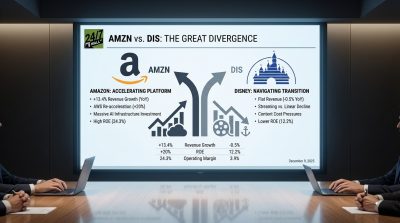
| Revenue Growth | -0.5% YoY | +17.2% YoY |
| Operating Margin | 11.9% | 28.2% |
| Main Growth Engine | Streaming + Parks | Membership + Ads |
One Diversifies Risk. One Doubles Down on Focus.
Disney’s Parks & Experiences segment delivered 13% operating income growth. Management plans to invest $24 billion in content across Entertainment and Sports in fiscal 2026 and doubled the share buyback target to $7 billion. CEO Robert Iger emphasized leveraging “the value of our creative and brand assets” across a portfolio spanning theme parks, cruises, linear TV, and streaming.
Netflix operates with singular focus. No parks. No linear networks. No theatrical releases. The company expects 17% revenue growth in Q4 and forecasts $45.1 billion in revenue for full-year 2025 with a 29% operating margin. It generated $2.66 billion in free cash flow during Q3 compared to Disney’s $739 million. Netflix’s profit margin of 24% runs nearly double Disney’s 13.1%, and return on equity of 42.9% triples Disney’s 12.2%.
| Metric | Disney | Netflix |
| Profit Margin | 13.1% | 24.0% |
| Free Cash Flow (Recent Quarter) | $739M | $2.66B |
| P/E Ratio | 15.3 | 45.6 |
Which Strategy Works Through 2026?
Disney must stabilize legacy media while scaling streaming without cannibalizing what still generates cash. Management expects double-digit adjusted EPS growth in fiscal 2026, weighted to the second half. That timing suggests the turnaround takes longer than investors might prefer. Netflix faces a simpler challenge: keep membership growing and prove advertising can scale without degrading the core experience.
Key Differences in Business Models
The two companies present contrasting approaches to entertainment. Netflix operates with a focused streaming model generating higher margins and cash flow, while Disney maintains a diversified portfolio spanning parks, traditional media, and streaming. Each model carries distinct risks and opportunities that investors must weigh based on their own investment criteria and risk tolerance.











 Top Gaining Stocks
 Top Losing Stocks