


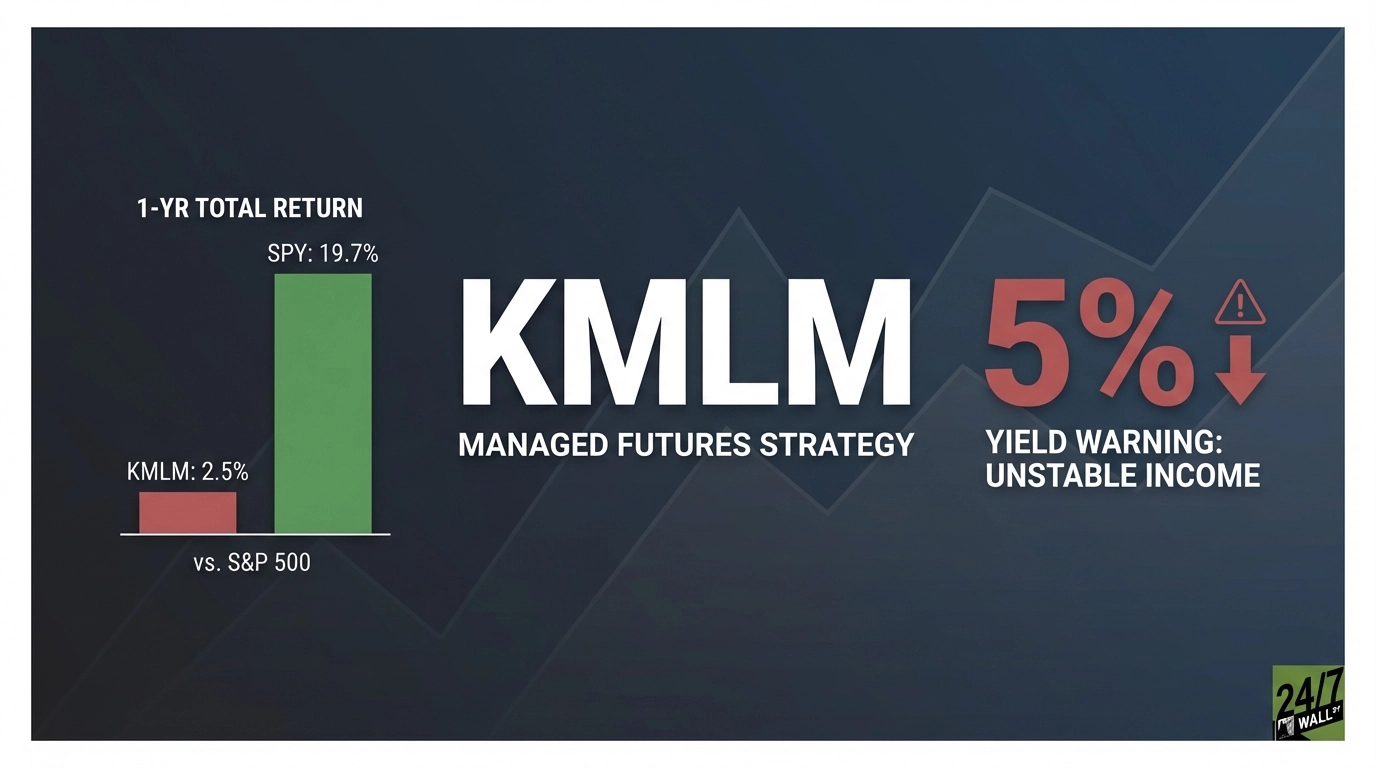
The KraneShares Mount Lucas Managed Futures Index Strategy ETF (NYSEARCA:KMLM) offers a 5% dividend yield based on its most recent annual distribution. However, investors considering this ETF for income should understand the dividend’s headline number masks significant instability and disappointing total returns.
How KMLM Generates Income
KMLM doesn’t generate income like traditional dividend ETFs. It tracks the KFA Mount Lucas Index through a trend-following managed futures strategy investing in 22 futures contracts across commodities, currencies, and global fixed income markets. Distributions represent trading gains from futures positions, not dividend payments from stocks. When the strategy captures price trends, it generates profits distributed to shareholders. When trends reverse or markets remain range-bound, distributions plummet.
The fund’s dividend history reveals extreme instability that undermines its appeal as an income investment. Last December’s distribution surged compared to the prior year, yet remained far below the 2022 peak when commodity trends were exceptionally strong. This volatility stems from the fund’s reliance on capturing price trends in futures markets. When trends reverse, distributions collapse.
The Total Return Reality Check
The 5% yield headline masks disappointing performance when examining total returns. Over the past year, KMLM delivered just 2.5% when combining dividends with price changes. This weak performance stems from the fund’s reliance on capturing futures market trends, which failed to materialize consistently. The result: distributions barely compensated for capital losses as the strategy struggled in range-bound markets.
Traditional equity exposure would have served investors far better. The S&P 500 delivered nearly eight times KMLM’s return over the past year, demonstrating the substantial opportunity cost of choosing managed futures for income. This performance gap persists over longer periods, highlighting how KMLM’s crisis-hedging design conflicts with its use as an income vehicle.
The fund’s managed futures approach is designed for portfolio diversification and crisis hedging, not stable income generation. During the 2022 inflation surge and market volatility, KMLM excelled with strong gains. But in calmer markets, the strategy struggled with disappointing returns. Investors chasing the 5% yield are buying a volatility hedge while expecting it to function as an income vehicle. This represents a fundamental mismatch.
Consider DBMF for More Consistent Managed Futures Exposure
For investors genuinely interested in managed futures exposure, the iMGP DBi Managed Futures Strategy ETF (BATS:DBMF) offers a compelling alternative. With $2 billion in assets versus KMLM’s $170 million, DBMF provides better liquidity and more institutional backing since its 2019 launch. The fund’s distributions have shown less extreme volatility than KMLM’s wild swings, though they still fluctuate with market trends.
DBMF offers practical advantages beyond performance. The current yield stands near 4%, and the fund uses simpler 1099 tax reporting rather than K-1 forms that complicate year-end filing for investors.
KMLM’s 5% yield is tempting only if you ignore the unstable distribution history and disappointing total returns. Managed futures belong in portfolios as diversifiers, not income generators. Typically 5-10% allocations rather than core holdings.









 Top Gaining Stocks
 Top Losing Stocks