



When the yen weakens, Japanese stocks can deliver strong returns in their home market but disappointing results for U.S. investors. Currency moves can erase gains. That’s the problem WisdomTree Japan Hedged Equity Fund (NYSEARCA:DXJ | DXJ Price Prediction) was designed to solve. In 2024, it returned 34% while the S&P 500 gained 16%.
The Case for Hedging Currency Risk
DXJ holds 430 Japanese companies that pay dividends and generate at least 20% of revenue from outside Japan. These are exporters like Toyota (NYSE:TM), Mitsubishi UFJ Financial (NYSE:MUFG), and Sumitomo Mitsui Financial (NYSE:SMFG). The fund uses forward currency contracts to neutralize yen-dollar fluctuations, allowing investors to capture Japanese equity returns without currency headwinds.
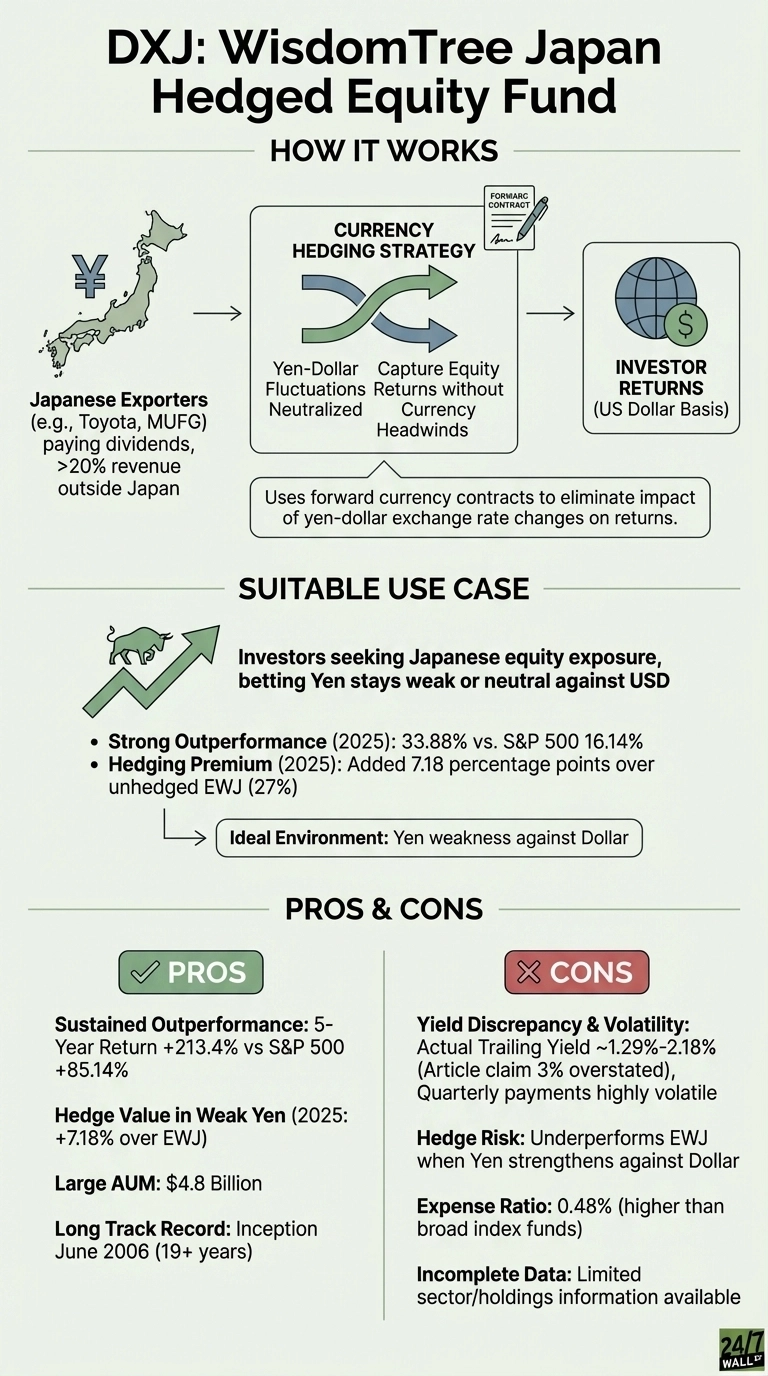
That hedging strategy added over 7 percentage points of outperformance in 2024. The unhedged alternative, iShares MSCI Japan ETF (NYSEARCA:EWJ), returned 27% over the same period. The difference represents what investors would have lost to unfavorable currency movements.
What You Get Beyond Performance
DXJ yields 3.1%, providing modest income alongside capital appreciation potential. The fund’s dividend distributions can be volatile quarter to quarter because they include both underlying equity dividends and gains or losses from the hedging strategy. This isn’t a pure income play, but the yield offers something while you wait for price appreciation.
The fund charges a 0.48% expense ratio, reasonable for an actively hedged strategy but higher than broad market index funds. With $4.8 billion in assets, DXJ offers sufficient liquidity. The portfolio trades at roughly 16x earnings, attractive compared to U.S. large caps.
The Tradeoffs You Accept
Currency hedging works both ways. When the yen strengthens against the dollar, unhedged investors benefit from favorable currency translation while DXJ holders miss out. In those periods, EWJ would outperform DXJ. You’re betting the yen stays weak or Japanese equities rise enough to compensate.
The fund concentrates in cyclical sectors, particularly industrials and financials. This amplifies sensitivity to global economic conditions and trade policy. Japan’s export-driven economy means these companies are vulnerable to tariffs, supply chain disruptions, and shifts in international demand. The 0.48% expense ratio compounds over time, eating into long-term returns.
Who Should Avoid This Fund
Conservative income investors seeking stable quarterly distributions should look elsewhere. DXJ’s dividend payments fluctuate significantly based on hedging results, making it unreliable for those who need predictable cash flow.
Investors who believe the yen will strengthen should also avoid DXJ. If you think Japanese monetary policy will shift toward a stronger currency, the unhedged EWJ would be the better choice. The hedge becomes a drag when currency moves work in your favor.
Consider EWJ for Simplicity and Lower Costs
EWJ offers a simpler, cheaper alternative with a 0.49% expense ratio and $15.8 billion in assets. The key difference is the lack of currency hedging. EWJ tracks the MSCI Japan Index without attempting to neutralize yen movements.
EWJ’s dividend yield is lower at 1.3%, and its performance will diverge from DXJ based entirely on currency movements. In 2024, DXJ’s hedge added substantial value, but that won’t always be the case. Investors who want pure Japanese equity exposure without taking a view on the yen might prefer EWJ’s straightforward approach.
DXJ works best for investors who want Japanese equity exposure while betting the yen stays weak or neutral, but the currency hedge cuts both ways depending on forex trends.











 Top Gaining Stocks
 Top Losing Stocks