


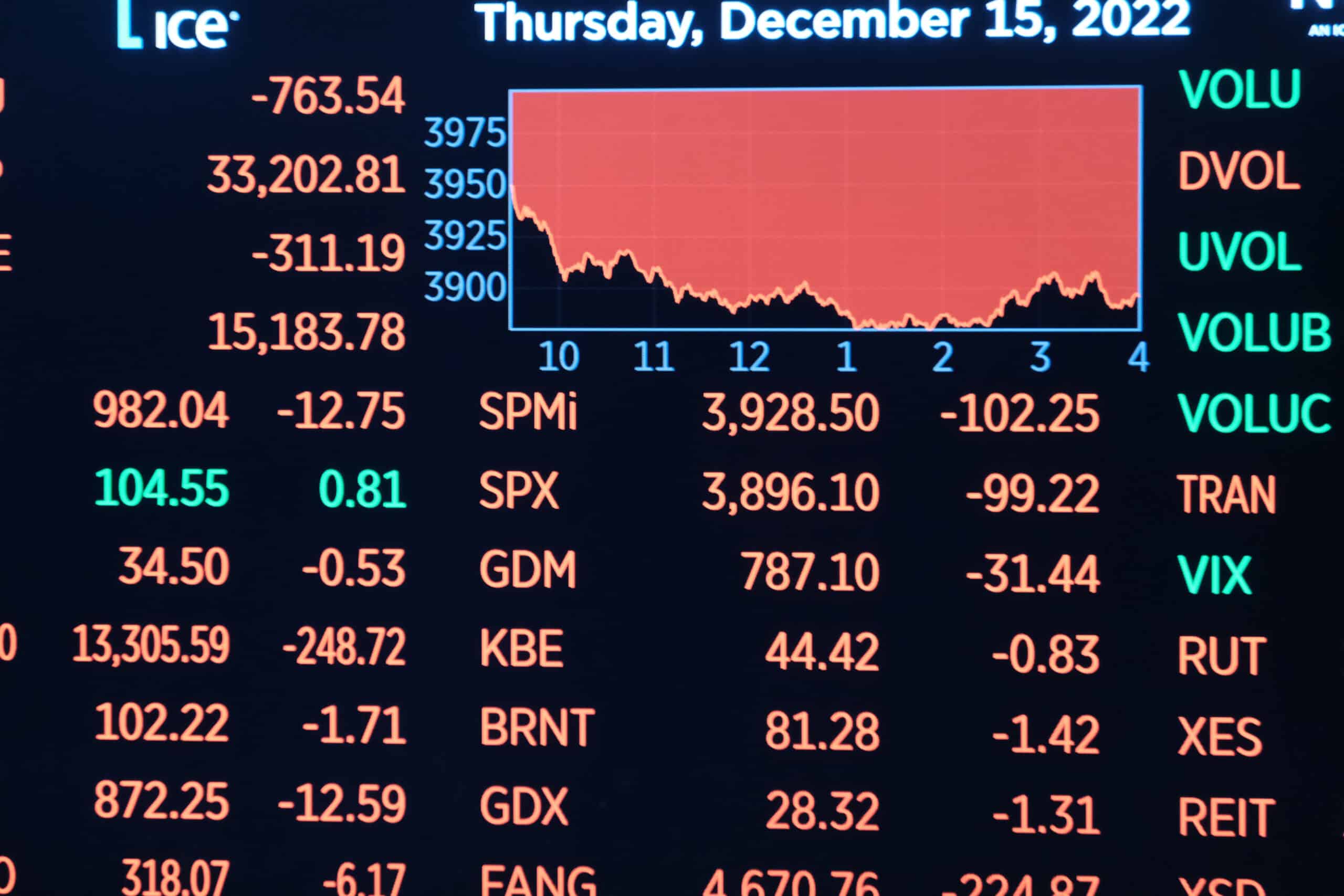
The S&P 500 has shed roughly its worst drawdown in the past 12 months during the early months of 2026, as tariff escalation and macro uncertainty rattled equity markets. While broad indexes fell, three managed futures ETFs posted gains in the same window: KMLM is up 7% year to date, DBMF is up 8%, and CTA is up 8% through April 8, 2026. The structural logic of managed futures is playing out exactly as designed.
Why Managed Futures Earn the “Crisis Alpha” Label
Managed futures strategies use trend-following models to go long or short across commodities, currencies, interest rates, and equity index futures. The critical feature is directionality: these funds do not need markets to go up. They need markets to move persistently in one direction. When a tariff shock drives sustained dollar weakness, when Treasury yields trend sharply higher, or when commodity prices move in a sustained arc, trend-following systems capture those moves whether they run up or down.
This is what practitioners call crisis alpha. Equity selloffs tend to be accompanied by large, sustained moves in rates, currencies, and commodities. Managed futures strategies are positioned to harvest exactly those moves. The result is low or negative correlation to equities during the periods when equity correlation matters most: drawdowns.
The drag is real during calm bull markets when trends are choppy and reversals are frequent. Investors who added managed futures during the 2023-2024 equity rally paid a performance cost. The tradeoff is portfolio-level: a 10% managed futures allocation in a 60/40 portfolio historically improves Sharpe ratio and reduces maximum drawdown by smoothing out the periods when both stocks and bonds fall together.
KMLM: Rules-Based Index Replication at a Low Cost
KraneShares Mount Lucas Managed Futures Index Strategy ETF (NYSEARCA:KMLM) replicates the Mount Lucas Management Index, a systematic trend-following benchmark with a long track record across commodity, currency, and fixed income futures. The fund launched in December 2020 and carries net assets of roughly $194.5 million with an expense ratio of 0.9%.
The index methodology is transparent and rules-based, which matters for investors who want to understand exactly what they own. Positions are driven by price signals across energy, metals, agricultural commodities, global rates, and foreign exchange. KMLM does not attempt to replicate hedge fund manager behavior; it tracks a published benchmark that has been stress-tested across multiple market cycles.
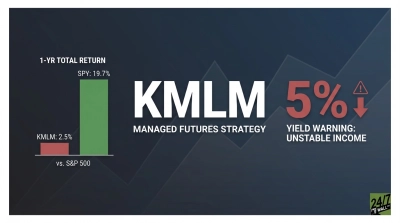
The year-to-date gain of 7% extends a one-year return of about 10%. The tradeoff: at roughly $195 million in assets, KMLM is the smallest fund on this list, which can mean wider bid-ask spreads and less institutional liquidity than the larger alternatives.
DBMF: The Largest Fund and the Sharpest One-Year Track Record
iMGP DBi Managed Futures Strategy ETF (NYSEARCA:DBMF) takes a different structural approach. Rather than tracking a fixed index, it uses dynamic replication to mirror the aggregate positioning of the largest managed futures hedge funds. The model analyzes hedge fund return patterns and reverse-engineers their likely futures exposures, then replicates those positions in liquid futures markets. The fund launched in May 2019, making it the most seasoned of the three, and has grown to $3.2 billion in assets with an expense ratio of 0.85%.
The one-year return of 30% stands well above the other two funds on this list over the same window, reflecting both strong trend capture and the replication model’s ability to adapt positioning as macro conditions shift. Year to date, DBMF is up 8%.
The replication approach has a structural caveat: it lags actual hedge fund positioning by the time the model updates, which means DBMF can be slow to exit crowded trades when trends reverse abruptly. During sharp, fast reversals, the lag can cost performance. Investors are effectively buying a systematic approximation of hedge fund behavior, not direct trend-following signals.
CTA: Simplify’s Leveraged Systematic Approach
Simplify Managed Futures Strategy ETF (NYSEARCA:CTA) launched in March 2022 and has grown to $1.4 billion in assets. Its stated objective is to deliver absolute returns, low correlation to equities, and positive convexity in risk-off environments by dynamically adjusting between long and short positions across commodity and interest-rate futures daily, using institutional-grade algorithms and trend-following models. The expense ratio is 0.76%, the lowest of the three.
CTA benchmarks against the SG CTA Index, a widely followed measure of systematic trend-following performance across the institutional CTA universe. The fund is classified as leveraged in its prospectus, meaning it uses futures notional exposure that can exceed net assets. That leverage amplifies both gains and losses.
The year-to-date return of 8% is the highest of the three funds in 2026, and the one-year return of 8% is solid. The most recent trading day showed a 5% decline, a reminder that leveraged positioning can produce outsized single-day moves in either direction. Investors who want the sharpest crisis alpha profile should understand that CTA’s leverage structure means the fund will be more volatile than its peers, both in drawdowns and in recoveries.
Three Funds, Three Structural Tradeoffs
All three funds delivered in the environment they were built for, but they suit different investor profiles. DBMF is the most liquid and institutionally established option, with $3.2 billion in assets and a one-year return that leads the group by a wide margin. It belongs in portfolios where liquidity and scale matter. CTA offers the lowest expense ratio and the highest 2026 return so far, but its leveraged structure makes it better suited for investors who want maximum crisis alpha and can tolerate sharper intraday swings. KMLM is the most transparent of the three, tracking a published rules-based index, which appeals to investors who want to understand exactly what drives their returns rather than relying on a replication model or proprietary algorithm.













 Top Gaining Stocks
 Top Losing Stocks