



When it comes to tax season, it’s always an annual reminder that where you live does determine how much of your paycheck actually stays in your pocket. While federal taxes apply equally across state lines, state and local taxes can vary, often dramatically, and for residents of the highest-taxed states, the difference can amount to thousands of dollars every year.
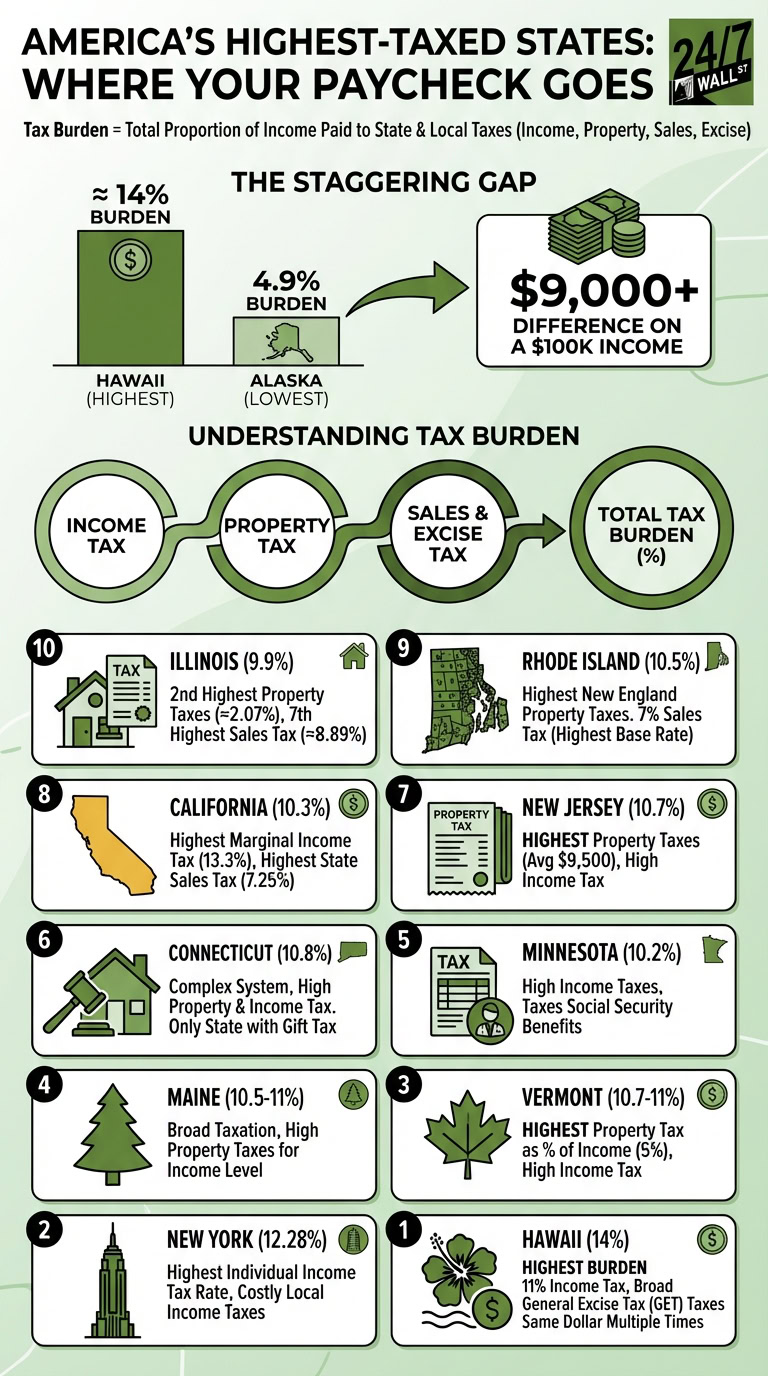
What’s also notable is that the gap between the most and least taxed states is pretty staggering. Hawaii, unsurprisingly, has the highest total tax burden, with residents paying out nearly 14% of their income to state and local governments.
Meanwhile, Alaska residents keep far more of what they earn, paying only 4.9% of their income in combined state and local taxes. This 9% difference, on a $100,000 income, translates to approximately $9,000 more in annual taxes simply for choosing a different address.
What “Tax Burden” Actually Measures
Unlike tax rates, which apply to specific transactions or income tax brackets, a tax burden measures the total proportion of income residents pay toward all state and local taxes combined. This includes not just income taxes, but also taxes on property, sales taxes, and excise taxes on things like gasoline, alcohol, and tobacco.
This comprehensive view matters because states use different strategies to raise revenue. A state with no income tax might make up for it with high property taxes (hello, Florida!) or high sales taxes. Another state might have modest rates across all categories but still collect heavily due to how these taxes interact with local costs. The best way to compare apples to apples is to look at what percentage of income residents actually surrender to state and local governments every year.
10. Illinois

No matter where you are in Illinois, taxes will find you.
Illinois residents are paying approximately 9.9% of their income in combined state and local taxes, which gets the Prairie State just inside the top 10. The state’s flat income tax rate of 4.95% is moderate by national standards, and Illinois doesn’t tax retirement income from 401(k), IRA, or pension accounts, a benefit for retirees.
What is the challenge with Illinois? Its property taxes are among the highest in the country. The average rate was around 2.07% of a property’s total value, making it second in the nation behind New Jersey. Combined with a sales tax average 8.89%, also the seventh-highest in the country, so rest assured that Illinois knows how to extract revenue from its residents.
9. Rhode Island
Rhode Island’s total tax burden of approximately 10.5% reflects the reality of living in a small but densely populated state with hefty infrastructure and service costs. The state’s progressive tax rate tops at 5.99%, which combines with the state’s property tax rate, which is the highest in New England.
On top of this, there is a 7% sales tax, tied for the highest base rate in the nation. For working-age residents with mortgages, the combined weight of income, property, and sales tax can add up quickly.
8. California
The tax burden of California, at around 10.3%, might seem low given the state’s reputation, but the figure is reflective of averages across all income levels and property values. For high earners, the state can be even more punishing as its marginal tax income rate of 13.3% is the highest in the nation, with an additional 1% mental health services tax for those earning over $1 million.
California’s state sales tax of 7.25% is the highest in the country, and when combined with local taxes, rates can exceed 10% in some areas. Property taxes are thankfully somewhat restrained due to Prop 13, which limits increases in annual assessed values, but for anyone earning substantial income in the state, California takes a chunk of it.
7. New Jersey
Hampered by some of the most punishing property taxes in the country, New Jersey also has the highest corporate income tax in the country and the highest individual income taxes. This gives the state a total tax burden of around 10.7%, which is a number that is hard to ignore.
At the top of New Jersey’s burdens is property tax, in which the average homeowner in the state pays $9,500 annually, more than 10x more what residents in states like Alabama pay. Income tax can reach 10.75% for high earners, also the fourth highest in the country, much of which can be attributed to its proximity to New York City, something residents pay the price for.
6. Connecticut

Connecticut is beautiful, but also growing increasingly expensive.
Connecticut’s total tax burden of 10.8% reflects a complex tax system that is one of the most challenging in the nation. Reporting often hits on Connecticut’s property taxes as being among the highest, if not the highest, in the country. Separately, you have an income tax burden that is ranked the fourth highest, which tops out at 6.99%, though surcharges can push it higher.
The property tax burden is also a major headache as the state relies heavily on local property taxes to fund both education and municipal services. Connecticut also has a gift tax, the only state in the nation that does, which creates a disadvantage for small business owners who are trying to transfer ownership.
5. Minnesota
With a tax burden of around 10.2%, Minnesota’s total tax burden is largely the result of its high income taxes and taxes on most retirement incomes. Making matters worse is how the income tax brackets work for residents, ranging from 5.35% to 9.85%, meaning that even middle-income earners are facing substantial tax burdens.
Add to this the idea that Minnesota is just one of eight states that still taxes Social Security benefits. Even with income-based exemptions, you still face significant financial hurdles, and this is before you can get to the property tax argument, which puts Minnesota firmly in the middle of all American states. Ultimately, W-2 employees and business owners feel the biggest pinch and are partially responsible for the state’s strong education and healthcare facilities.
4. Maine
Maine’s total tax burden of approximately 10.5-11% reflects a state that taxes heavily across multiple categories without exceptionally high rates in any single one. The state’s top income tax rate of 7.15% applies to income over $58,050 for single filers, a relatively low threshold that pushes many middle-class residents into the top bracket.
Property taxes in Maine are also fairly substantial, ranking among the highest in the nation as a percentage of income. The state offers a homestead exemption and property tax relief programs for seniors, but these don’t fully offset the burden for most homeowners.
Although a sales tax of 5.5% is moderate, the state applies it broadly with fewer exemptions than many states. Maine’s aging population and relatively low median tax income do mean the burden falls more and more on a shrinking number of working-age residents.
3. Vermont

Vermont might be a romantic place to live, but it’s also very expensive.
Vermont charges the most in property taxes of any state at a whopping 5% of residents’ income. This single category drives much of the state’s total tax burden of approximately 10.7-11%, placing it as the third-highest-taxed state in America.
The state’s income tax rate of 8.75% on income over $229,500 is also among the highest in the nation. Vermont is also one of eight states that still taxes Social Security benefits, and it imposes an estate tax with a $5 million minimum, well below the federal exemption. For a state with a median household income of around $74,000, these taxes can take a significant portion of a resident’s earnings.
2. New York
Bouncing between first and second place of states with the highest tax burden, with Hawaii, New York residents “enjoy” a total tax burden 12.28% on average. With the country’s highest individual income tax rate, the Empire State is one of the most expensive places to live, period.
At 5.8% of residents’ income, there are costly state and local income taxes, and a marginal tax rate of 10.9% on income over $25 million, which combines with rates exceeding 9% for those earning over $1 million. You also have to contend with property tax rates that hover in the 2.3% range, depending on which county you are in, and even areas with more moderate property taxes, when combined with income and sales tax, things just get more and more expensive.
1. Hawaii
Unsurprisingly, Hawaii is the worst tax-burdened state in the country, as residents pay a whopping 14% of their income to state and local governments. This includes 4.2% on income taxes, 2.6% on property taxes, and 7.2% in sales and excise taxes. It is worth noting that while some methodologies have Hawaii ranking first or second, others can place it behind New York.
Either way, Hawaii is ranked second only to California in terms of income tax, with a 11% rate, as a major tax burden. However, the real driver of concern is the general excise tax, which functions like a sales tax but applies more broadly, including many services and business-to-business transactions. This tax tentacles out throughout the Hawaiian economy, effectively taxing the same dollar multiple times








 Top Gaining Stocks
 Top Losing Stocks