



Choosing where to spend your retirement involves far more than just picking the right kind of weather and proximity to grandchildren. Where you live often determines just how much of your hard-earned money over a lifetime of work can stay in your pocket. This is especially true for those retiring on fixed incomes, as every dollar matters.
According to the latest economic data from the US Census Bureau, the average per capita state and local tax burden is $7,109. Unfortunately, this number masks enormous variation, as some states can collect more than 2x this amount while others collect less than half. The difference can mean tens of thousands of dollars over a retirement spanning two or three decades.
Why Per-Capita Collections Matter for Retirement Planning
Per-capita tax collections measure how much money state and local governments are actually “extracting” from each resident on average. This number differs from tax rates or tax burden calculations because it shows real dollars leaving a very real bank account.
For retirees, this metric captures the comprehensive cost of living in a particular state from a tax perspective. A state with high property taxes and low income taxes might look attractive until you realize you’ll pay those property taxes every year, regardless of your income. Per-capita collections strip away the marketing and show what residents are actually paying, and each presents a challenge for retirees.
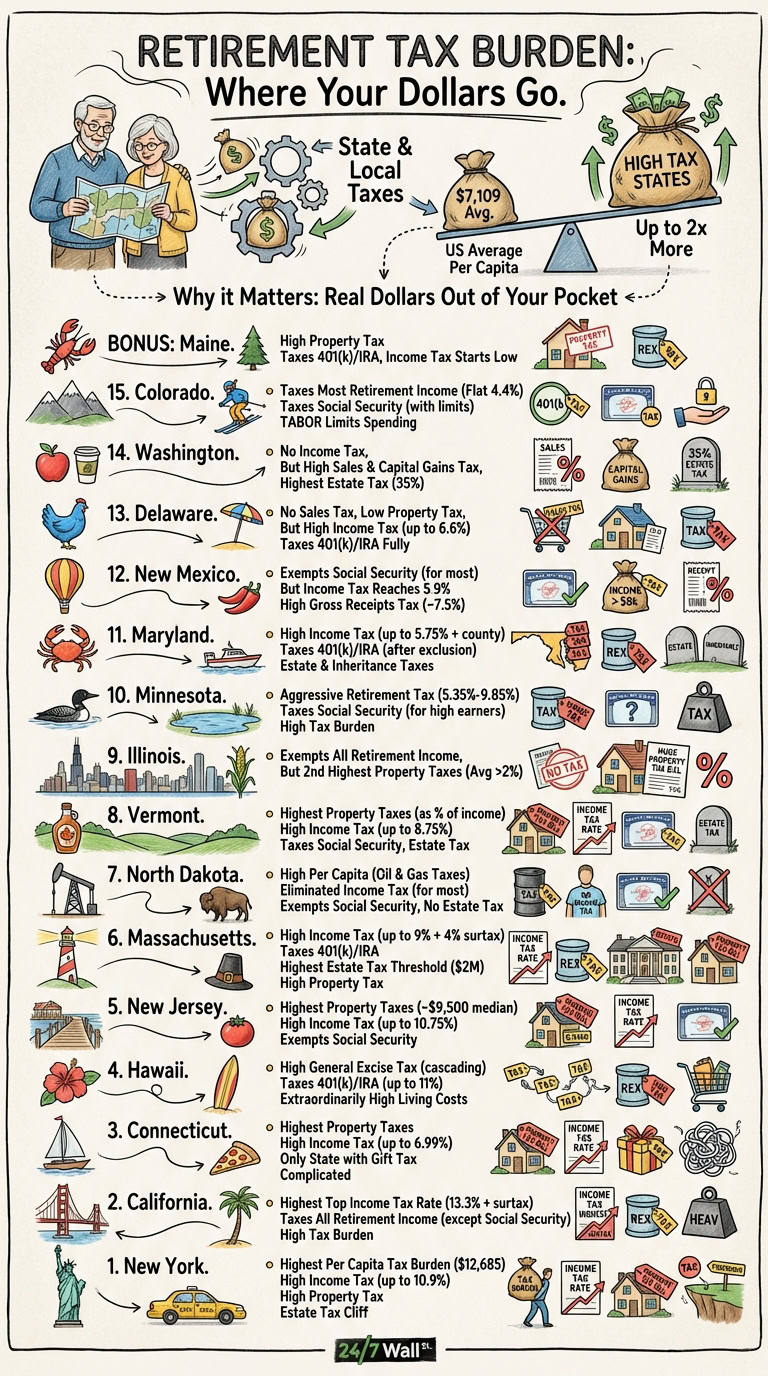
Bonus: Maine
Maine just barely crosses the $7,109 average threshold at $7,216 per capita, but it does, and as a result, its tax structure is a challenge for retirees. The state’s income tax reaches 7.15% on relatively modest incomes as the top bracket begins at just $58,050 for single filers.
It also fully taxes 401(k) and IRA withdrawals. Social Security is exempt, but property taxes are among the highest in the nation as a percentage of home value, and the state’s aging population is putting pressure on those still working.
15. Colorado
Colorado’s flat 4.4% income tax rate applies to most retirement income, including 401(k) and IRA distributions, which contributes to its $7,263 per capita tax burden. The state is also one of eight that still taxes Social Security benefits, even if there are some Adjusted Gross Income (AGI) exclusions. The only good news might be that the state’s TABOR amendment imposes limits on government spending growth, which has kept state taxes from driving residents away.
14. Washington
At $7,431 per capita, Washington is above the national average even if it doesn’t have a state income tax. This might sound appealing, until you learn that the state generates revenue courtesy of an avearge 9.38% sales tax and a 9.9% tax on capital gains above $270,000. Better yet, the estate tax has been raised to 35%, the highest in the nation.
13. Delaware
Delaware might market itself as tax-friendly, but it’s $7,693 per capita tax burden would argue otherwise. There is no sales tax, which is a plus, and it offers relatively low property taxes, but income tax can reach 6.6% on income over $60,000, all while fully taxing 401(k) and IRA distributions.
12. New Mexico
New Mexico exempts Social Security for most retirees and allows those 65 and older to exclude up to $8,000 in income. Even so, New Mexico offers a $7,752 per capita tax burden, as income over $8,000 is taxed at rates reaching 5.9%. The state’s gross receipts tax averages around 7.5% when combined with the lowest rates, though property taxes are low.
11. Maryland
With an $8,048 per capita tax burden, Maryland isn’t a surprising entry on this list, as retirement income is taxed at rates reaching 5.75%, with county taxes adding up to another 3.2% on top of this. Social Security earnings are exempt, but 401(k) and IRA distributions beyond a $39,500 exclusion face a combined rate that can exceed 8% in some counties, and this is before you ever factor in estate and inheritance taxes.
10. Minnesota

Residents of Minnesota enjoy exceptional healthcare but also face high tax burdens.
Minnesota taxes retirement income aggressively, applying rates of 5.35% to 9.85% on 401(k) and IRA distributions, with no special exemptions. The state also taxes Social Security benefits for high earners, which helps contribute to its $8,050 per capita tax burden. For retirees with substantial savings, Minnesota remains one of the more expensive places to live.
9. Illinois
At $8,148 per capita, Illinois’s tax burden on retirees is pretty substantial, even if it exempts all retirement income, including Social Security, from taxation. The challenge for Illinois is that its property taxes rank as the second-highest in the nation, averaging over 2% of home value. A $300,000 home might cost $6,000 or more in annual property taxes. The truth about Illinois for retirees is that owning a home here can mean paying more in property taxes than they would in all their taxes in a less expensive state.
8. Vermont
With the highest property taxes in the nation as a percentage of income, it’s not at all surprising that Vermont is on this list. With a $8,158 per capita tax burden on residents, income tax reaches 8.75% on higher incomes, and Vermont is also one of eight states that still taxes Social Security benefits. Add an estate tax on any amount over $5 million, and it’s a burden on wealthier residents. The bottom line is that if you own property in Vermont, its tax burden can feel like a relentless attack on your wallet.
7. North Dakota
While North Dakota ranks seventh on this list, it is a little misleading, as the $8,961 per capita figure reflects severance taxes on oil and gas extraction, which are largely paid by out-of-state energy consumers. The state recently eliminated its individual income tax for most residents, and Social Security is exempt, along with estate taxes, of which there are none. In other words, North Dakota looks worse on paper than it is in reality.
6. Massachusetts

It’s hard to ignore Massachusetts’s high income tax burden for retirees.
Recently adding a 4% surtax on income exceeding $1 million, Massachusetts now has its top rate on income at 9%. The state exempts Social Security, but does fully tax 401(k) and IRA distributions at 5% and 9% over $1 million. Property taxes are among the nation’s highest, and the estate tax on any dollar over $2 milliion is the highest in the country, which contributes to its $9,341 per capita tax burden.
5. New Jersey
Home to the nation’s highest property taxes, New Jersey offers median annual payments exceeding $9,500, which is very close to its $9,366 per capita tax burden. The state does exempt Social Security and offers retirement income exclusions up to $100,000 for those with incomes below $150,000. However, income tax rates can reach 10.75% for high earners.
4. Hawaii
Hawaii’s general excise tax cascades throughout the island’s economy, effectively taxing everyone’s dollar multiple times. This is the reason for its $9,503 per capita number, even as it exempts Social Security while taxing 401(k) and IRA distributions at rates reaching as high as 11%, second only to California. Property taxes might be low, but living costs on the islands are extraordinarily high, which means purchasing power is challenging.
3. Connecticut
Connecticut exempts Social Security for those with a GI below $75,000 individually or $100,000 joint, and recently began exempting IRA distributions. However, property taxes remain the nation’s highest, and the state income tax can reach as high as 6.99%. Connecticut is also the only state that imposes a gift tax, which is complicated for residents who want to leave wealth to the next generation, all of which contributes to its $9,718 per capita tax burden.
2. California

There is no question that living in California requires accepting its high tax burden.
California has the nation’s highest top income tax rate of 13.3%, plus a 1% surtax on income over $1 million. The state does exempt Social Security, but taxes any other form of retirement income with no special deductions. This contributes to its $10,319 per capita tax burden. Long-term homeowners do receive some property tax relief thanks to Prop 13, but new residents will face full-value assessments based on their current home values.
1. New York
Leading the nation with a $12,685 per capita tax burden, New York extracts nearly 80% more than the country’s average from each resident. Social Security is exempt at least, but income above this threshold is taxed at rates reaching 10.9%, and property taxes are also among the nation’s highest. The one bit of good news for the state’s wealthier residents is that it includes a “cliff” provision where estate taxes are exempt if it exceeds 105% of the current $7.16 million threshold.















 Top Gaining Stocks
 Top Losing Stocks