



In mid-January, President Trump announced an initiative to help ease mortgage liquidity. He instructed Housing Finance Director Bill Pulte to increase the Freddie Mac and Fannie Mae $40 billion caps to $200 billion. The strategy was that the creation of an uptick in mortgage buying liquidity would allow some mortgage underwriting rates to be more flexible, and thus allow for more home finances to manifest.
While many feel that the move will be a drop in the bucket for the $13 trillion US mortgage industry, it may nevertheless see a boost if a rate cut is announced by the Federal Reserve at its upcoming meeting and if the next Durable Goods orders report is positive. However, this move makes the prospects of privatization for FNMA and FDMC even more remote, and the market’s reaction in their stock’s prices reflected this disappointment.
However, here are several stock sectors that could well become beneficiaries if the cumulative sentiment from the aforementioned forthcoming announcements is bullish. These would include:
- Mortgage underwriting companies
- Home building companies
- Home improvement retail companies
Below are an example of each of these categories that may bear watching in the near future:
- Ellington Financial, Inc. (NYSE: EFC)
- Toll Brothers Inc. (NYSE: TOL | TOL Price Prediction)
- Home Depot (NYSE: HD)
Ellington Financial, Inc.

EFC’s Longbridge subsidiary directly underwrites home mortgages as well as reverse mortgages and other related loan finance.
Real Estate Investment Trusts (REIT) are real estate based companies that register with the SEC in which they can access the capital markets as long as they remit 90% of profits back to their shareholders. It’s a win-win scenario that can result in nice real estate based income for shareholders without the headaches of having to manage and finance physical real estate properties or securities.
REITs can combine several different real estate related businesses under a single umbrella. Old Greenwich, CT based Ellington Management Group, LLC has a presence in several different profit center platforms. Ellington Financial, Inc. represents its real estate sector interests, as a registered Real Estate Investment Trust (REIT). Ellington Financial has two primary operations:
- The Portfolio Segment manages a portfolio of real estate based commercial and residential mortgage loans, mortgage-backed securities and derivatives, non-mortgage debt, derivatives, and equity stakes in loan origination companies and related investments. This portfolio was $18.2 billion as of the time of this writing.
- The Longbridge Segment is a wholly owned Ellington Financial subsidiary. It originates and underwrites home mortgage loans. It also specializes in Home Equity Conversion Mortgages and acquires and services reverse mortgage loans, commercial mortgage bridge loans, second lien closed-end loans, and their securitization. It is an approved HUD lender for reverse mortgages.
As for yields, EFC delivers a very attractive 11.22% yield that pays monthly. EFC has a “strong buy” rating with a 12-month consensus target price of $14.63.
Toll Brothers, Inc.

Toll Brothers has become best known for its upscale, luxury houses, townhouses, and condominiums.
Although better known in recent years for their luxury housing and condominium builds, Toll Brothers has built a vertically integrated real estate business over the past 59 years that has earned a #411 ranking in the Fortune 500. In addition to single-family houses, condominiums, carriage houses, and townhouses, Toll Brothers also provides mortgage, insurance, landscaping, security, and home automation services.
Fort Washington, PA based Toll Brothers was recently announced as Fortune magazine’s 2026 #1 Most Admired Home Builder in its World’s Most Admired Companies List, which assesses 685 top revenue companies from 51 industries and 29 countries.
The Wall Street analyst consensus for TOL on a 1 to 5 scale where 1 is a “strong buy” and 5 is a “sell”, is 1.94, and 12-month projection target average is $154 with a high of $181.
Home Depot
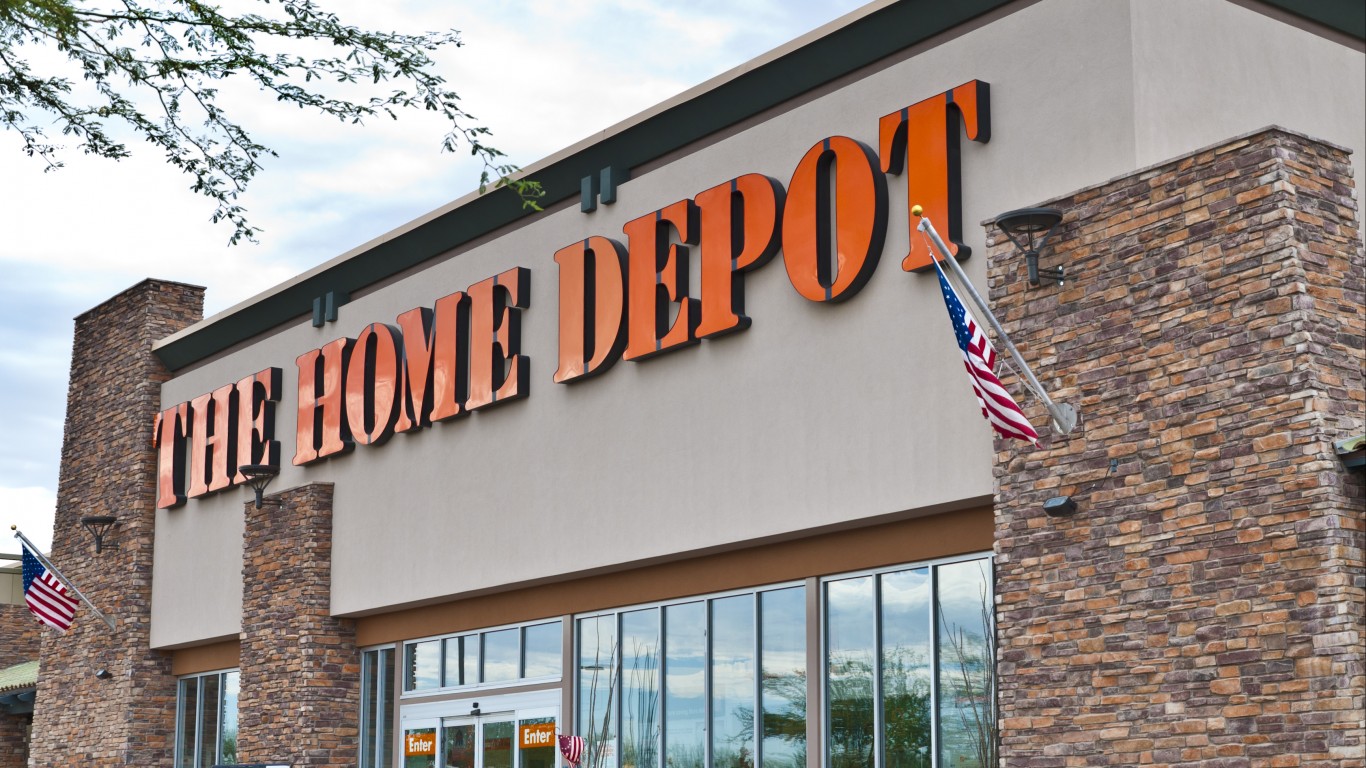
Founded in the late 1970s, Home Depot has since grown to become the largest home improvement retailer in the world.
When it comes to the American Do-It-Yourself (DIY) ethos, the home improvement industry has by far the largest number of adherents. The US notion of men building their own homes for their families is a foundational part of American culture, dating back to the Pilgrims. The current US home improvement DIY market generated sales of roughly $610 billion in 2025, and hit TV shows like Tim Allen’s Home Improvement appealed to this massive demographic. The retailer that best represents this demographic is Home Depot – the largest home improvement retailer in the world, with 2,300 retail outlets in North America alone.
As a result, Home Depot is now synonymous with hand tools, building materials, paints, and a huge range of other items, as well as appliances, plumbing and lighting fixtures, and many other associated items.
Although it is still ranked #1, Home Depot’s competitors, such as Lowe’s, Menards, and Ave Hardware have been eating into its market share. Not content to rest on its laurels, Home Depot has embraced technology. Its AI-powered fulfillment capabilities have been the company’s latest growth driver, accelerating deliveries, expediting custom orders, and raising customer satisfaction levels by over 400 basis points.
Previous softness in the housing market – one of the reasons for President Trump’s recent announcement – had dampened analyst ratings for Home Depot to a “moderate buy” and an average price target of $424, with a high of $497.












 Top Gaining Stocks
 Top Losing Stocks