



High earners face a painful reality with taxable bonds, the IRS claims up to 37% of every interest payment. A bond yielding 4% in nominal terms delivers far less after federal taxes extract their share. Invesco National AMT-Free Municipal Bond ETF (NYSE:PZA | PZA Price Prediction) sidesteps this erosion by delivering federally tax-exempt income, making it particularly valuable for investors in the top tax bracket.
The Tax Shelter Built Into Every Payment
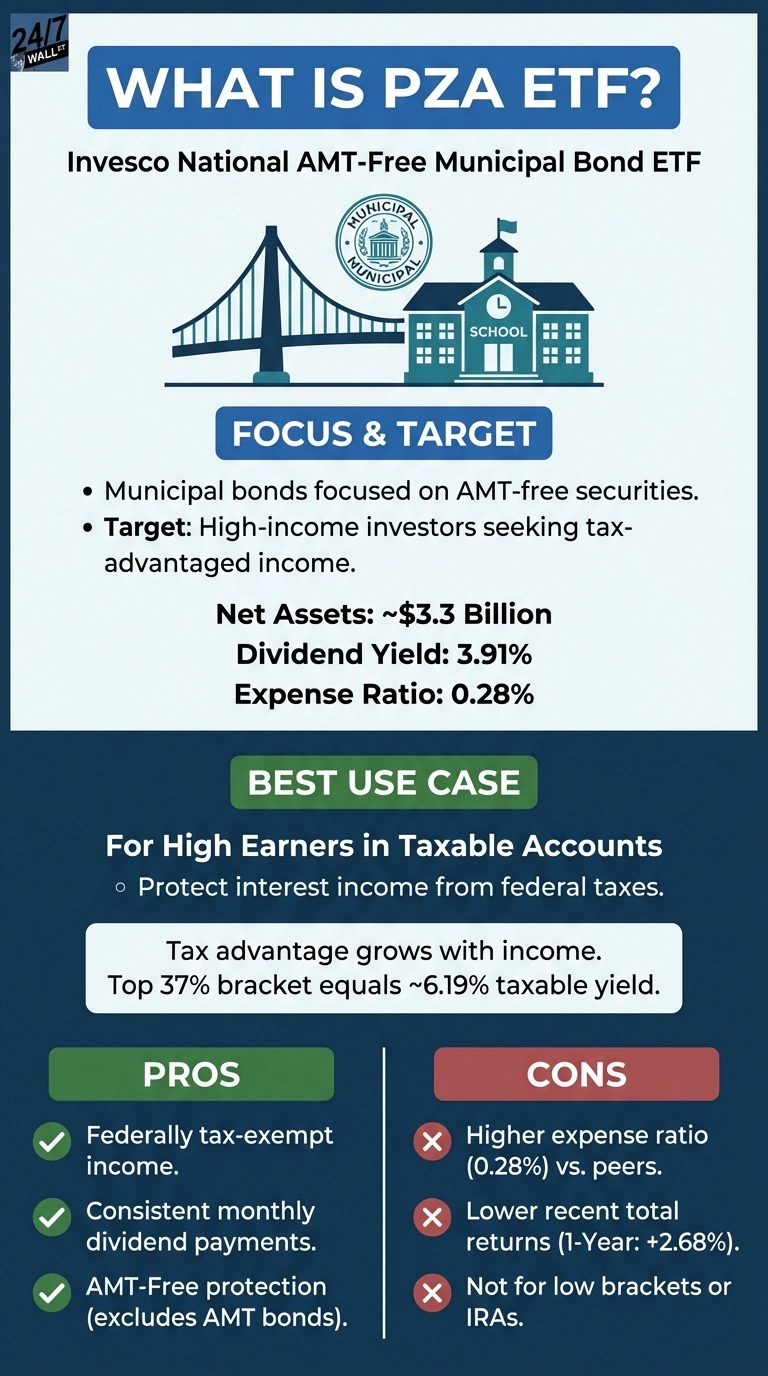
PZA holds over 5,600 municipal bonds issued by states, cities, and local governments. These bonds fund infrastructure projects like roads, schools, and hospitals. In exchange for lending money to these entities, investors receive interest payments exempt from federal income tax. The ETF distributes this income monthly, currently yielding around 3.9%.
The tax advantage grows more powerful as income rises. For someone in the top federal bracket, PZA’s tax-free yield becomes equivalent to earning significantly more from taxable bonds—roughly 6.2% before taxes. This explains why municipal bonds have historically attracted wealthy investors seeking to preserve income from IRS erosion, especially when compared to taxable alternatives like iShares Core U.S. Aggregate Bond ETF (NYSE:AGG) that surrender a substantial portion of their yield to federal taxes. For investors in the 32% bracket, PZA’s 3.9% yield equals a 5.74% taxable return. In the 35% bracket, it equals 6.0%. In the top 37% bracket, it equals 6.19%.
The AMT Protection Layer
Not all municipal bonds are equal for tax purposes. Some trigger the Alternative Minimum Tax, a parallel tax system that can catch high earners off guard. PZA specifically excludes those bonds, making it a safe harbor for investors subject to AMT. With recent policy changes potentially expanding AMT exposure starting in 2026, this feature matters more than many realize.
Performance Reality Check
PZA’s recent performance reflects the challenging environment for bonds throughout 2025. The fund returned 2.7% over the past year as rising interest rates pressured bond prices across the market. This underperformance relative to peers like iShares National Muni Bond ETF (NYSE:MUB), which returned 4.6%, stemmed from duration positioning and credit quality decisions that left the fund more exposed to rate movements, though the monthly tax-free income helped cushion the blow for investors who prioritized after-tax returns.
What You’re Trading Away
PZA charges a 0.28% expense ratio, nearly six times higher than comparable municipal bond ETFs. You’re also accepting lower total returns in exchange for tax benefits that only matter if you’re in a high bracket. For investors in lower tax brackets or holding bonds in tax-advantaged accounts like IRAs, this ETF makes no sense.
PZA works for high earners who need tax-exempt income in taxable accounts, but only if the math favors it after accounting for higher fees and recent underperformance.











 Top Gaining Stocks
 Top Losing Stocks