



A physician in California earning $500,000 a year hands roughly half of every dollar of taxable investment income to the government. That math is quietly pushing high-earning professionals toward municipal bonds right now, and the window for this trade is as wide as it has been in over a decade.
The Tax Problem High Earners Face
Doctors and attorneys in high-tax states like California, New York, and New Jersey face a compounding tax burden most investors do not. The federal top marginal rate sits at 37% in 2026. California adds 13.3% at the top bracket. New York adds 10.9%. New Jersey reaches 10.75%. On top of those, the IRS applies a 3.8% net investment income tax (NIIT) on investment earnings above certain thresholds. Municipal bond interest is exempt from the NIIT.
For a California physician in the top bracket:
- Federal marginal rate: 37%
- California state rate: 13.3%
- Net investment income tax: 3.8%
- Combined effective marginal rate on taxable bond income: approximately 54%
A thread in r/bonds captures the sentiment: “Unless you’re in a high-tax state (munis!)” one user wrote when discussing bond strategy for 2026. The math backs that instinct completely.
Tax-Equivalent Yield: The One Number That Matters
Tax-equivalent yield answers a single question: what taxable yield would you need to match a given muni yield after taxes?
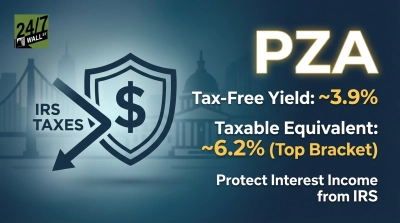
At a 54.1% combined rate, a 5% California muni bond has a tax-equivalent yield of almost 11%. No investment-grade taxable bond comes close. A 10-year Treasury currently yields about 4%. After taxes at that same 54% rate, a Treasury investor keeps roughly 2% in real after-tax income. The muni investor keeps the full 5%.
This math is compelling now because of the rate environment. The Federal Reserve held its benchmark rate at 4.5% through mid-September 2025 before cutting to 3.75% by late 2025, where it has remained steady. That elevated backdrop pushed muni yields to levels not seen in years. A decade of near-zero rates made the muni math less compelling, even for high earners. At 4.5% to 5.5% muni yields, the calculation has fundamentally changed.
The state-specific double exemption sharpens the advantage further. Most states exempt their own municipal bond interest from state income tax. A California resident buying California munis avoids both federal and California income tax entirely, producing that 54% effective rate advantage.
Two Practical Paths
Option 1: Build a direct municipal bond ladder. Buying individual bonds maturing in 1, 3, 5, 7, and 10 years provides both tax efficiency and a predictable cash flow schedule. A ladder eliminates interest rate risk at each rung, since bonds mature at par regardless of market conditions. The tradeoff is minimum scale: effective laddering requires approximately $250,000 to $500,000. Below that threshold, transaction costs and bid-ask spreads erode the advantage. This path works best for professionals with significant taxable brokerage assets who want maximum control and no management fees.
Option 2: Use a low-cost muni ETF. For investors below the laddering threshold or those who prefer simplicity, funds like Vanguard Tax-Exempt Bond ETF (NYSEARCA:VTEB | VTEB Price Prediction) or iShares National Muni Bond ETF (NYSEARCA:MUB) offer broad exposure with minimal friction. VTEB carries an expense ratio of 0.03% and an SEC yield of approximately 3.54%. MUB carries an expense ratio of 0.05%. The tradeoff: ETFs hold bonds from multiple states, so a California resident will not get full double exemption on every holding. The after-tax yield advantage is real but narrower than a California-only ladder.
The ETF path is more practical for most people. The ladder delivers better tax outcomes for those who qualify.
Three Critical Steps
- Calculate your actual combined marginal rate first. The advantage is enormous at 54% but meaningfully smaller at 45%. A New Jersey attorney faces a different calculation than a California physician. Know your number before assuming the muni trade makes sense. The NIIT status of your investment income matters too: bond interest from Treasuries or corporates is subject to the 3.8% NIIT, while muni interest is not, widening the gap further for high earners.
- Match the bond’s state to your state of residence. Buying out-of-state munis means forfeiting the state exemption. A New York attorney buying California bonds still pays New York state tax on that interest. The double exemption only applies when the bond issuer and your home state match.
- Always convert to tax-equivalent yield before comparing fixed-income options. A 4% muni yield looks inferior to a 4.29% Treasury yield on paper. For a California physician, it is worth nearly twice as much after taxes.
The rate environment that created this window has already begun to shift. The Fed has cut rates 0.75 percentage points over the past year, and further cuts would compress muni yields over time. Professionals with taxable bond allocations can run the after-tax numbers to see how the comparison stacks up.










 Top Gaining Stocks
 Top Losing Stocks