


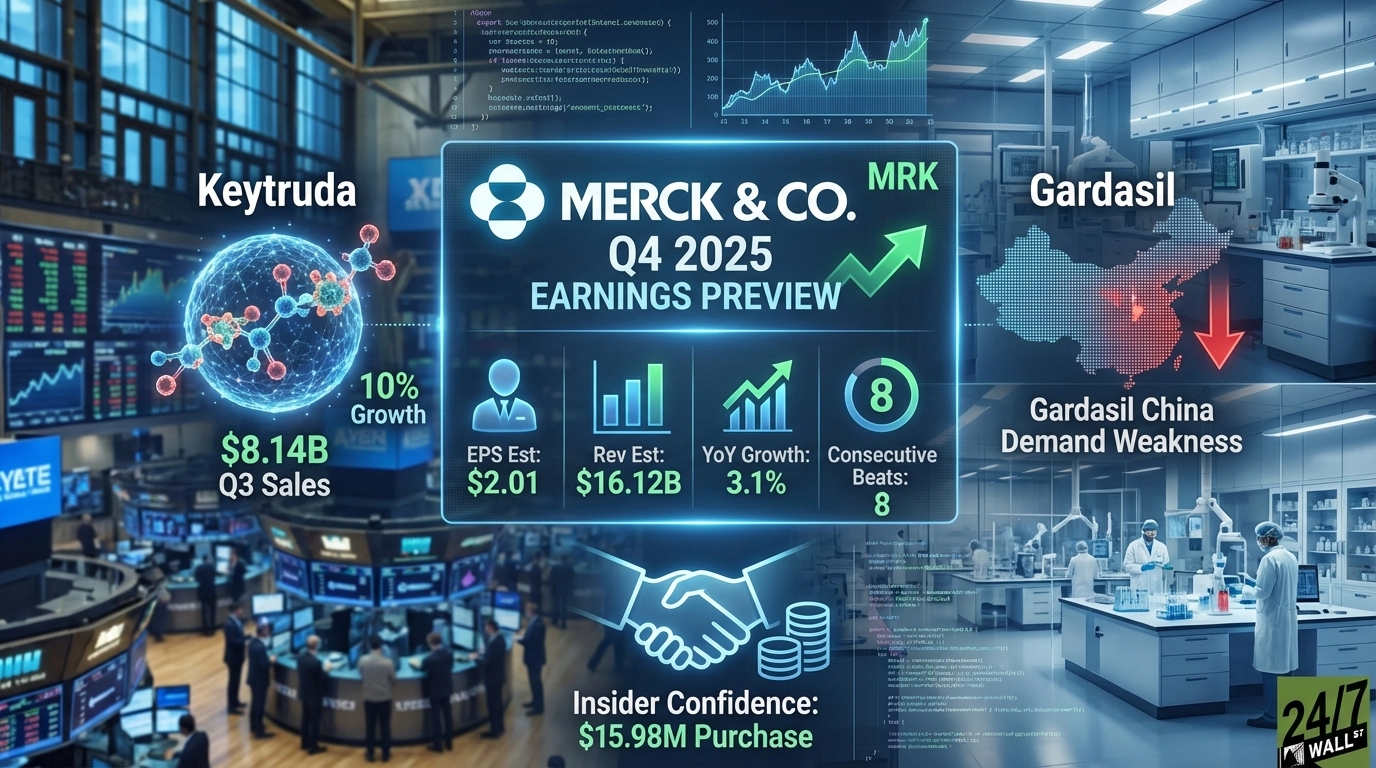
Merck & Co. reports Q4 2025 earnings on Tuesday, Feb. 3, 2026, before market open. Wall Street expects earnings of $2.01 per share on revenue of $16.12 billion, representing 3.1% year-over-year growth. Shares have gained 13% over the past year, outperforming the healthcare sector’s broader returns. Here’s what investors should watch for.
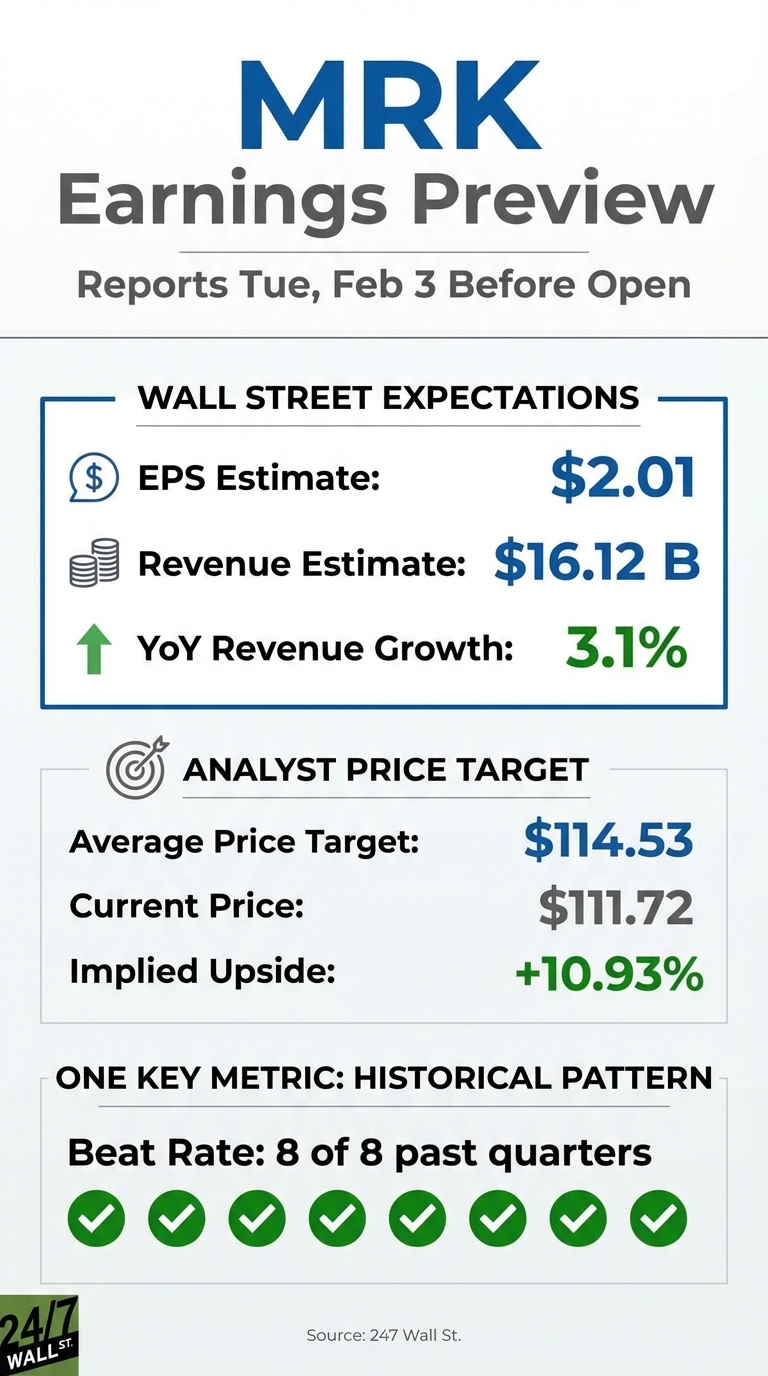
The Numbers That Matter
Wall Street expects EPS of $2.01 per share with revenue consensus at $16.12 billion. Analysts have recently reconfirmed these estimates, reflecting confidence in the company’s execution despite headwinds.
The beat threshold: Based on Merck’s historical volatility, the stock typically moves 3% to 5% on earnings surprises. A meaningful beat would require EPS of at least $2.10 (4.5% above consensus) paired with revenue of $16.5 billion or higher.
Historical context: Merck has beat on earnings estimates in three consecutive quarters, with an average surprise of 5.1%. The average post-earnings move is 3.2%, though shares jumped 8.9% last quarter after beating by $0.21. The company’s beat streak since Q1 2025 establishes high expectations heading into this report.
What Happened Last Quarter
Three key takeaways from Q3 2025:
- Keytruda sales reached $8.14 billion, up 10% year-over-year, demonstrating continued strength in oncology despite increasing biosimilar competition concerns
- Gardasil sales fell 24% to $1.75 billion due to persistent China demand weakness, though the decline moderated from Q2’s 55% drop
- Management raised full-year 2025 guidance to $64.5 to $65.0 billion in sales and $8.93 to $8.98 in non-GAAP EPS, signaling confidence in fourth-quarter execution
Management’s promise: CEO Robert Davis emphasized “delivering value through innovative portfolio” while “securing future with pipeline investments.” This quarter will test whether the company can maintain momentum while integrating the recently completed Verona Pharma acquisition.
Insider Confidence Signal
On Jan. 26, 2026, 10 senior executives purchased $15.98 million in stock at $107.40 per share, seven days before the earnings report. CEO Davis led with 47,434 shares worth $5.1 million, while CFO Caroline Litchfield purchased 15,852 shares for $1.7 million. The coordinated buying across all major divisions suggests management confidence heading into the report.
What Could Move the Stock
Bull case triggers:
- EPS above $2.10 with 2026 guidance indicating sustained Keytruda growth above 8%
- Gardasil sales exceeding $1.8 billion would signal China demand stabilization
- Management commentary on Verona Pharma integration and pipeline progress, particularly CORALreef Lipids trial commercialization timeline
Bear case triggers:
- Revenue miss below $16.0 billion, especially if driven by Keytruda weakness
- Operating margin compression beyond 200 basis points from Q3’s 39%
- Conservative 2026 guidance suggesting limited visibility on China recovery or competitive pressure in oncology
The wild cards:
Recent FDA approval of Keytruda QLEX subcutaneous injection could drive upside commentary on patient convenience and market expansion. However, ongoing Medicare price negotiation discussions and potential 2026 policy changes create uncertainty around long-term pricing power.
What Analysts Are Watching
In the past 30 days, analysts from Wells Fargo, Morgan Stanley, UBS, Goldman Sachs, and Bank of America have raised price targets. The average target of $114.53 implies 10.9% upside from current levels around $111. However, Cantor Fitzgerald maintained a neutral rating, expecting “near-term guidance to fall below Wall Street estimates” despite raising their target to $116.
The one metric that matters: Keytruda sales trajectory. Analysts expect $7.8 to $8.0 billion for Q4, but more importantly, they’re focused on 2026 guidance. If management projects Keytruda growth below 8% for next year, it would signal the blockbuster drug is approaching peak sales sooner than expected. Conversely, guidance above 10% would reinforce the drug’s long runway despite biosimilar threats.
Valuation Context
Merck trades at 9.13x forward earnings, significantly below Johnson & Johnson’s 16.42x and Eli Lilly’s 27.17x. The discount reflects investor concerns about Keytruda’s long-term growth and limited near-term pipeline visibility beyond the drug. With shares trading at 4.29x sales versus the sector average, investors are pricing in execution risk.
The key question: Can management demonstrate that the $3 billion optimization initiative announced in Q2 2025 is successfully funding pipeline development while maintaining margins? With eight consecutive beats and coordinated insider buying, expectations are elevated for another strong quarter and confident 2026 guidance.













 Top Gaining Stocks
 Top Losing Stocks