



For investors who want a single ticker to represent the entire investable world, the iShares MSCI ACWI ETF (NASDAQ:ACWI | ACWI Price Prediction) is one of the most direct answers available. The promise is straightforward: one fund, global coverage, no active management. Whether that holds up depends heavily on what you actually need from it.
What ACWI Is Designed to Do
ACWI tracks the MSCI All Country World Index, covering approximately 2,900+ stocks across 23 developed and 24 emerging market countries. It captures aggregate earnings growth and price appreciation of global businesses, weighted by market cap, with no derivatives or leverage. Portfolio turnover is just 3%, making it genuinely passive. The fund holds $26.9 billion in net assets and charges a 0.32% expense ratio.
Does It Deliver?
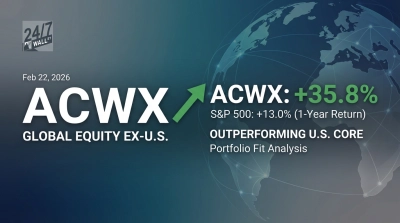
Over the past year, ACWI returned 21.2% over the trailing 12 months versus 12.95% for SPY — a notable reversal that suggests international diversification has begun contributing rather than dragging on performance. This recent outperformance reflects a broader rotation into non-U.S. markets, though over a five-year horizon the S&P 500 still leads by a meaningful margin, a reminder that global diversification has historically come with a patience premium.
The fund’s heavy U.S. concentration is the key nuance. The top three holdings — NVIDIA, Microsoft, and Apple — alone represent 12.3% of the fund, and Information Technology accounts for 20.8% of total weight. Investors expecting meaningful insulation from U.S. tech volatility won’t find it here, even across 2,900 names.
The Tradeoffs
At 0.32%, ACWI is significantly more expensive than Vanguard’s comparable Vanguard Total World Stock ETF (NYSEARCA:VT) — a gap that compounds meaningfully over decades. The fund’s 10-12% emerging market allocation also introduces currency and geopolitical risk absent from a pure U.S. fund, and its 1.2% dividend yield makes it a poor fit for income-focused portfolios.
ACWI offers global equity exposure in a single ticker with low turnover and broad diversification. Investors researching global equity ETFs may also want to review VT, which uses a nearly identical strategy at a lower expense ratio.












 Top Gaining Stocks
 Top Losing Stocks