



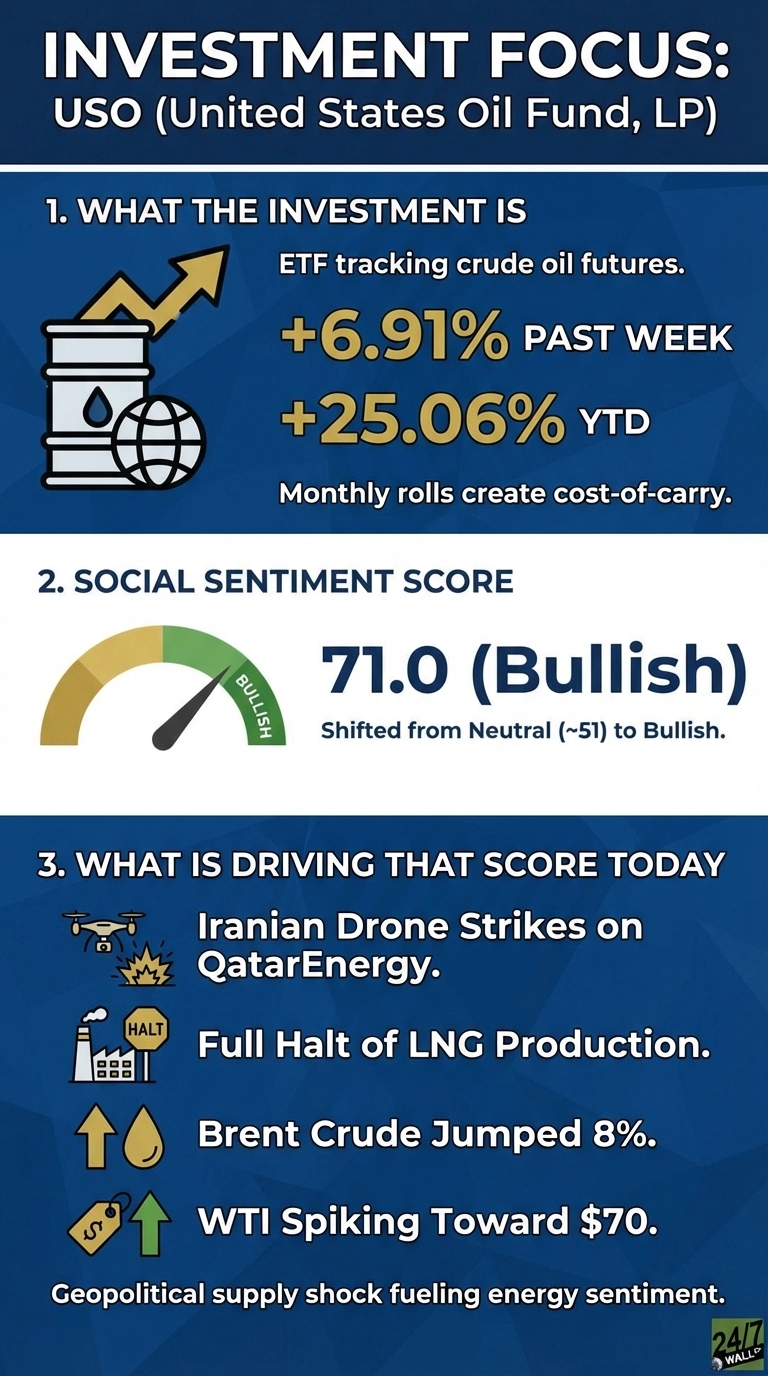
Understandably, United States Oil Fund (NYSEARCA:USO) is going to be something the world keeps a close eye on this week, as the stock has surged 6.87% in the past week and is up 23% year-to-date. Today, the geopolitical pressure that has been building since January has become an active supply crisis, and now that Iranian drone strikes are hitting QatarEnergy’s facilities at Ras Laffan and Mesaieed, forcing a full halt of LNG production. Saudi Aramco’s Ras Tanura refinery shut down as a precaution, all while Brent crude jumped 8% on the day.
Reddit Was Watching the Fuse Before It Lit
US President Trump Signals Possible Second Carrier Deployment as Iran Deal Prospects Fade.
by u/StockMarket in r/StockMarket
That post drew 388 upvotes and 146 comments. One commenter wrote: “If Trump deploys a second carrier, oil is going to $80 minimum — Iran knows the window is closing.” As oil pressed toward $70, a second post captured the market focus:
U.S. crude oil set to top $70 a barrel when trading begins
by u/StockMarket in r/StockMarket
That post generated 193 upvotes and 39 comments, with its edit noting: “Dow futures drop 500 points as oil prices spike following U.S. attack on Iran.” Threads are bullish on energy prices but split on duration: some expect a sustained supply shock, others expect diplomatic de-escalation to cap the move.
Three factors analysts cite in USO’s recent price surge:
- Qatar halted LNG production after strikes on Ras Laffan and Mesaieed, disrupting roughly 20% of global LNG supply and triggering force majeure declarations
- USO’s 0.7% expense ratio and futures-roll structure create a cost-of-carry drag in contango markets; supply shocks can flip the curve into backwardation, where near-term contracts trade at a premium relative to longer-dated ones, altering the roll dynamics for futures-based ETFs like USO
What the Supply Shock Means for USO
USO holds front-month crude futures and rolls them monthly, which normally creates a cost-of-carry drag, and that drag has weighed on long-term performance: over five years, USO has returned just 0.21% despite dramatic oil price swings. In acute disruptions, the curve flips into backwardation, and USO’s roll structure has historically performed better in backwardation environments. The Strait of Hormuz, through which a fifth of global oil supply flows, is seeing near-halted shipping. Whether WTI holds above $70 and whether the Hormuz disruption persists are the two variables that will determine if today’s spike is structural or a short-term fear premium.














 Top Gaining Stocks
 Top Losing Stocks