



The S&P 500 is down 4.29% over the past month, and the VIX fear gauge has climbed 53% in that same window to sit at 27, firmly in elevated-uncertainty territory. Meanwhile, a handful of oil and gas funds have quietly posted gains while the broader market retreated. The reason is straightforward: WTI crude surged 48% in a single month, providing a significant tailwind for oil and gas funds. That kind of commodity move creates a natural hedge against broader equity weakness, and the three funds below are positioned to capture it in meaningfully different ways.
Kimbell Royalty Partners (KRP): The Royalty Angle
KRP is technically a master limited partnership rather than an ETF, but for investors seeking oil and gas exposure with a distinct structural advantage, the distinction matters less than the mechanics. Royalty companies collect a percentage of revenue from production on their land without bearing any drilling or operating costs. When oil prices rise sharply, that revenue flows almost entirely to the bottom line.
The recent price environment has been favorable. KRP is up roughly 2% over the past month while the broader market fell, and the year-to-date gain stands at 25% — a stark contrast to the S&P 500’s decline.
The fundamental picture supports that outperformance. In Q4 2025, revenue came in at $82 million, well ahead of the $69 million consensus estimate, reflecting how sharply higher oil prices flow through to royalty revenue with minimal cost offset.
KRP’s basin diversification is what gives it staying power in a commodity surge. The fund holds royalty interests across major U.S. plays, with the Permian Basin anchored by the $230 million Mabee Ranch acquisition completed in early 2025. It currently has 85 active rigs on its acreage, representing 16.1% of the U.S. land rig count. That breadth means production holds up even when individual basins underperform.
The distribution is structured to be tax-advantaged. The $0.37 per unit Q4 2025 distribution is classified as approximately 100% return of capital, which defers taxes for most investors. The main tradeoff: KRP’s unit price is directly tied to commodity prices, so a reversal in oil would pressure both distributions and the unit price simultaneously.
Global X MLP ETF (MLPA): Midstream Infrastructure Income
Where KRP bets on royalties, MLPA bets on the pipes, terminals, and processing plants that move oil and gas from wellhead to market. Midstream infrastructure MLPs generate revenue primarily through fee-based contracts, which means their cash flows are more stable than upstream producers when commodity prices swing. The flip side is that they also capture less upside in a sharp oil rally.
MLPA’s top holdings read like a who’s-who of midstream: Energy Transfer and Enterprise Products Partners each represent about 13% of the fund, followed by MPLX at roughly 11%. These are large, established operators with long-term contracts and distributions paid consistently across commodity cycles. That concentration in scaled midstream giants reflects a deliberate bet on contract stability rather than diversification — the fund is not trying to spread risk across dozens of names but instead anchoring to operators with the infrastructure footprint to sustain distributions across cycles.
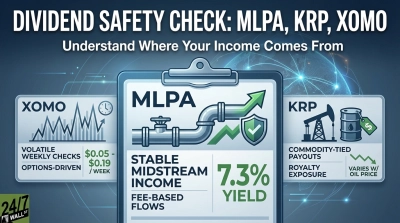
The fund carries a 7.3% dividend yield and an expense ratio of 0.45%, which frames what income investors receive relative to the cost of access. It has been around since April 2012, giving it a track record long enough to evaluate across multiple commodity cycles, including periods of sharp oil price declines that tested midstream distribution sustainability.
Year to date, MLPA is up 13%, and the one-year return sits at 12%. Those gains reflect the fee-based model’s ability to participate in energy sector strength while the underlying contract structure limits downside exposure to commodity price swings.
Income stability is what midstream MLPs offer in a volatile market. Midstream MLPs tend to hold their distributions even when oil prices fall, because their revenue comes from throughput volumes rather than commodity prices directly. The tradeoff is concentration: with the top two holdings making up more than a quarter of the fund, a problem at either Energy Transfer or Enterprise Products would have an outsized impact.
Adams Natural Resources Fund (PEO): Active Management Across the Energy Complex
PEO is a closed-end fund with a different structure than the other two. As an actively managed vehicle, it gives portfolio managers the flexibility to shift weightings across the energy value chain, from integrated majors to refiners to natural gas producers, depending on where they see the best opportunities. That active discretion is either an advantage or a risk depending on your view of active management in commodity-driven sectors.
The fund has $803.6 million in assets and has been one of the stronger performers on this list over longer horizons. The one-year return of 36% and a five-year gain of 149% reflect the fund’s ability to capture energy cycles through active positioning across the value chain, from integrated majors to refiners.
Closed-end funds trade on exchanges like stocks, which means PEO can trade at a premium or discount to its net asset value. That creates an additional variable that ETF investors do not typically deal with. When sentiment toward energy is strong, the fund can trade at a premium; when energy falls out of favor, the discount can widen and amplify losses beyond the underlying portfolio’s performance.
The broader energy exposure also means PEO is more sensitive to oil price direction than MLPA’s fee-based midstream model. In the current environment, that sensitivity has been a tailwind. In a commodity downturn, it would work the other way.
How These Funds Compare
These three funds have distinct structural characteristics. MLPA offers a 7.3% yield with fee-based midstream holdings that are less directly tied to commodity price swings. KRP provides royalty-based exposure with tax-advantaged distributions and no operating cost exposure. PEO offers active management across the broader energy complex with a closed-end fund structure that can trade at a premium or discount to net asset value.










 Top Gaining Stocks
 Top Losing Stocks