


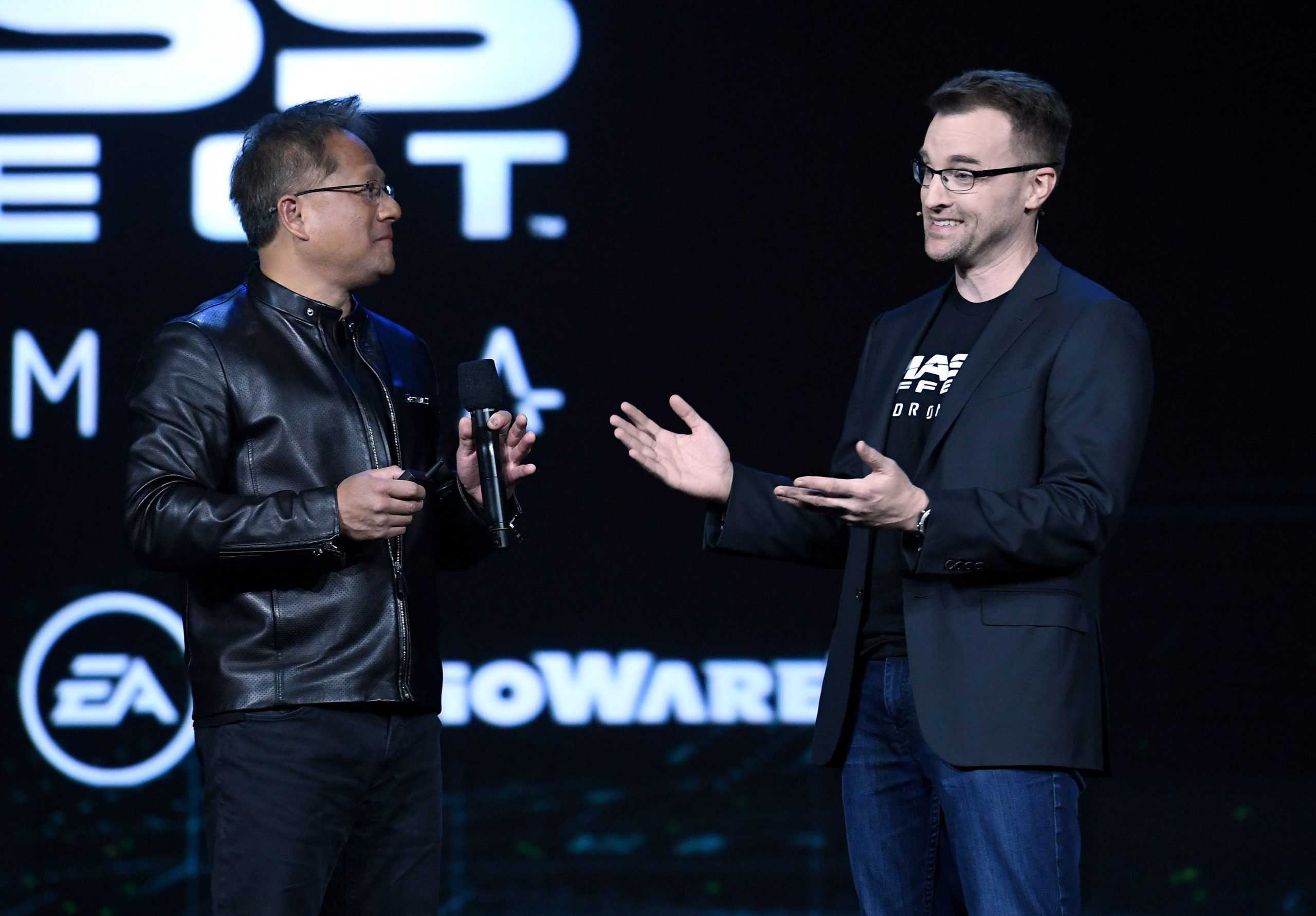
Nvidia (NASDAQ:NVDA | NVDA Price Prediction) could become the first $10 trillion company, the CEO gave about as clean an answer as you’ll hear from a Fortune 500 executive.
“Absolutely. Absolutely possible. And that’s our hope. And I think we’re on our way there. The market will take care of itself. Our growth is accelerating. Our customer base is expanding. The number of ways that we’re using AI is growing.”
What the Numbers Actually Say
Nvidia’s market cap sits at roughly $4.4 trillion today. Getting to $10 trillion means more than doubling from here. That sounds like a stretch until you look at what the business is actually doing.
Q4 fiscal 2026 revenue came in at $68.13 billion, up 73% year-over-year. Full fiscal year 2026 revenue hit $215.94 billion, up 65% from the prior year. Net income for the year was $120.07 billion. Free cash flow came in at $96.58 billion.
These are not semiconductor company numbers. These are platform company numbers.
The segment driving almost all of it: Data Center, which generated $62.31 billion in Q4 alone, up 75% year-over-year. Within that, networking revenue exploded 263% year-over-year to $10.98 billion as NVLink-based systems scale across hyperscaler deployments.
Huang framed the demand environment on the Q4 call: “Computing demand is growing exponentially — the agentic AI inflection point has arrived. Grace Blackwell with NVLink is the king of inference today — delivering an order-of-magnitude lower cost per token — and Vera Rubin will extend that leadership even further.”
The Path to $10 Trillion
Huang’s $10 trillion case rests on a simple premise: intelligence is infrastructure. He put it this way during an earlier earnings call: “I don’t know any company, industry, country who thinks that intelligence is optional. It’s essential infrastructure. And so we’ve now digitalized intelligence.”
Forward guidance of approximately $78 billion in Q1 fiscal 2027 revenue — with zero China Data Center compute included — shows the underlying demand trajectory is intact even with a significant market effectively cut off.
Analysts have a consensus price target of $267.54, with 58 buy ratings against just 2 holds and 1 sell. The stock trades at a forward P/E of roughly 23x — not cheap, but not absurd for a company compounding earnings at this pace.
Whether $10 trillion happens in five years or ten, Huang’s statement reflects something real: Nvidia is no longer competing for semiconductor market share. It’s competing to be the foundational layer of the global AI economy. If that framing is right, the valuation conversation changes entirely.












 Top Gaining Stocks
 Top Losing Stocks