



FuboTV (NYSE:FUBO) stock is down Tuesday as the company’s officially scheduled reverse stock split ignites a sharp debate among retail investors about whether the move signals a turnaround or a company in distress. FUBO shares are trading around $1.10, and the mood is tense heading into split-adjusted trading.
The reverse split itself is the headline catalyst. Reverse splits reduce the number of shares outstanding while proportionally increasing the per-share price, leaving the total market value unchanged in theory. In practice, the market tends to read them as a red flag, and FUBO stock is no exception today.
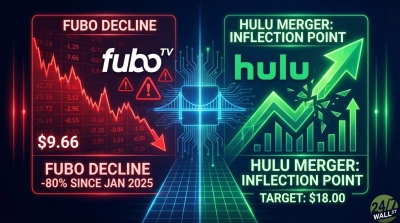
The stock’s recent trajectory makes the skepticism understandable. FUBO is down roughly 56% year to date and has lost about 65% over the past year. That kind of sustained pressure is exactly what pushes companies toward reverse splits, and it’s also exactly what makes retail investors nervous about what comes next.
The Reverse Split Debate Splits the Room
FuboTV’s board approved the reverse stock split, with major shareholder Hulu, LLC consenting to the action. The company’s stated rationale is to align share count with business size and increase marketability to institutional investors. That framing is straightforward enough, but retail investors are not taking it at face value.
On one side, some investors are anticipating that the sharply reduced float following the split could create conditions for a short squeeze or a burst of volatility that lifts the stock. Class A shares are set to shrink from roughly 353 million to about 29 million, and Class B shares from roughly 948 million to about 79 million. A compressed float can amplify price swings in either direction, and some traders are positioning around that possibility. This is speculation, not a thesis grounded in fundamentals.
On the other side, a vocal contingent is frustrated. They point to the absence of clear catalysts for a sustained recovery, question management’s execution, and view the reverse split as a cosmetic fix that does nothing to address the underlying competitive pressures FuboTV faces. Social sentiment on FUBO scores just 18 out of 100, reflecting how sour the retail mood has turned.
Disney’s Majority Stake and Relentless Content Costs
The bearish case on FuboTV extends well beyond the mechanics of a stock split. FuboTV operates a live TV streaming platform built around sports, news, and entertainment, competing directly against platforms backed by companies with resources that dwarf its own.
Disney (NYSE:DIS | DIS Price Prediction) and Hulu hold a 72.9% beneficial ownership stake in FuboTV, which provides some structural support, but it also means minority shareholders are operating with limited influence over the company’s direction.
FuboTV’s most recent quarterly results showed real operational progress. Revenue came in at $394 million, beating estimates, with 24% year-over-year growth. North American paid subscribers grew 18% year over year to 1.29 million.
Still, FuboTV may struggle to compete in a sector where content costs are relentless and subscriber churn is brutal. For more on how other struggling streaming names have navigated similar pressures, see this analysis of beaten-down streaming and media stocks.
Analyst Targets and Insider Activity Tell a Mixed Story
Analysts carry a consensus price target of $3.44 on FUBO stock, a level that implies a large recovery from where the shares trade today. Of eight analysts covering the stock, four rate it a buy, three a hold, and one a sell.
That is a modestly constructive setup on paper, but analyst targets have been sliding alongside the stock for months, and the gap between the target and the current price reflects how much execution FuboTV still needs to deliver.
FuboTV CEO David Gandler acquired 434,890 shares in January 2026, though the transaction also involved a disposal of shares tied to restricted stock unit vesting, making the net signal harder to read cleanly. The broader insider activity trend over the recent period leans toward selling, which does not add confidence to the bull case.
FuboTV’s reverse stock split represents a structural adjustment that changes the optics of the share price without changing what the business earns or how fast it grows. FuboTV still needs to demonstrate a path to sustainable profitability in a streaming market dominated by rivals with far greater scale. The gap between operational momentum and competitive reality is what keeps FUBO stock a battleground for retail investors on both sides of the trade.














 Top Gaining Stocks
 Top Losing Stocks