



It’s possible to replace your salary with dividend stocks, even if you need to replace $75,000. While Social Security benefits, pensions, and other income sources can also help, you can create a nice buffer for yourself if you just do it with dividend stocks.
The math to replace a $75,000 salary with dividend stocks is pretty straightforward. You can use this same math for any salary amount that you want to replace with passive income.
Set A Target Yield
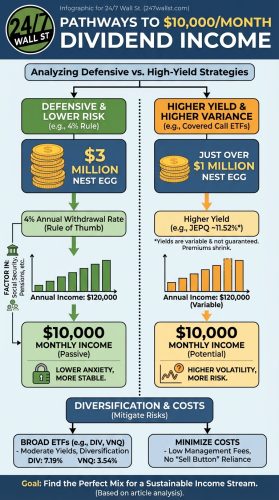
Your portfolio’s average yield is a decisive factor that determines how much cash you must save up to replace your salary with dividends. A higher yield, like 5%, requires less capital, but most of the stocks with that yield are mature companies that won’t beat the S&P 500 in the long run.
You can also invest in stocks with 2% yields that still have a shot of outperforming the market. Those same companies tend to hike their dividends at a higher rate than mature companies, but a low yield will require more capital to retire.
If you average a 5% yield, you will need $1.5 million to earn $75,000 per year. An average 2% yield requires a $3.75 million portfolio. If Social Security covers some of the salary requirement, you don’t need as much money in your dividend portfolio. Someone who receives $50,000 per year from Social Security only needs to earn $25,000 per year in dividends to match their $75,000 salary. Then, the portfolio size becomes more doable.
Two Forces That Act In Your Favor
While amassing a $1.5 million portfolio with a 5% yield or a $3.75 million portfolio with a 2% yield may sound intimidating, there are two forces that act in your favor. If you don’t need the money right away, you can reinvest every dividend payment you receive. Those reinvestments translate into more shares, and each additional share in your account results in higher dividend payouts.
The second force that works in your favor is dividend hikes. Many companies raise their dividends each year to signal financial strength to their investors. While high-yield, mature companies may only hike their dividends by 1% to 3% per year, some high-growth dividend stocks have a long history of boosting their dividends by more than 10% per year.
Reinvestments and annual dividend hikes help investors replace their full-time incomes with less money. Their stocks do some of the work for them, and if you combine that with regular portfolio contributions, the $75,000 figure becomes more attainable.
Watch How Your Dividends Are Taxed
Dividend income can help a lot when you are retired, but that same income will be taxed. Luckily, most dividend distributions are qualified dividends, which means they get taxed as long-term capital gains. It’s a much lower tax rate than ordinary income.
However, some dividend stocks have their distributions taxed as ordinary income, with REITs and options income ETFs being two of the most common offenders. High-yielding REITs like Arbor Realty Trust (NYSE:ABR) and options income ETFs like the JPMorgan Premium Equity ETF (NYSEARCA:JEPI) have much higher yields than the average stock, but ordinary income tax rates mean you’re left with less than expected.
It’s even worse if you combine non-qualified dividend distributions with high RMDs. You can end up in a very high tax bracket, even in retirement, which can make up to 85% of your Social Security benefits eligible for taxation.
Sticking with qualified dividend stocks and gradually building your positions over many years can eventually put you in a position to replace your $75,000 salary with passive income.












 Top Gaining Stocks
 Top Losing Stocks