


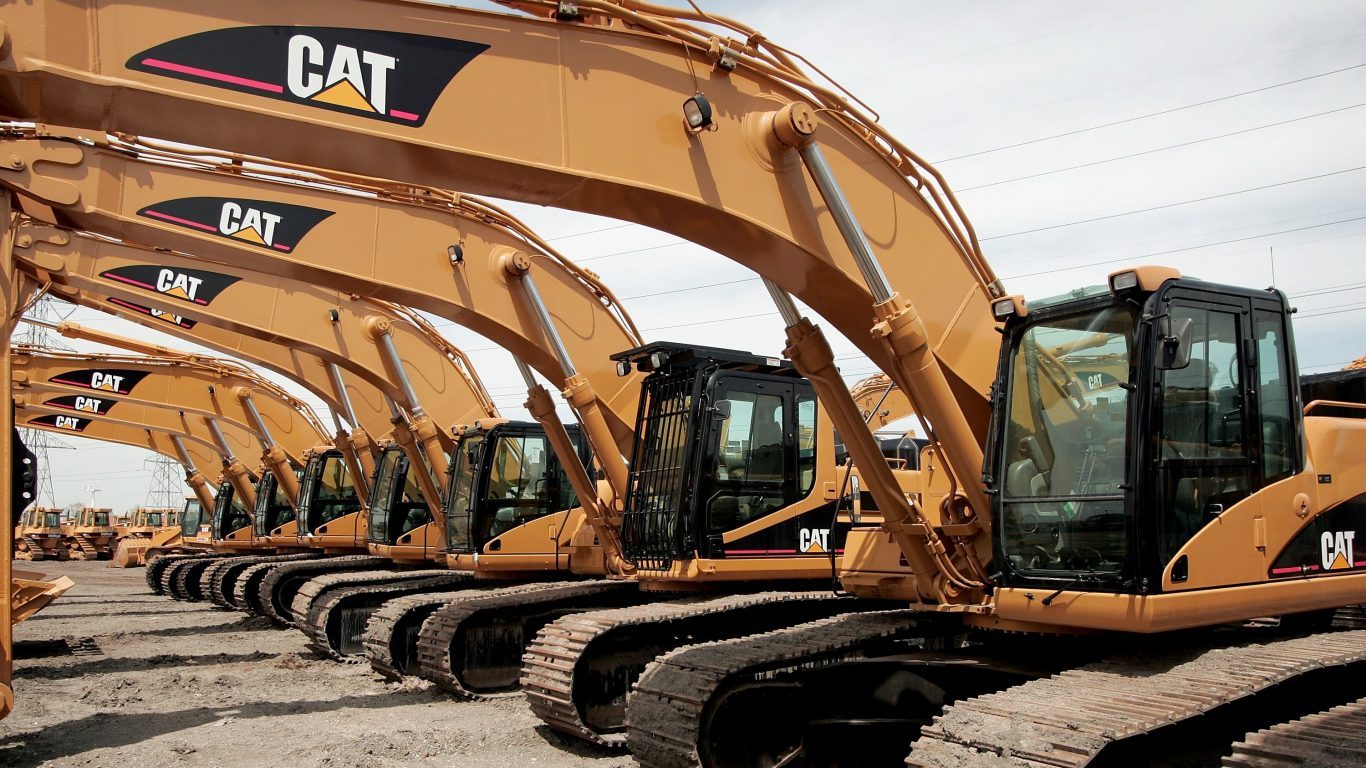
While Wall Street fixated on artificial intelligence chips and soaring tech valuations, one blue-chip Dow name delivered returns that left Nvidia (NASDAQ:NVDA | NVDA Price Prediction) in the dust. Over the past year, Caterpillar (NYSE:CAT) shares have risen 104%, more than double Nvidia’s 50% gain. That outperformance came not from flashy semiconductors, but from yellow machines moving dirt for data centers, mines, and infrastructure projects.
So, let’s examine what powered this quiet Dow winner, whether the momentum holds, and what risks investors should watch.
The Numbers Tell a Compelling Story
According to Caterpillar’s fourth-quarter and full-year 2025 earnings release in January, the company posted record full-year sales and revenues of $67.6 billion. Fourth-quarter revenue alone hit $19.1 billion, up 18% from the prior year. Adjusted earnings reached $19.06 per share for the year, with Q4 adjusted EPS at $5.16 — beating estimates of $4.70. Enterprise operating cash flow totaled $11.7 billion, and the company deployed $7.9 billion for share repurchases and dividends.
Those figures explain the stock’s run. Higher volumes across construction, resource, and energy segments drove growth, while a shift toward high-margin services added stability. Zacks data shows Caterpillar outperformed its Manufacturing – Construction and Mining industry peers by 104.2% versus the group’s 99% return over the past year. No matter how you slice it, Caterpillar turned real-world demand into shareholder value.
AI Infrastructure Gave Caterpillar an Unexpected Boost
Believe it or not, the same AI boom that lifted Nvidia also lifted Caterpillar — through power generation equipment. Data centers need massive generators and turbines, and Caterpillar’s Energy & Transportation segment delivered. Management highlighted strong demand for prime power solutions tied to AI builds, contributing to the record results. Copper mining for data center wiring added another tailwind, as miners relied on Caterpillar’s heavy equipment.
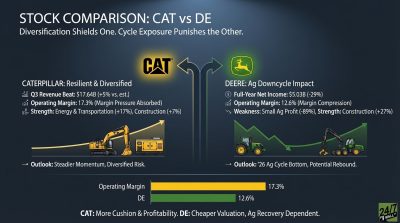
Compare that to peers: Komatsu posted far weaker returns, while Deere (NYSE:DE) trailed in growth and return on equity (Caterpillar’s ROE stands at 47.16% versus Deere’s 21.97%). Caterpillar didn’t just ride the cycle — it capitalized on secular shifts in infrastructure and energy.
A Record Backlog Points to 2026 Momentum
Here’s what the numbers tell us about staying power. Caterpillar ended 2025 with a record $51.2 billion order backlog, according to its SEC filing and earnings release. That’s up sharply from the previous year and provides visibility well into 2026 and beyond. Management guided for full-year 2026 sales growth near the top of the 5% to 7% range, supported by backlog conversion, pricing discipline, and continued services expansion. Services revenue already exceeds $24 billion annually and targets $30 billion by 2030.
For safety-focused investors, that backlog acts like a buffer. It means revenue isn’t dependent on new orders alone. Pricing power and a growing installed base should help offset cyclical pressures.
Tariffs and Valuation Present Real Risks
That said, no story this strong comes without caveats. Caterpillar flagged $2.6 billion in incremental tariff costs for 2026 — up from roughly $1.7 billion in 2025 — primarily tied to China-related manufacturing and imports. Q4 operating margins narrowed to 15.6% from 18.3% the prior year, partly due to those costs. If trade tensions escalate, margins could compress further.
Valuation adds another layer. Caterpillar trades at a trailing P/E of 36.2, well above its five-year average near 19x. At around $695 per share, the stock carries a forward dividend yield of 0.87% based on an annual dividend of $6.04 per share. That’s modest for income seekers, though the company has raised its dividend for 30 straight years at a 7.23% five-year average clip.
Key Takeaways
All in all, Caterpillar’s double in value versus Nvidia only rising by half that rate wasn’t luck — it stemmed from tangible demand in AI infrastructure, mining, and construction, backed by a $51.2 billion backlog and $11.7 billion in operating cash flow. Those factors should continue into 2026, with 5% to 7% sales growth on the horizon and services providing recurring revenue.
Granted, tariffs could shave margins, and the premium valuation leaves less room for error. But for long-term investors who value data over hype, the outlook remains attractive. Caterpillar proved it can deliver in an AI-driven world without the volatility of pure tech plays. If the backlog converts and pricing holds, this surprising Dow stock still has room to run — tariffs and all.







 Top Gaining Stocks
 Top Losing Stocks