


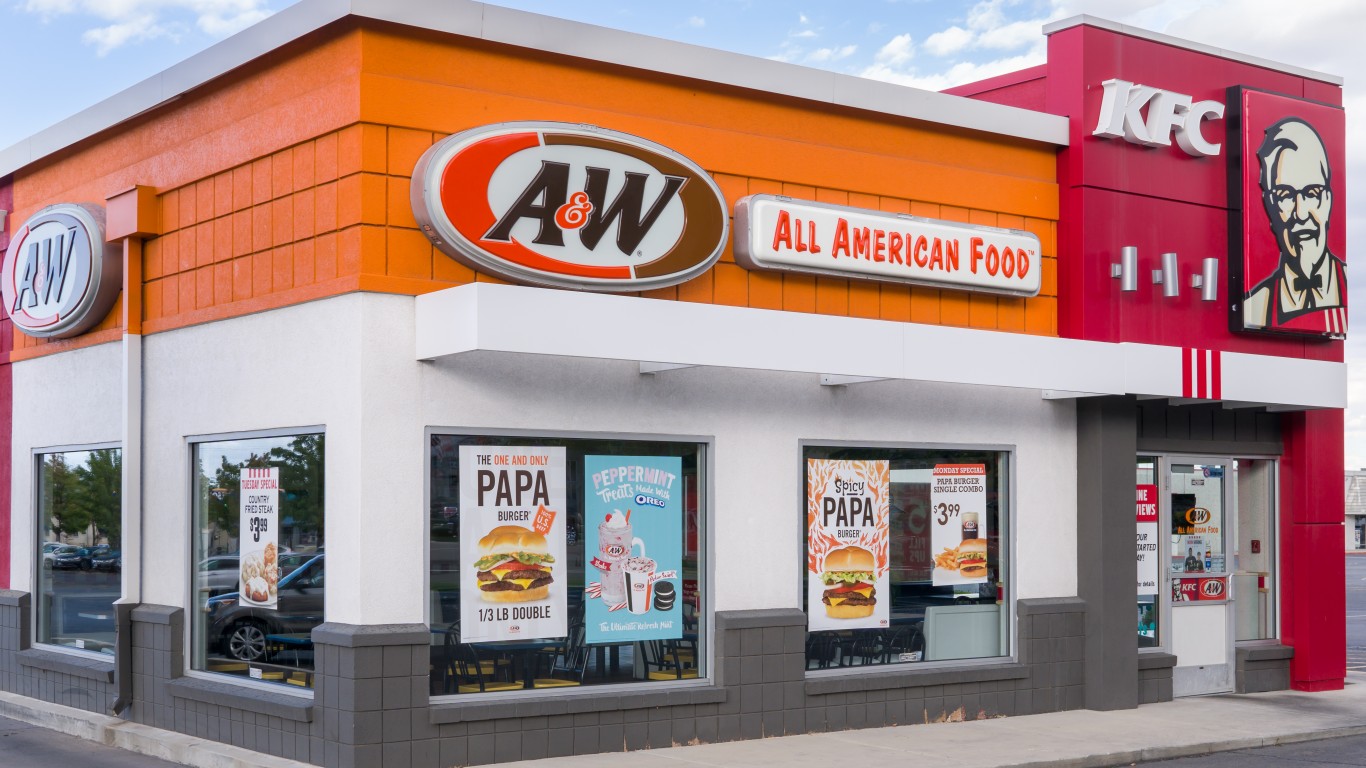
Restaurant Brands International (NYSE: QSR | QSR Price Prediction) and Yum! Brands (NYSE: YUM) are the two most direct comparisons in franchised fast food, but for a retirement-focused investor deciding between them right now, only one makes a compelling case across the dimensions that matter most: valuation, income, and long-term price performance.
Valuation
On a forward earnings basis, Restaurant Brands (RBI) trades at a meaningfully cheaper multiple. Its forward P/E of 14x compares favorably to Yum’s forward P/E of 24x , a significant gap for two businesses with broadly similar long-term growth algorithms. Both companies target 8%-plus organic operating profit growth annually, yet the market is pricing Yum at a substantial premium.
RBI also trades at 4.4x EV/revenue versus Yum’s 6.8x, reinforcing the valuation discount. Yum’s negative shareholders’ equity of −$7.325 billion, a product of aggressive buybacks and accumulated debt, adds a layer of balance sheet risk that the forward multiple alone does not capture. RBI carries net leverage of 4.2x, elevated but improving from 4.6x the prior year.
Winner: RBI.
Income
Yum raised its quarterly dividend to $0.75 per share, a 6% increase, putting its annual run rate at $3.00 per share against a stock price near $156. RBI targets an annual dividend of $2.60 per share against a stock price near $77. The math strongly favors RBI in yield terms.
RBI also announced a $1.6 billion capital return plan for 2026, including a $1 billion share repurchase authorization running through September 2027. Yum repurchased $552 million in shares during full-year 2025, a solid program but smaller in relative scale. For a retirement portfolio where income generation matters, RBI delivers more yield per dollar invested at current prices.
Winner: RBI.
Long-Term Track Record
Yum has compounded more effectively for long-term shareholders. Over the past decade, Yum shares returned 220.75% versus RBI’s 166.81%. Over five years, Yum returned 56.03% against RBI’s 38.94%. That long-run edge is driven by Taco Bell, which posted 7% same-store sales growth in both Q4 and full-year 2025, and KFC, which opened nearly 3,000 new units in 2025 across 155 countries.
Analysts project 11% EPS growth in 2026 for Yum, with a consensus price target of $171.92. RBI’s International segment delivered 30.5% adjusted operating income growth in Q4, but Popeyes remains a drag with comparable sales down 4.8% in Q4. Yum’s Pizza Hut is similarly troubled, with a strategic review already underway.
Winner: YUM.
The Verdict
Restaurant Brands wins this comparison for the retirement-focused investor. It trades at a cheaper forward multiple, delivers a higher dividend yield at current prices, and CEO Josh Kobza’s confidence is backed by data: “We delivered our third consecutive year of roughly 8% organic Adjusted Operating Income growth,” with a reaffirmed long-term algorithm through 2028.
Year-to-date in 2026, RBI shares have risen 13.22% versus Yum’s 3.65%, suggesting the valuation gap is beginning to close. Yum is the stronger choice for a growth-oriented investor with a longer time horizon who can tolerate a richer valuation and a leveraged balance sheet in exchange for Taco Bell’s category-leading momentum and KFC’s global expansion engine. For an investor prioritizing income, capital return, and value, RBI presents a stronger combination of yield and valuation at current prices.













 Top Gaining Stocks
 Top Losing Stocks