


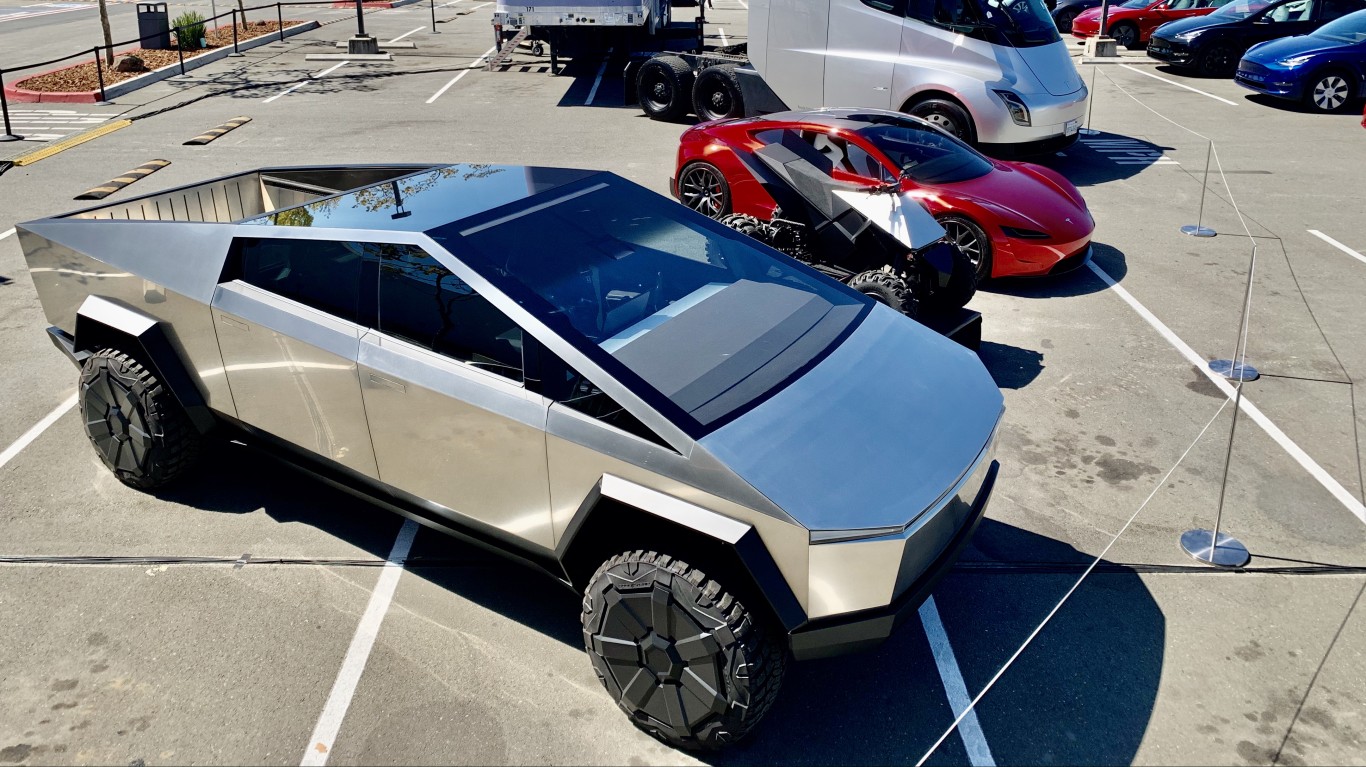
The Electric Vehicle (EV) sector has ballooned to become an industrial sector in its own right. Last year, EV’s comprised 23% of global passenger vehicle sales, and are projected to reach 57% by 2035. In addition to the EVs themselves, there is an entire infrastructure of component manufacturers, maintenance services, battery factories, recharging stations, and A.I./robotics developers (for autonomous driving technology) that are all part of that industry. When you get past tires and lights, EVs have grown into a completely different animal than gasoline and diesel powered vehicles, as other components are not interchangeable.
Although EVs and hybrids continue to expand in popularity, geography and politics has determined its regional growth. For example, despite global growth projected as 19% in 2026, the bulk of it is targeted in China and Europe. The EV industry is contracting in the US as a result of subsidy cuts and the return to an energy independence policy under President Trump, which favors oil and gas. Nevertheless, there is an EV focused ETF that is up +22% YTD and up +76% in the past year: the Global X Autonomous & Electric Vehicles ETF (NASDAQ: DRIV).
Global X Autonomous & Electric Vehicles ETF

A big part of DRIV’s success has been its investments in companies that are integral to the EV supply chain, such as Samsung, which manufactures EV batteries, radars for autonomous driving, and other crucial components.
DRIV was launched roughly eight years ago from the time of this writing, in April 2018. It was created by Global X to track the Solactive Autonomous & Electric Vehicles Index. Its $390 million AUM is spread across 76 different stock holdings, both domestic as well as international. One of the key reasons for DRIV’s gains has been sizable holdings in EV infrastructure related companies, as opposed to direct EV manufacturers. For example, EV company Tesla is #5 on DRIV’s largest holdings list, but semiconductor company Intel is #1, and Korea’s Samsung, a big player in EV batteries, radar components for autonomous robot driving, and other critical EV supply chain elements, is at #6.
An overview of DRIV includes:
|
Net Assets |
$390.19 million |
NAV |
$36.13 |
|
Yield |
1.05% |
Expense Ratio |
0.68% |
|
Daily Avg. Volume |
50,849 shares |
YTD Return |
22.06% |
|
52-Wk. Range |
$20.20-$36.43 |
1-Year Return |
76.48% |
|
Beta |
1.54 |
3-Year Return |
19.19% |
|
Holdings |
76 |
5-Year Return |
3.98% |
Top 10 Holdings:
- Intel – 4.14%
- Nvidia – 3.02%
- Alphabet A (Google) – 2.76%
- Microsoft – 2.43%
- Tesla – 2.26%
- Samsung SDI Co. – 2.18%
- Toyota Motor Corp. – 2.03%
- Amprius Technologies – 2.03%
- Coherent Corp. – 2.02%
- Qualcomm – 1.99%
Midstream LPs, which handle the transportation infrastructure for hydrocarbon fuels via pipelines, land, and maritime shipping, render energy producers worthless without the means to monetize the product. In like fashion, companies that make crucial components for EVs are along for the overall ride, but play an integral part in its success.
Outperforming the EV ETF Competition

Although self-driving cars from China’s Waymo are proliferating to expand EV growth, their subsequent financial results have not boosted IDRV and KARS to the same degree as US companies in the EV space have benefited DRIV.
The emphasis that DRIV places on specific infrastructure companies that are critical for EV success is proving to be a winning strategy. For example, two of DRIV’s ETF competitors are iShares Self-Driving EV and Tech ETF (NYSE: IDRV) and KraneShares Electric Vehicles and Future Mobility Index ETF (NYSE: KARS).
In the case of IDRV, its YTD return is 13.02%, 1-year return is 50.75%, and 3-year return is 8.23%. KARS is somewhat better, with a YTD return of 17.09%, a 1-year return of 73.53%, and a 3-year return of 8.06%.
By comparison, DRIV beats them both, with a YTD return of 22.06%, a 1-year return of 76.48%, and a 3-year return of 19.19%.
Ironically, the top 10 largest holdings lists of both KARS and IDRV contain more foreign companies, especially from Korea and China, compared to DRIV, which has Magnificent 7 US stocks in its top 5 largest holdings and only 2 foreign stocks in its top 10. The irony is from the EV industry contraction in the US market compared to its growth track in Asia and Europe. In any event, DRIV shareholders certainly aren’t complaining as long as DRIV stays on track to keep bringing home the bacon.











 Top Gaining Stocks
 Top Losing Stocks