



After years of delays, autonomous vehicles are shifting from pilot programs to commercial reality. At CES 2026, NVIDIA (NASDAQ:NVDA | NVDA Price Prediction) unveiled partnerships with Mercedes-Benz (OTC:MBGAF) for city-street autonomy and a robotaxi alliance with Lucid (NASDAQ:LCID) and Uber (NYSE:UBER). Waymo plans to expand to 12 new cities this year while targeting over one million weekly rides. iShares Self-Driving EV and Tech ETF (NYSEARCA:IDRV) offers exposure to the entire value chain at a modest valuation.
The Full Stack Play on Self-Driving Technology
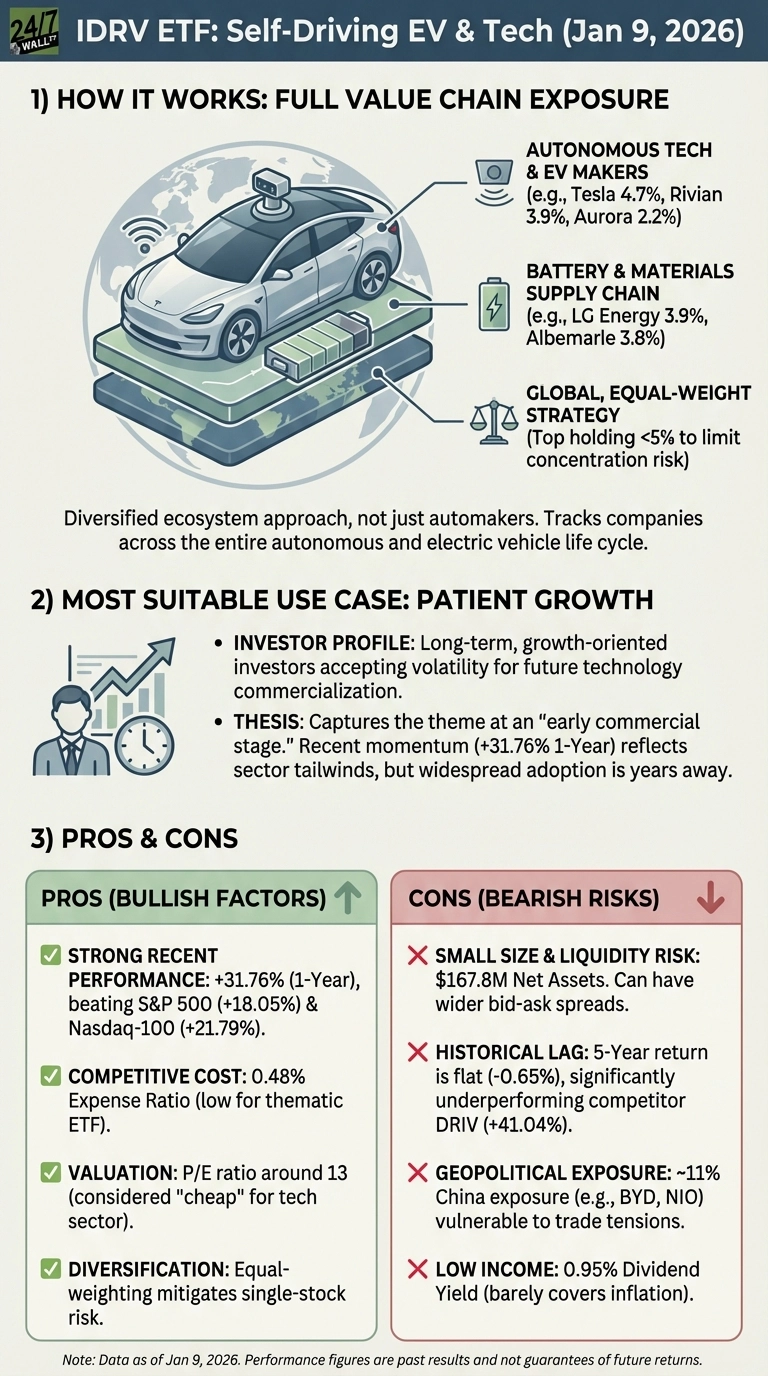
The iShares Self-Driving EV and Tech ETF holds $168 million in assets and tracks companies across the autonomous vehicle ecosystem. IDRV spreads exposure across automakers (Tesla (NASDAQ:TSLA) at 4.7%, Rivian (NASDAQ:RIVN) at 3.9%), battery suppliers (LG Energy Solution (KRX:373220) at 3.9%, LG Chem (KRX:051910) at 3.9%), materials producers (Albemarle (NYSE:ALB) at 3.8%), and emerging autonomy players (Aurora Innovation (NASDAQ:AUR) at 2.2%). The fund trades at a P/E ratio around 13, cheap for a technology ETF in a sector reaching commercialization.
This diversification matters because the autonomous vehicle winner isn’t obvious. Tesla leads in consumer vehicles with Full Self-Driving software, Waymo dominates robotaxis with over 100 million autonomous miles driven, and Chinese manufacturers like BYD (OTC:BYDDF) (3.9% of IDRV) are scaling production rapidly. IDRV captures all approaches while limiting single-company risk through equal-weight methodology where the top holding represents just 4.7% of assets.
Performance Shows Sector Momentum Building
IDRV returned 32% over the past year, crushing the S&P 500’s 18% gain by 14 percentage points and beating the Nasdaq-100’s 22% return by 10 percentage points. The fund is up 3% year-to-date in 2026. Rivian, one of IDRV’s holdings, surged 44% over the past year and gained 14% in just the last month.
The fund’s 0.48% expense ratio is competitive for a thematic ETF, though the small asset base creates liquidity considerations. Average daily volume remains light, so larger positions may experience wider bid-ask spreads.
The Tradeoffs: Small Size and Concentration Risk
IDRV’s biggest weakness is its size. At $168 million in assets, the fund is tiny compared to Global X Autonomous & Electric Vehicles ETF (DRIV), which holds $340 million. Smaller funds face higher operational costs and vulnerability to redemptions during market stress. The 51% portfolio turnover suggests frequent rebalancing, which can generate tax consequences in taxable accounts.
The fund carries significant China exposure through BYD, NIO (NYSE:NIO), and XPeng (NYSE:XPEV), which combine for roughly 11% of holdings. If U.S. tariffs on Chinese EVs intensify or trade tensions escalate, these positions could underperform sharply. The equal-weight approach means it doesn’t benefit as much from a single breakout winner compared to market-cap-weighted alternatives.
Who Should Avoid This ETF
Conservative investors seeking income should look elsewhere. IDRV’s 0.95% dividend yield barely covers inflation, and the fund focuses on growth companies where capital appreciation drives returns, not distributions. Retirees needing stable cash flow would be better served by dividend-focused equity funds or bond ladders.
Short-term traders face challenges. The fund’s low liquidity and thematic focus create volatility that punishes investors without a multi-year time horizon. Commercial rollouts are accelerating, but widespread consumer adoption remains years away.
Consider DRIV for Greater Scale and Track Record
The Global X Autonomous & Electric Vehicles ETF (NYSEARCA:DRIV) offers a comparable strategy with $340 million in assets, double IDRV’s size. DRIV outperformed IDRV over the past five years with a 41% gain versus IDRV’s flat performance, though the gap has narrowed recently with both funds up around 32-36% over the past year. DRIV allocates 29% to information technology versus 24% to consumer discretionary, emphasizing semiconductor and software advantage of U.S. companies over Chinese volume manufacturers.
The tradeoff is cost. DRIV charges 0.68% annually compared to IDRV’s 0.47%, a 21 basis point difference that compounds over time. DRIV holds less Chinese exposure, which could be an advantage if trade tensions persist but might miss upside if Chinese EV makers continue gaining global market share.
IDRV captures the autonomous vehicle theme at an early commercial stage with diversified exposure and modest valuation, but its small size and China exposure create risks that patient, growth-oriented investors must accept.









 Top Gaining Stocks
 Top Losing Stocks