


The stock market spent much of the past two years celebrating artificial intelligence as the next great productivity boom. Companies from Nvidia (NASDAQ:NVDA | NVDA Price Prediction) to Microsoft (NASDAQ:MSFT) raced higher as investors poured money into anything tied to AI infrastructure. But there’s another side to that story beginning to emerge. What happens when the technology that boosts profits also replaces workers?
That question moved from theory to reality this week after Coinbase (NASDAQ:COIN) CEO Brian Armstrong warned employees that mass layoffs are coming to “every company” as AI reshapes corporate America. Coinbase is eliminating roughly 14% of its workforce — about 700 jobs — and Armstrong suggested the cuts are only the beginning of a much broader shift across the economy.
For investors, workers, and policymakers alike, the warning deserves attention.
AI Is Turning Productivity Into Fewer Employees
Armstrong told Coinbase workers in an email, businesses are entering an era where smaller teams can accomplish work that once required entire departments. It is not alone. Companies may soon need fewer people to perform the work AI is taking over.
Coinbase’s layoffs come amid a wave of tech-sector cuts that has already swept through Silicon Valley in 2026. Layoffs.fyi, which tracks technology industry job reductions, reports roughly 100 tech companies have announced layoffs this year totaling more than 92,000 employees.
Some of the largest examples include:
| Company | Estimated Layoffs | Notes |
| Meta Platforms (NASDAQ:META) | 8,000+ | Continued AI restructuring |
| Oracle (NYSE:ORCL) | 30,000 | Automation and cloud efficiency push |
| Amazon (NASDAQ:AMZN) | 16,000+ | Alexa and corporate division cuts |
What stands out is that many of these companies are not struggling financially. Quite the opposite.
Meta generated $48.2 billion in free cash flow over the last 12 months. Alphabet (NASDAQ:GOOG)(NASDAQ:GOOGL) sits on more than $126 billion in cash and marketable securities. Coinbase itself returned to adjusted net profitability during the crypto rebound.
The cuts are not simply about survival. They are about efficiency. And Wall Street has rewarded that strategy.
Sam Altman Thinks the Disruption Could Be Permanent
Granted, technological revolutions have historically created new industries even as they destroyed old ones. The automobile replaced horse-and-buggy jobs but created factories, mechanics, highways, and logistics networks. The internet wiped out video rental stores while opening the door to e-commerce and cloud computing.
Armstrong argues AI could follow a similar path He told employees workers need to rethink the value they bring to companies because AI tools can increasingly handle routine tasks. New opportunities will emerge for employees who learn how to direct, manage, and deploy those systems.
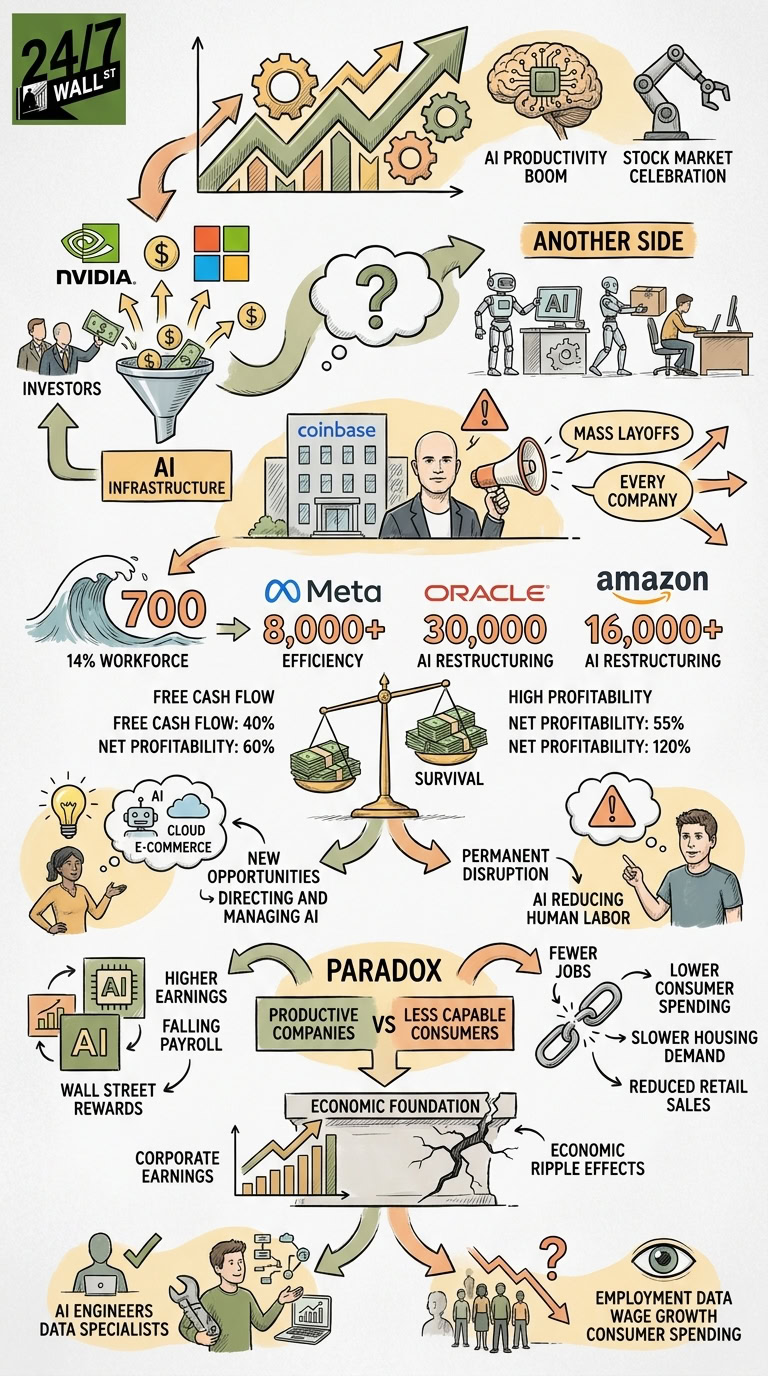
But not everyone in the tech world shares that optimism. Sam Altman has repeatedly warned that AI may permanently reduce the need for human labor across many industries. OpenAI’s newest models already perform coding, research, customer service, and content-generation tasks once handled by teams of employees.
Surprisingly, the economic concern isn’t just unemployment. It’s demand. Consumer spending accounts for nearly 70% of U.S. GDP. If businesses replace large numbers of workers with AI systems, households may lose income even while corporate profits expand.
That creates an uncomfortable paradox: companies become more productive while consumers become less capable of spending money on the products those companies sell. That’s a difficult balance for the economy to maintain long term.
Investors May Benefit — but the Economy Could Pay a Price
From an investor standpoint, the appeal of AI-driven efficiency is obvious. Replacing a 20-person support staff with two employees overseeing AI systems has benefits. Payroll expenses fall. Operating margins expand. Earnings per share rise. Wall Street often rewards that immediately.
But put it into perspective. Labor is one of the largest expenses for most businesses. S&P Global data shows compensation costs account for roughly 70% of operating expenses in many service-based industries. Even modest workforce reductions can materially boost profits.
That helps explain why companies continue accelerating AI investments despite public concern over layoffs. But economies depend on workers earning paychecks. Fewer jobs can eventually mean:
- Lower consumer spending
- Slower housing demand
- Reduced retail sales
- Higher credit stress
- Weaker tax revenues
In short, AI could create a period where corporate earnings improve faster than the broader economy. That divergence may already be appearing. The stock market continues pushing higher behind mega-cap tech names while job security in white-collar industries grows shakier by the quarter.
Key Takeaway
Coinbase’s layoffs are not just another round of Silicon Valley belt-tightening. Armstrong’s warning reflects a broader shift already underway across corporate America: Companies increasingly see AI not merely as a tool to assist employees, but as a replacement for them.
That said, history suggests technology revolutions also create opportunities for workers willing to adapt. Investors should expect strong demand for AI engineers, data specialists, cybersecurity experts, and employees capable of managing automated systems.
Still, the transition could prove painful. If AI allows companies to operate with dramatically smaller workforces, the economic ripple effects may stretch far beyond the tech sector.
AI may continue boosting profits and stock prices in the near term, but sharp investors should also keep an eye on employment data, wage growth, and consumer spending because those numbers will determine whether this productivity boom strengthens the economy — or quietly weakens its foundation.














 Top Gaining Stocks
 Top Losing Stocks