


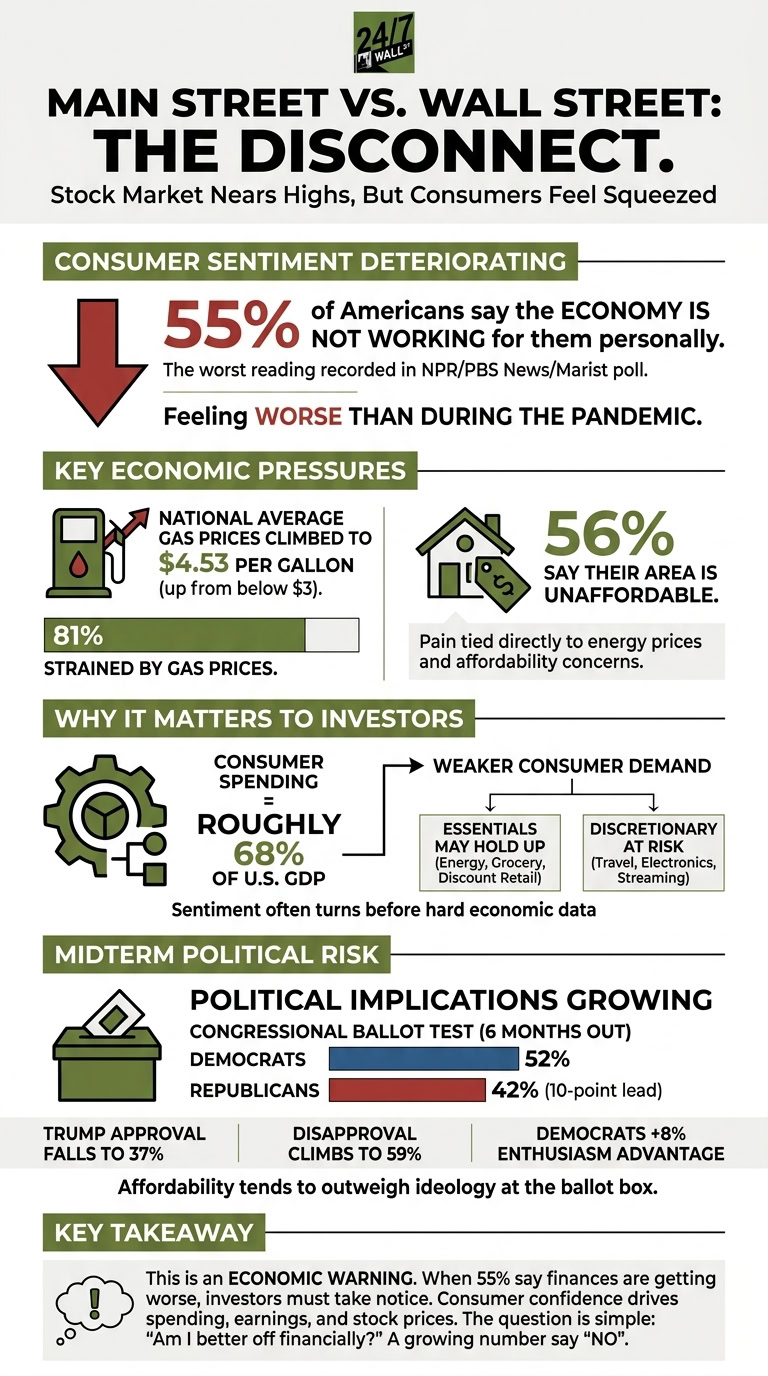
The stock market may be hovering near record highs, but Main Street is sending a very different message. Investors watching the S&P 500 might think consumers are holding up fine. Yet a new NPR/PBS News/Marist poll suggests households are feeling squeezed in ways not seen since the early 2000s — and even worse than during the pandemic.
That disconnect matters. Consumer spending accounts for roughly 68% of U.S. GDP, according to the Bureau of Economic Analysis. When households begin feeling financially cornered, it eventually shows up in earnings reports, retail sales, travel demand, and, yes, election results.
The big question investors should ask now is simple: if Americans felt more financially secure during COVID lockdowns than they do today, what does that say about the political and economic road ahead?
Americans Are Sending a Clear Economic Warning
The headline number from the NPR/PBS News/Marist poll was brutal: 55% of Americans said the economy is not working for them personally, the worst reading recorded in the survey. Simply, most Americans feel like they’re falling behind.
The pain appears tied directly to energy prices and affordability concerns. National average gasoline prices have climbed to $4.53 per gallon, up from below $3 before the Iran conflict escalated.
The poll found:
| Economic Concern | Percentage |
| Americans strained by gas prices | 81% |
| Americans blaming Trump for higher gas prices | 63% |
| Americans saying economy is not working for them | 55% |
| Americans saying their area is unaffordable | 56% |
Here’s what the numbers tell us: consumers may still be spending, but confidence is deteriorating fast.
Surprisingly, the dissatisfaction cuts across groups that traditionally lean Republican. NPR reported sharp approval declines among rural voters, white voters without college degrees, and households earning less than $50,000 annually.
That matters because those groups formed a key part of President Trump’s electoral coalition in 2024.
Why Investors Should Care About Consumer Mood
Markets can ignore unhappy voters for a while. They cannot ignore weaker consumer demand forever.
Higher gasoline prices act like a tax on households. According to an analysis cited by Axios and the Brookings Institution, every $1 increase in gasoline prices adds about $70 per month in costs for a median-income, two-driver household. That money has to come from somewhere.
Usually, consumers pull back on discretionary purchases first:
- Restaurant spending
- Travel
- Electronics
- Streaming services
- Apparel
- Home improvement projects
We’re already seeing hints of that shift. NPR reported that Americans are increasingly booking cheaper domestic vacations instead of European trips as airfare costs rise alongside jet fuel prices.
For investors, this creates a potential divide in the market. Companies tied to essentials — energy, discount retail, groceries, utilities — may hold up better. Consumer discretionary stocks, airlines, and travel companies could face pressure if household budgets continue tightening into the second half of 2026.
Granted, unemployment remains relatively low and corporate earnings have not collapsed. The AI boom also continues driving enormous capital spending from companies like Nvidia (NASDAQ:NVDA | NVDA Price Prediction), Advanced Micro Devices (NASDAQ:AMD), and Microsoft (NASDAQ:MSFT).
But sentiment often turns before the hard economic data does. Investors learned that lesson in both 2008 and 2022.
The Midterm Risk Is Growing
The political implications may be even bigger than the economic ones. The NPR/PBS News/Marist poll showed Democrats holding a 52% to 42% advantage on the congressional ballot test — a 10-point lead six months before voting begins.
Historically, that kind of gap signals potential wave-election conditions.
The poll also found:
- Trump’s approval rating fell to 37%
- Disapproval climbed to 59%
- Democrats held an 8-point enthusiasm advantage among likely voters
Regardless of political affiliation, investors should pay attention because elections influence policy direction, taxation, regulation, energy markets, and government spending priorities.
That said, the midterms are still six months away. Energy prices could ease if tensions with Iran continue cooling following Trump’s temporary pause of “Project Freedom” operations in the Strait of Hormuz. Markets have already begun pricing in lower recession odds following ceasefire discussions.
Still, the poll exposes a larger issue: voters appear exhausted by persistent affordability pressures. And when all is said and done, affordability tends to outweigh ideology at the ballot box.
Key Takeaway
In short, this poll wasn’t just a political warning. It was an economic one. When 55% of Americans say their finances are getting worse — worse than even during the pandemic — investors should take notice. Consumer confidence drives spending, spending drives corporate earnings, and earnings ultimately drive stock prices.
The market may still be optimistic about AI, rate cuts, and economic resilience. But households facing $4.53 gasoline, elevated grocery bills, and shrinking purchasing power are telling a different story.
If those pressures persist into the fall, the midterms may become less about ideology and more about a simple kitchen-table question: “Am I better off financially?” Right now, a growing number of Americans appear to be answering “no.”









 Top Gaining Stocks
 Top Losing Stocks