


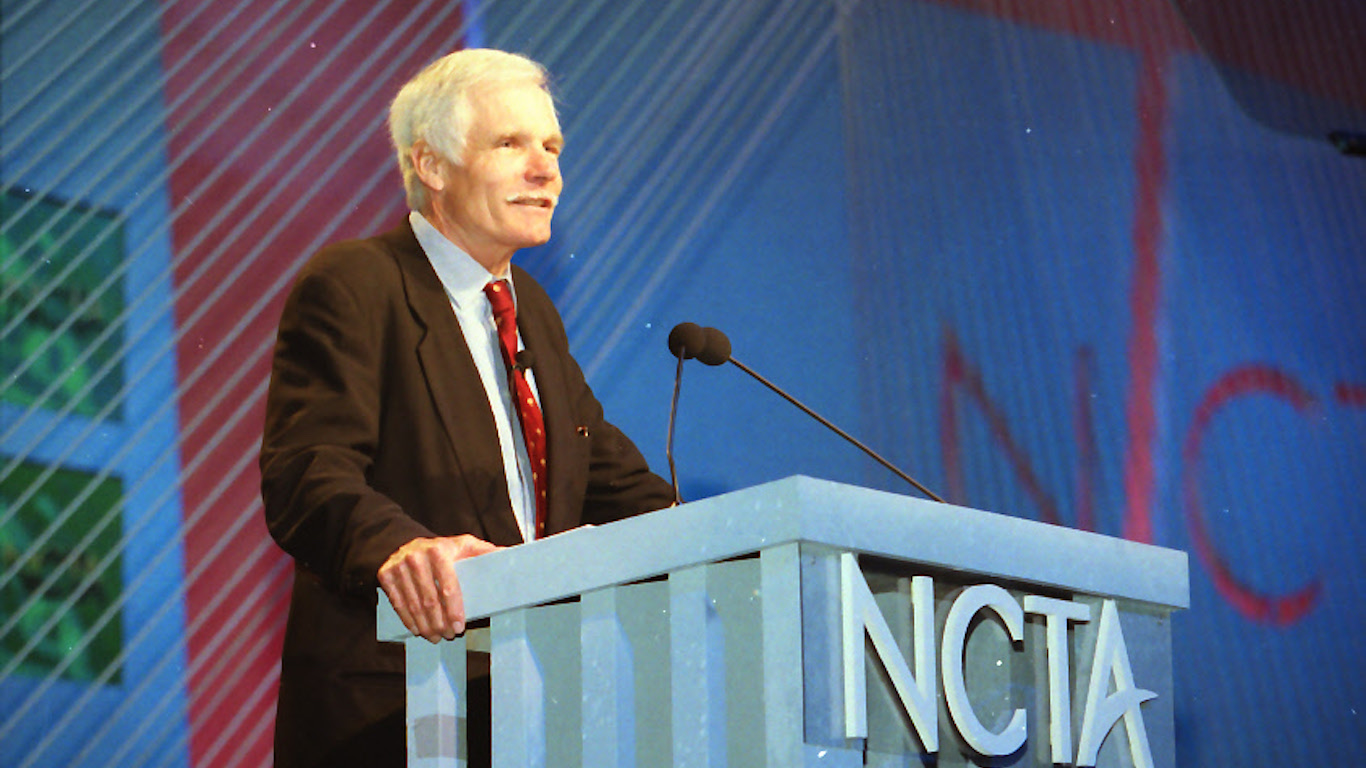
In 1997, Ted Turner’s advisors told him the United Nations could not legally accept private donations. He gave them forty-eight hours to find a way around it. Then he wrote the UN a check for $1 billion — the largest individual philanthropic gift in history at the time. He had decided he would rather embarrass Congress than die rich.
Turner died Wednesday at the age of 87. If you have watched 24-hour cable news, eaten in one of his restaurants, or driven through a restored stretch of the American West, you have lived inside something he built.
Forty-eight hours, one billion dollars
Turner spent his life making bets others thought were unreasonable. The arc — billboard prince, cable cowboy, bison rancher — runs from a boarding-school dormitory in Cincinnati to two million acres of American West.
The boy left behind in Cincinnati
His father didn’t take him. When Ed Turner Jr. — a Cincinnati billboard magnate with untreated bipolar disorder and a heavy hand — went off to a Navy posting on the Gulf Coast, he took his wife and daughter and left young Ted at a boarding school back in Ohio. The drive to prove his worth, by Turner’s own later admission, began there.
Military school polished what abandonment started. At McCallie in Chattanooga he won the Tennessee debating championship while building a reputation for scuffed shoes — small, deliberate insults to the institution’s spit-shine culture. Brown expelled him in 1959 for having a woman in his dormitory.
The hinge came in March 1963. Ed Turner, drowning in debt and a collapsing merger, shot himself at fifty-three. Ted was twenty-four years old, with a billboard company in mid-sale and a wall of lawyers telling him to let the deal close. He told them no — and unwound it.
Watch This Channel Grow
By 1970, Turner Outdoor Advertising was the largest billboard firm in the Southeast. So he mortgaged his house and bought a UHF television station in Atlanta — Channel 17 — that was hemorrhaging $50,000 a month and couldn’t cover its own metropolitan area. His own board had vetoed it. He bought it anyway, rebranded it WTCG, and told everyone the letters stood for Watch This Channel Grow.
To fill the airtime, he bought reruns of Gilligan’s Island and Star Trek outright. To fill the 3 a.m. slot, he put humorist Bill Tush on camera next to a German Shepherd named Rex who wore a tie and ate a peanut butter sandwich.
In 1976, Turner leased capacity on an RCA satellite and beamed Channel 17 to cable systems across the country. The “Superstation” had been invented. He bought the Atlanta Braves the same year — cheap live programming for a national feed.
A year later, with the Braves on a sixteen-game losing streak, he sent his manager on vacation and walked into the dugout in uniform No. 27 himself — stirrups backward, cigar in his mouth, no idea where he was hitting. The Braves lost 2-1. The commissioner of baseball rescinded the right of owners to manage their own teams the next morning. “If I’m smart enough to buy the team,” Turner shrugged, “I ought to be smart enough to manage it.”
Captain Outrageous, on the floor
While he was inventing cable, Turner was also winning trophies on the water. In September 1977, skippering the yacht Courageous with what one writer called a “ragtag bunch of blue-collar sailors,” he swept the Australians 4-0 to defend the America’s Cup. The post-race press conference was a shambles: Turner appeared visibly drunk and wound up stretched out on the floor, which made the front page. Sports Illustrated put him on its cover anyway. The nickname “Captain Outrageous” was already settled.
Two years later, the 1979 Fastnet Race — the roughest ocean race on record — killed fifteen sailors and sank or capsized dozens of boats in a single storm. Turner refused to abandon his sixty-two-foot Tenacious. He came in first of the eighty-seven boats that finished.
They called it the Chicken Noodle Network
In 1978, Turner told his staff he was going to start a 24-hour news network. The networks called it the “Chicken Noodle Network.” CNN went on the air June 1, 1980, and lost $20 million in its first year. “Barring satellite problems,” Turner said, “we won’t be signing off until the world ends.”
He had a one-minute clip recorded — military bands playing “Nearer, My God, to Thee” — for the actual end of the world. The tape was archived under the instruction “HFR till end of world confirmed.” He had meant it.
By the time CNN was carrying the Challenger explosion live and the Gulf War in saturation, the joke had stopped being a joke. Time named Turner Man of the Year in 1991.
Six years earlier he had bought the MGM/UA film library for $1.5 billion and begun colorizing the black-and-white classics. Orson Welles, weeks before his death, asked his friends not to “let Ted Turner deface my movie with his crayons.” Jimmy Stewart compared the process to dunking film in “a bath of Easter Egg dye.” Turner was unmoved. “The last time I checked,” he said, “I owned the films.”
Among the bison
The check at the top of this story was not the only large bet of Turner’s later years. The gift created the United Nations Foundation, which still channels his money toward climate, women’s health, and global peace. He had decided, by then, that the lists ranking the wealthy by net worth were the wrong scoreboard. He preferred lists ranked by what people gave away.
By the time he wrote that check he was already buying ranches. Vermejo Park in New Mexico, scarred by decades of coal mining when he picked it up in 1996, was eventually restored across half a million acres. He kept buying. By 2011 he held more than two million acres across thirteen ranches in six states — the largest private landowner in the country.
On those acres he built a herd of more than 45,000 bison, the largest commercial herd in North America. He opened a restaurant chain — Ted’s Montana Grill — to make the meat marketable enough that other ranchers would breed bison too. He rejected the cowboy label. “I’m a bison man,” he’d say.
He was a brash billionaire who lived above his office. An atheist who pledged a fortune to the United Nations. A media mogul who found his peace among bison. He rewrote the news cycle, rebuilt a baseball team, restored half a million acres of New Mexico, and challenged the world’s wealthiest people to keep score by what they gave away.
The man who told the world that “adventure is going out and doing something for the pure hell of it” wanted, when the time came, the simplest possible epitaph.
“I have nothing more to say.”







 Top Gaining Stocks
 Top Losing Stocks