



The 2026 chip war is over. Apple (NASDAQ:AAPL | AAPL Price Prediction) won it in procurement meetings, well before product launches. The market is just catching up.
Apple’s $287.44 share price and $4.22 trillion market cap already reflect what the silicon industry figured out two quarters ago: when you control the most advanced node and the scarcest memory, the rest of the consumer-electronics field competes for table scraps.
Apple’s Procurement Moat
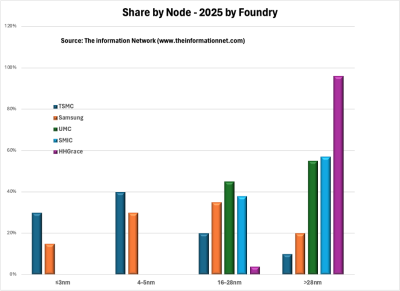
TSMC (NYSE:TSM)’s 2nm (N2) process entered mass production in early 2026, the most advanced node available anywhere. Gate-All-Around nanosheet transistors deliver up to 30% better power efficiency versus 3nm, and Apple booked over 50% of TSMC’s initial 2nm capacity for 2026 to feed next-generation A20 and M5 silicon. Qualcomm, Samsung’s silicon clients, and Google’s TPU partners are fighting over the leftovers or holding on 3nm.
TSMC chairman C.C. Wei was blunt on the Q1 call: “Capacity is very tight… it takes 2 to 3 years to build a new fab.” Translation: nobody is catching Apple’s allocation in 2026. 3nm already accounts for 25% of TSMC’s wafer revenue, with 7nm-and-below at 74%.
The Memory War, Won By Checkbook
Apple’s $147 billion in cash and marketable securities is a weapon. HBM3e and HBM4 production at SK Hynix and Micron is sold out through end of 2026, with memory prices up 80% to 90% versus late 2025. Tim Cook called this out directly: “beyond the June quarter, we believe memory costs will drive an increasing impact on our business.” Qualcomm already feels it. Handset revenue fell 13% to $6.02 billion, blamed on memory supply constraints and Chinese OEM softness.
Q2 2026: The Numbers
| Metric | Q2 FY2026 | YoY |
|---|---|---|
| Revenue | $111.18B | +16.6% |
| iPhone | $57B | +22% |
| Services | $30.98B | +16% |
| Gross Margin | 49.3% | +2.2 pts |
| EPS | $2.10 | +22% |
The board authorized a $100 billion buyback. That is confidence in a vertically integrated silicon model rather than a hope-and-spend strategy.
What The Field Is Up Against
Alphabet, sitting on a 26.06% YTD gain, is spending toward a record $180 billion in 2026 capex on Gemini and Android XR. Meta raised its envelope to $125 billion to $145 billion on AI infrastructure and ships Ray-Ban glasses through the same constrained memory pool. Qualcomm’s Snapdragon XR2+ Gen 2 is a 4nm-class part: capable, but a step behind state of the art.
Hyperscalers are renting compute. Apple owns it, monetizes it through hardware plus a 76.7% gross-margin Services business, and ships it on nodes nobody else can buy. When Vision Air and Apple smart glasses follow the iPhone 17 cycle, they will land on chips no competitor can match. The order book made the call last summer.





 Top Gaining Stocks
 Top Losing Stocks