


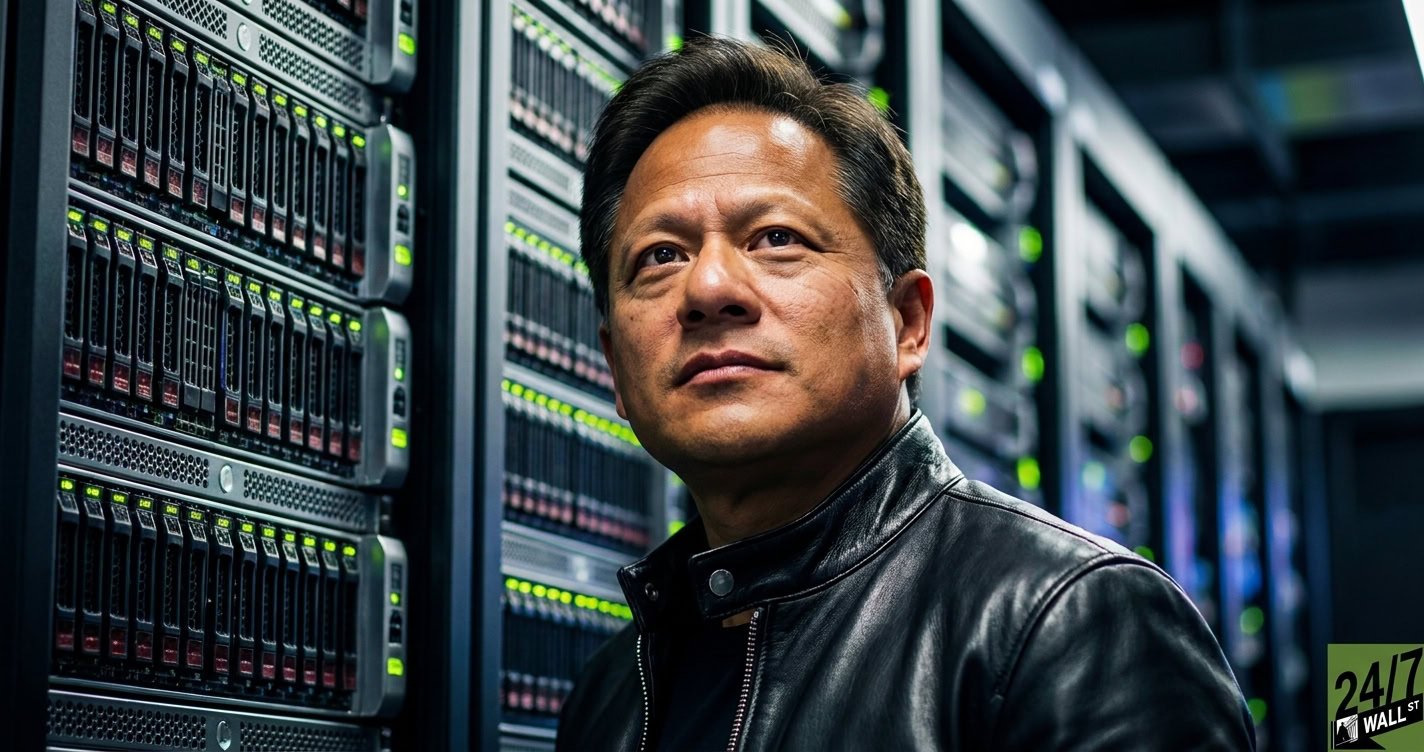
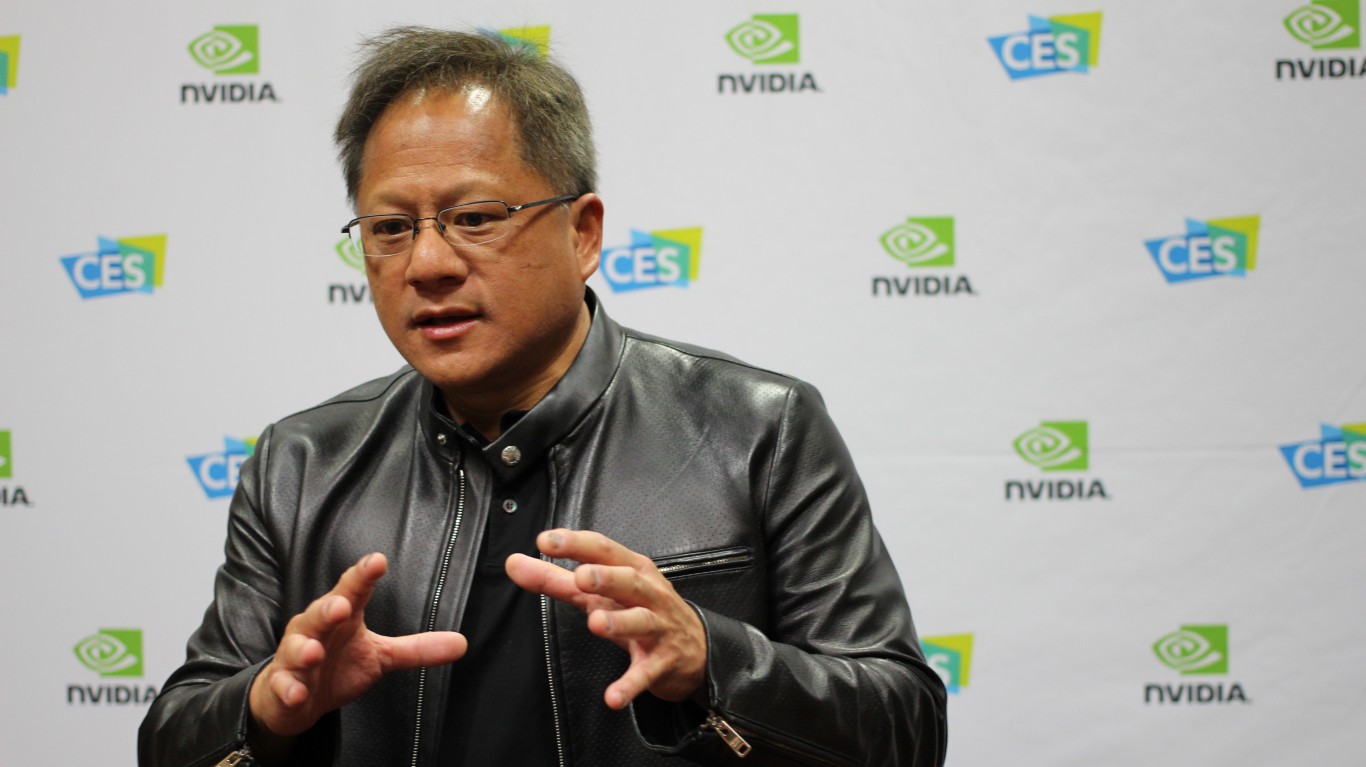
Jensen Huang co-founded Nvidia (NASDAQ: NVDA | NVDA Price Prediction) in 1993 and still owns roughly 3.5% of shares outstanding. He has given no indication that he plans to step down. Yet at a $5.1 trillion market cap, asking what happens to Nvidia without him is a fair governance question.
Why Huang Is an Atypical Semiconductor CEO
Huang narrated the pivot from gaming graphics into accelerated computing and personally evangelized CUDA (Compute Unified Device Architecture) to the developer ecosystem, which became the company’s moat. His framing shapes how the industry talks about demand. On the latest call, he framed the moment this way: “Computing demand is growing exponentially. The agentic AI inflection point has arrived. Grace Blackwell with NVLink is the king of inference today, delivering an order-of-magnitude lower cost per token, and Vera Rubin will extend that leadership even further.” He is also the marketing engine behind multi-gigawatt deployments with Meta, OpenAI, Anthropic, Microsoft, Google Cloud, Oracle, and sovereign AI buyers in the U.K., Saudi Arabia, UAE, South Korea, and Japan.
The Succession Landscape
There is technical and operational depth in Nvidia, but no anointed successor. CFO Colette Kress has been the public financial voice since 2013. Jay Puri leads Worldwide Field Operations after 20-plus years; Debora Shoquist runs Operations. On the research side, Bryan Catanzaro and Ian Buck anchor deep learning and hyperscale GPU computing. No formal succession plan appears in public filings.
The Valuation Risk
The unusual part is what the multiple already assumes. Shares closed most recently at $211.50, up 80.7% over one year and 1,327.9% over five. The trailing P/E is 43, forward P/E 24, and price-to-sales 23. FY2026 revenue reached $215.9 billion (up 65.5%), net income $120.1 billion, free cash flow $96.6 billion. Q4 alone produced $68.1 billion in revenue, with Data Center up 75% to $62.3 billion and networking up 263% to $11.0 billion. Q1 FY27 guidance is $78 billion, excluding any China Data Center compute. Continuity risk exists in three places: the Vera Rubin and Rubin CPX roadmap, CUDA developer evangelism, and sovereign relationships negotiated at head-of-state level.
The Bull Case for Life After Huang
CUDA carries roughly two decades of accumulated developer momentum. The supply book is locked: $95.2 billion in supply commitments and $27 billion in multi-year cloud agreements. Capital return is substantial, with $58.5 billion remaining under buyback authorization after $41.1 billion returned in FY26. Analyst sentiment is overwhelmingly constructive: nine Strong Buy, 48 Buy, two Hold, and one Sell rating, with a consensus target of $269.17. The partner roster, from Microsoft and Google Cloud to OpenAI, Anthropic, Synopsys, Siemens, GM, and Mercedes-Benz, reflects institutional commitments rather than personal ones.
The Verdict
A Huang departure would be both a brand event and a valuation event. That is, it would prompt a fundamental shift in how the company is perceived by its customers, partners, and the public, as well as a sudden, structural change in the stock price and the multiples that investors are willing to pay. Yet, the multiple has room to compress on the news alone, before any fundamentals change. Items to watch include GTC keynote tone, sovereign AI deal cadence, the next CUDA generation’s developer adoption metrics, and whether Kress’s role expands.







 Top Gaining Stocks
 Top Losing Stocks