Could Amazon German Strikes Spread to U.S.?

Photo of Douglas A. McIntyre
By Douglas A. McIntyre Published
This post may contain links from our sponsors and affiliates, and Flywheel Publishing may receive compensation for actions taken through them.

The strikes by Amazon.com Inc. (NASDAQ: AMZN) warehouse workers in Germany are no longer just a pesky problem. The Verdi labor union continues to protest what it believes are low wages. As is often the case with unions, Verdi wants to move to collective bargaining to improve the lot of almost 10,000 warehouse workers. Other Amazon warehouse workers may take a page from the German book. The e-commerce company’s U.S. workers apparently have little leverage either.

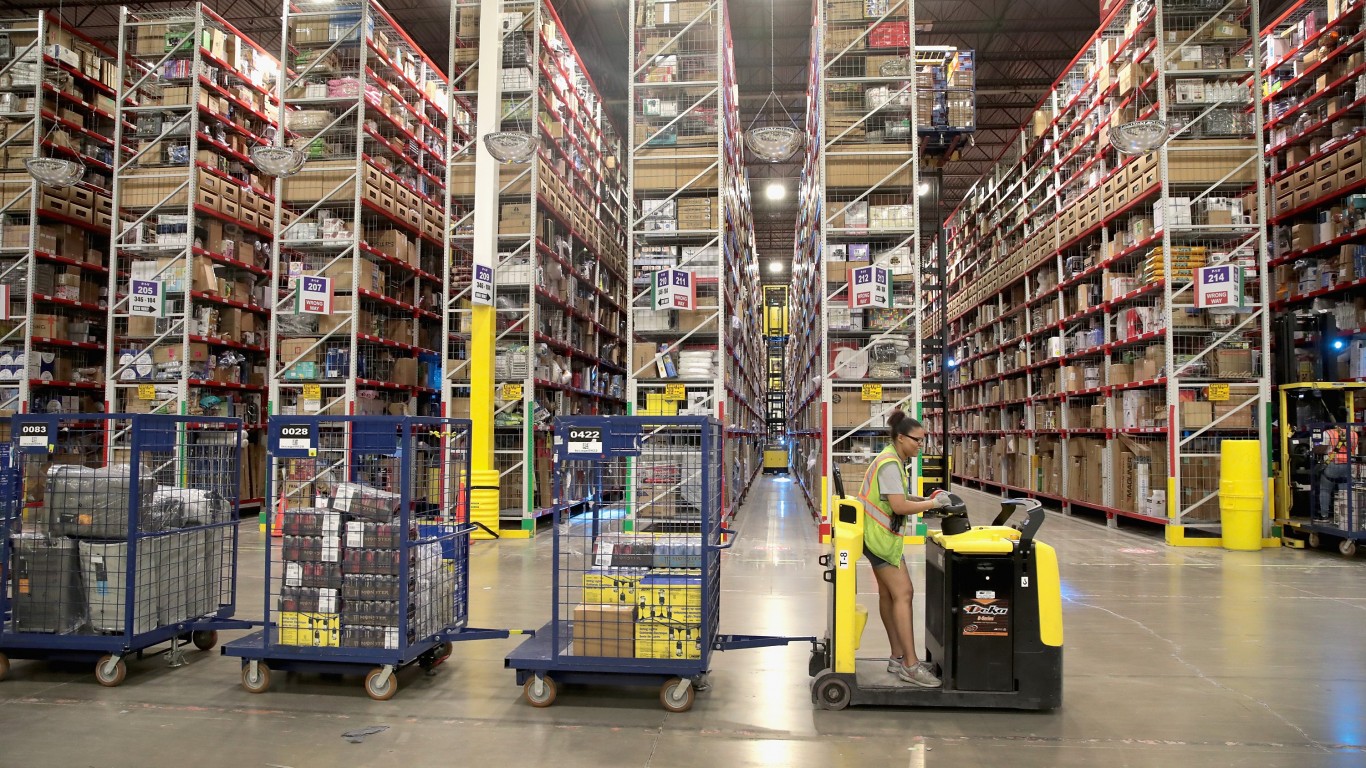
Amazon has spent what many analysts believe is over $2 billion to build warehouses in the United States. The company currently has more than 100 of them. They are part of a hub system that allows Amazon to get merchandise to customers more quickly, and presumably more cheaply. To run these warehouses, analysts estimate the company needs 30,000 workers. One union — the International Association of Machinists and Aerospace Workers — has already moved to add workers at Amazon.

ALSO READ: States With the Strongest Unions

Amazon does not disclose what it pays its warehouse workers, but presumably it is not very much. Many are temporary, which means they are likely paid very low hourly wages. The full-time staff face the fact that warehouse employees are close to a commodity. Skill levels are low, and presumably job candidates plentiful.

So far, most of the effort to get large corporations to raise the minimum wage has been directed at fast-food firms like McDonald’s Corp. (NYSE: MCD) and huge retailers, particularly Wal-Mart Stores Inc. (NYSE: WMT). However, the movement has been savvy in terms of its public relations effort. Amazon is a visible target, not just because of its factory worker population, but also because of its balance sheet. Amazon holds $8.7 billion in cash and cash equivalents.

ALSO READ: States With the Weakest Unions

Many large U.S. companies have effectively kept their workers from organizing and collective bargaining. Amazon is among them. However, the recent action to push the minimum wage higher has not discriminated against companies based on whether their workers are union members. The critical issue is what they paid their lowest paid workers in general. Amazon’s labor problem may be isolated to Germany. However, that could change very quickly.


Photo of Douglas A. McIntyre
About the Author Douglas A. McIntyre →

Douglas A. McIntyre is the co-founder, chief executive officer and editor in chief of 24/7 Wall St. and 24/7 Tempo. He has held these jobs since 2006.

McIntyre has written thousands of articles for 24/7 Wall St. He is an expert on corporate finance, the automotive industry, media companies and international finance. He has edited articles on national demographics, sports, personal income and travel.

His work has been quoted or mentioned in The New York Times, The Wall Street Journal, Los Angeles Times, The Washington Post, NBC News, Time, The New Yorker, HuffPost USA Today, Business Insider, Yahoo, AOL, MarketWatch, The Atlantic, Bloomberg, New York Post, Chicago Tribune, Forbes, The Guardian and many other major publications. McIntyre has been a guest on CNBC, the BBC and television and radio stations across the country.

A magna cum laude graduate of Harvard College, McIntyre also was president of The Harvard Advocate. Founded in 1866, the Advocate is the oldest college publication in the United States.

TheStreet.com, Comps.com and Edgar Online are some of the public companies for which McIntyre served on the board of directors. He was a Vicinity Corporation board member when the company was sold to Microsoft in 2002. He served on the audit committees of some of these companies.

McIntyre has been the CEO of FutureSource, a provider of trading terminals and news to commodities and futures traders. He was president of Switchboard, the online phone directory company. He served as chairman and CEO of On2 Technologies, the video compression company that provided video compression software for Adobe’s Flash. Google bought On2 in 2009.

Featured Reads

Our top personal finance-related articles today. Your wallet will thank you later.

Continue Reading

Top Gaining Stocks

CBOE Vol: 1,568,143
PSKY Vol: 12,285,993
STX Vol: 7,378,346
ORCL Vol: 26,317,675
DDOG Vol: 6,247,779

Top Losing Stocks

LKQ
LKQ Vol: 4,367,433
CLX Vol: 13,260,523
SYK Vol: 4,519,455
MHK Vol: 1,859,865
AMGN Vol: 3,818,618