


Live Nasdaq Composite After-Hours: Tariffs Lead to Massive QQQ Sell Off

Live Updates
Head to Our Thursday Live Blog!
We have a new live blog covering market activity on Thursday. You can visit it by clicking here.
We will be covering all the most important stock market news on what could be a historic Thursday.
Shortly before the market opens, Nasdaq Futures are down 4.64%, S&P Futures are down 3.83%, and Dow Futures are down 3.1%.
Morning Check In
The Stock Market is set to open in about 45 minutes. Let’s look at where most major indexes are at 8:45 a.m. ET.
- Nasdaq Futures: -4.00%
- S&P 500 Futures: -3.39%
- Dow Futures: -2.83%
Overseas Markets Struggling As Well
Japan’s Nikkei Index is down about 4.45% in premarket trading. It’s hardly the only foreign market that’s expected to see pain tomorrow.
For example, the VanEck Vietnam ETF (BATS: VNM) is down 8.3% in after-hours trading. The iShares MSCI China ETF is down 3.2%.
How Did Trump Calculate Tariffs Charged to the U.S.?
Trump’s tariff press conference included tariff rates charged to the United States that are significantly higher than most calculations. For example, Trump said China is charging 67% tariffs on the U.S., and the European Union charges 39% tariffs.
These rates came with the nebulous asterisk that they included ‘Currency Manipulation and Trade Barrier Costs.‘
Market observers have been trying to figure out where these numbers came from, but it appears we have an answer.
The chart below comes from Twitter user Ben Hunt (link here) and shows how the formula ‘Trade Deficit / U.S. Imports almost exactly equals the tariffs Trump claimed each country is charging the United States. You can see this calculation below:
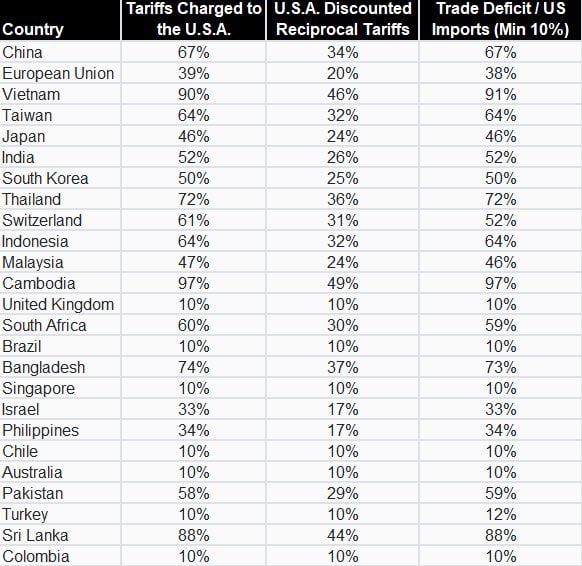
We posted the weighted tariff rates of most developed countries below and they typically fall in the 1-2% range. This explains why Trump’s reciprocal tariffs are so much higher than the actual tariffs any country charges.
Index Check at 6:45 p.m. ET
Let’s check where futures stand at 6:45 p.m. ET:
- Dow Jones: -938.00 (-2.21%)
- S&P Futures: -188.25 (-3.30%)
- Nasdaq Futures: -820.25 (-4.20%)
Dow Futures have briefly sunk below 1,000 points but have rebounded slightly. As we’ve noted in this live blog, the strongest selling is ‘risk-off’ impacting technology and growth stocks.
Amazon (Nasdaq: AMZN) is currently down 6%, Apple (Nasdaq: AAPL) down 7.1%), NVIDIA (Nasdaq: NVDA) down 4.7%, Tesla (Nasdaq: TSLA) down 6.1%, Meta (Nasdaq: META) down 4.8%, and Microsoft (Nasdaq: MSFT) is down 2.9%.
Earlier tonight, Treasury Secretary said “the equity market selloff is a Mag 7 problem, not a MAGA problem,” which is likely adding even more selling pressure to large stocks beyond tariff headlines.
How Big Are the Tariffs Announced Tonight?
Estimates are coming out on how large tonight’s tariffs might be.
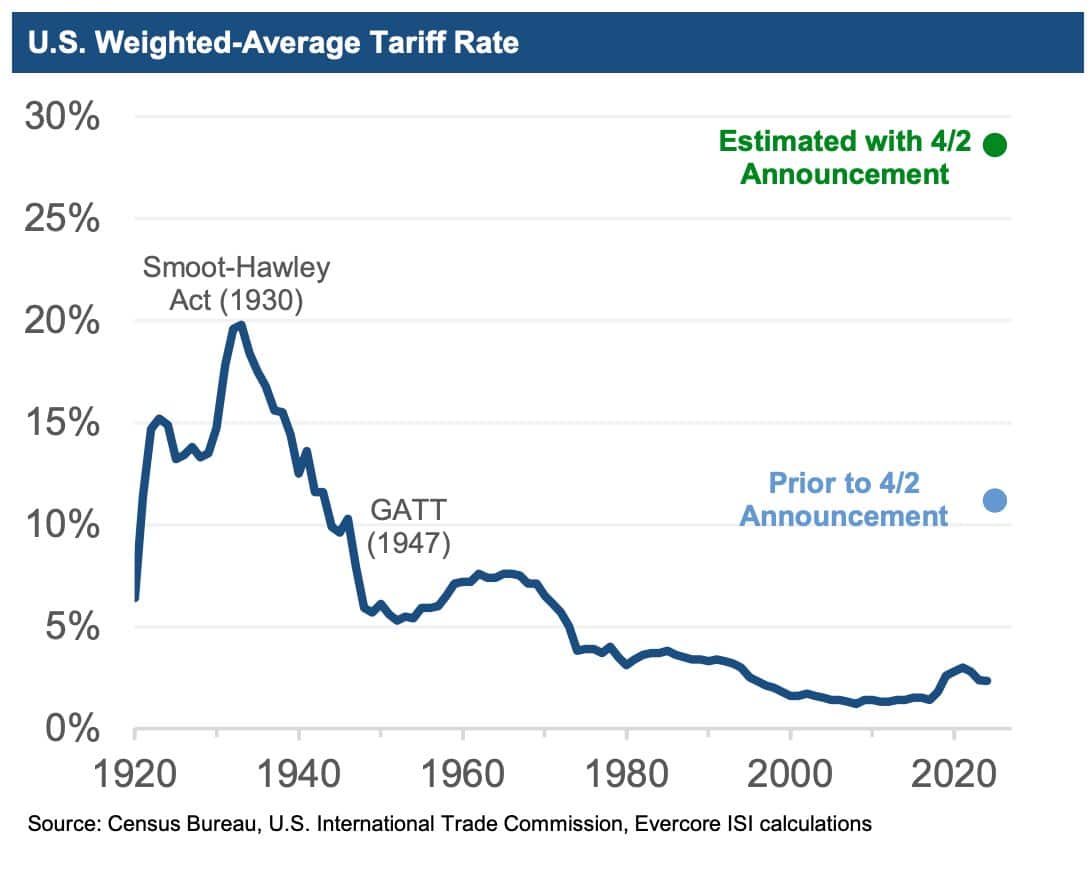
Evercore/ISI is estimating that the weighted-average tariff rate would be 29% after tonight’s tariff announcements. Prior to the announcements tonight, the weighted-average tariff rate was just over 10%.
How would a blended rate of 29% compare? The highest tariff rate in the past 100 years was about 20% after the passing of the Smoot-Hawley Act in 1930. You can see EvercoreISI’s chart below.
Of course, we’ll see what rates are actually charged and how much of tonight’s announcement is a negotiating tactic in the weeks to come.
Odds of Recession Are Soaring in Prediction Markets
One ‘easy’ way to see how above consensus expectations these tariffs were is the odds of a recession in prediction markets.
For example, Polymarket – which famously outperformed pollsters in predicting Trump’s appeal headed into the 2024 election – has seen the odds of a US recession rise from less than 40% to 48% following the announcement of reciprocal tariffs.
Why are the odds of a recession rising? There are a few key factors.
First, companies may slow investments as they try to navigate how long tariffs will last and what their long-term spending plans look like.
Second, tariffs are generally considered inflationary. If inflation rises, that decreases the chance of the Federal Reserve continuing to cut rates.
Third, tariffs are also expected to decrease overall trade which will slow the economy, potentially leading to negative growth rates.
How Big Could Tomorrow's Sell Off Get?
As of 6:20 p.m. ET, the Invesco QQQ Trust which tracks the Nasdaq is now down 4.6% after hours. An hour ago, the ETF was down 3.4%.
If the selling continues, there could be a 5% (or larger) sell off in the Nasdaq. As we noted earlier, risk assets are taking the brunt of selling activity as investors flee to safety.
How Do U.S. Tariffs Compare?
How will U.S. tariffs compare to other countries if the reciprocal tariffs announced today go into effect? Here’s a selection of blended tariff rates on imports for countries around the world according to the World Bank:
- Australia: 1.0%
- Sweden: 1.3%
- Canada: 1.4%
- United States (Previously): 1.5%
- Israel: 2.8%
- United Kingdom: 3.1%
- South Korea: 8.6%
As you can see, if these tariffs go into effect they would put the United States significantly beyond any other industrialized economy.
Stocks Seeing the Biggest Declines
What stocks are seeing the biggest declines after tonight’s tariff announcements? Here are a few of the most notable names:
- Apple (Nasdaq: AAPL): Down 5.6% due to tariffs on China coming in above expectations.
- Crocs (Nasdaq: CROX): Down 10.8% as the company produces its shoes in Vietnam, a country that had 46% tariffs leveled on it.
- Nike (NYSE: NKE): Down 7% after hours. The company is another tariff ‘loser’ impacted by the steep rates on Vietnam.
Some industries were exempted from reciprocal tariffs like semiconductors. That exemption has led to more muted selling in stocks like NVIDIA (Nasdaq: NVDA). However, NVDIA is still down 3.4% after hours as the Trump Administration has said they’re still considering industry tariffs that could impact the company.
After weeks of market selling on fears that Donald Trump’s tariff proposals would push the United States economy into a recession, the Administration announced their tariff policies in an event branded ‘Liberation Day.’
The headline is that reciprocal tariffs range from 10% on countries like Singapore all the way up past 50% for other countries. For example, China now faces a 34% reciprocal tariff. The administration is quoting tariffs for other countries that include ‘currency manipulation and trade barriers’ and then applying roughly half the rate of that number.
Here’s a table with some selected countries:
| Country | Tariffs Charged to U.S. (As reported by President Trump and including currency manipulation and trade barriers) | U.S.A. discounted reciprocal tariffs |
| China | 67% | 34% |
| Japan | 46% | 24% |
| Singapore | 10% | 10% |
| Sri Lanka | 88% | 44% |
| Israel | 33% | 17% |
A couple of notes:
- Many companies aren’t listed in reciprocal tariffs. For example, neither Canada nor Mexico is listed.
- The tariffs are additive to previously announced tariffs. So China’s 34% is actually now a 54% rate because Donald Trump had previously announced a 20% tariff on imports.
- The tariffs charged to the United States figure in the above table is self-reported from the Trump Administration. Actual tariff rates from most countries listed are dramatically smaller, so it’s likely the Trump Administration is leaning heavily into currency manipulation and trade barriers to reach the reported numbers.
- Tariffs go into effect on April 9th.
- Other tariffs announced include 25% tariffs on auto imports that will begin at 12:01 a.m. Thursday.
How Are Markets Reacting
As of 5:25 p.m. ET, futures are falling after the announcement of tariffs. Selling is more ‘risk off’ with technology stocks and other riskier stocks being sold first.
- Dow Futures: Implied -.49% open
- S&P Futures: Implied -1.58% open
- Nasdaq: Implied -2.31% open
In addition, many popular ETFs are down even more than futures imply. The Invesco QQQ Trust (Nasdaq: QQQ) is down 3.43%.
Why are markets selling off? Simply put, the size of these tariffs is beyond expectations. Many market participants had hoped for something closer to a 10% tariff, which would have led to a market rally tomorrow.
However, the size of these tariffs shows that tariffs will remain a primary storyline throughout this year. It also increases risks related to the United States entering a recession and seeing inflation rise, which would limit the monetary responses from the Federal Reserve.
We’ll continue following the market’s reaction in this live blog.


Eric Bleeker has been investing for more than 20 years. He began his career working at Microsoft before joining Motley Fool, one of the largest publishers of financial research. In his 15 years at Motley Fool Eric served as the General Manager for Fool.com and led coverage in the Technology & Telecom sector. In addition, he was a featured columnist and has hosted dozens of investing seminars attended by more than a million total investors. Eric has more than 1,000 financial bylines to his name and has been featured in The Wall Street Journal, CNBC, Fox Business, and many other leading publications. He is currently focused on artificial intelligence investing and is a CFA Charterholoder.
© Canva





 Top Gaining Stocks
 Top Losing Stocks