


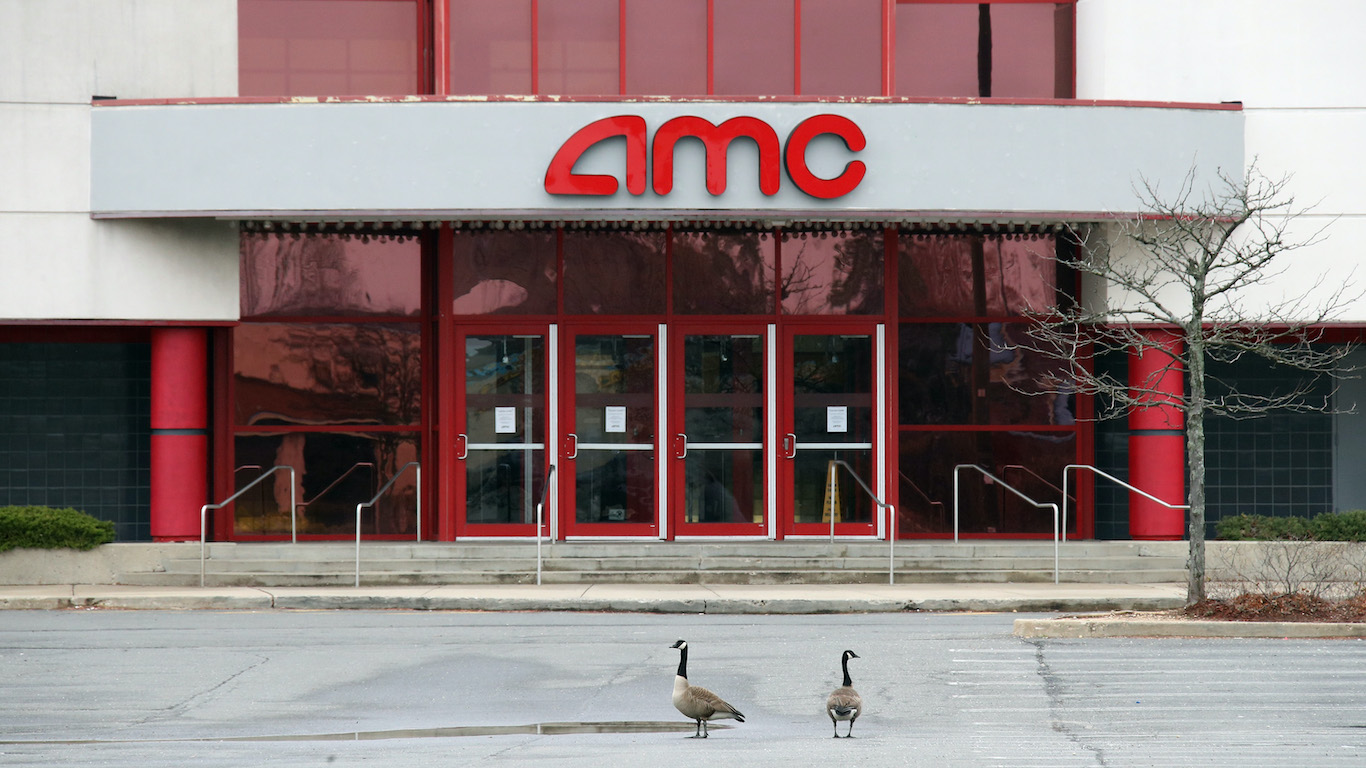
The middle of a pandemic when most movie theaters are closed or at least not drawing much in the way of crowds may seem like a good time for consolidation of the theater business. That might have been true even last year, but COVID-19 has changed the landscape.
That’s why a report last Friday in the New York Post seems hard to believe. The paper reported that theater operator Cinemark Holdings Inc. (NYSE: CNK) is interested in taking over some leases currently held by AMC Entertainment Holdings Inc. (NYSE: AMC) in the event that AMC defaults on its lease obligations.
Also on Friday, AMC announced that it had received a commitment for a $100 million cash/payment-in-kind first-lien secured note from Mudrick Capital Management, a firm that specializes in distressed debt investing. AMC will pay interest in cash of 15%, or payment-in-kind of 17%, on any funds it withdraws.
On the same busy Friday, AMC also filed a prospectus with the U.S. Securities and Exchange Commission for an at-the-market offering of some 178 million shares through an equity distribution agreement with Goldman Sachs and B. Riley. AMC stock closed down more than 4% on Friday at $3.92.
[nativounit]
On top of all that, AMC is under heavy pressure from Apollo Global Management and other debt holders to file for Chapter 11 bankruptcy protection. Apollo, along with Canyon Capital Advisors and Davidson Kempner Capital Management, reportedly has offered the theater owner $1 billion of debtor-in-possession financing.
The $100 million note for Mudrick will meet AMC’s cash needs only through January. The company has said it will need an additional $750 million in cash to remain open through all of 2021. AMC has already pushed on some $40 million in rent payments and other obligations to its landlords.
All this activity is based on the idea that once the pandemic is brought under control, the movie business will return to the status quo ante. How realistic is that? WarnerMedia, the movie division of AT&T Inc. (NYSE: T | T Price Prediction), has already announced that its 17 new movies for 2021 will be released simultaneously in theaters and on its HBO Max streaming service, regardless of whether the pandemic is squashed.
The big question for movie theater operators is whether consumers will return to theaters, or will they be happy to stay at home and watch first releases on their 65-inch TV screens? Theater box office is down 80% to 90% this year, and there is little chance that a full recovery will materialize in 2021.
According to last year’s annual report by the Motion Picture Association, theatrical ticket sales in the U.S. totaled $11.4 billion. The market for digital entertainment totaled $20.5 billion. Over the five-year period between 2015 and 2019, the market for theatrical entertainment grew by 2% and the market for digital home and mobile entertainment rose by 40%.
WarnerMedia’s decision to release new movies simultaneously on HBO Max may mark the beginning of the end for movie theaters. While AT&T’s marketing of HBO Max has been a jumble, the new streaming service managed to gather U.S. 12.6 million subscribers as of early December and is targeting 50 million U.S. subscribers by 2025.
To juice subscriber numbers, HBO Max is offering a six-month subscription for $12 a month, a discount of 20% to the standard price of $15 a month. If AT&T takes the plunge and lowers its regular rate to $12 a month, including a commitment to simultaneous releases, AMC and Cinemark will be that much closer to extinction.
The future of movie houses depends on the number of people willing to pay more than $9 a ticket to sit in a movie theater at a specified time with some inconvenience when watching the same movie at home will be free with a subscription to the right streaming service. If theater owners think they have something to offer that consumers really want, they need to look hard at music labels that thought consumers would always buy CDs instead of switching to streaming music services.
AMC stock traded down nearly 20% in early trading Monday, at $3.15 in a 52-week range of $1.95 to $8.78. The price target on the stock is $2.15.
Cinemark shares traded down nearly 6% to $15.34, in a 52-week range of $5.71 to $35.74. The stock’s price target is $14.50.
[recirclink id=824523][wallst_email_signup]












 Top Gaining Stocks
 Top Losing Stocks