



If you’re thinking about withdrawing $10,000 in cash from your checking account to play blackjack during your week-long trip to Las Vegas, you might want to know what happens when you do.
The Bank Secrecy Act was passed by Congress in 1970 to fight money laundering in the U.S. Under the Act, financial institutions are required to report cash transactions over $10,000. The form filed with the Financial Crimes Enforcement Network (FinCEN) is called a Currency Transaction Report (CTR).
Here’s what will happen when you go to your bank to withdraw $10,000 or more.
Could Trigger a Federal Report
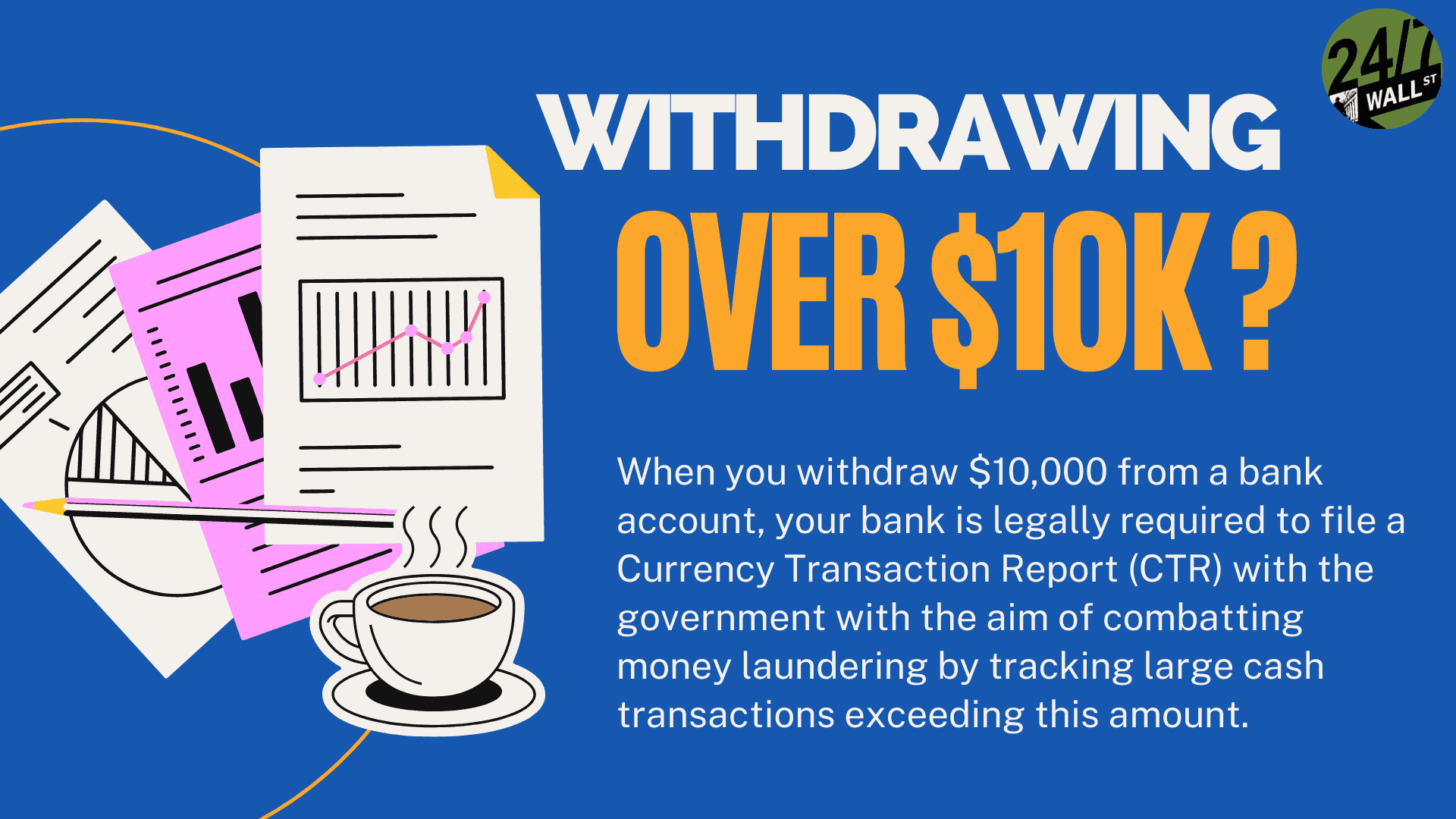
Importantly, it’s best to avoid splitting the withdrawal into two parts to fall below the $10,000 minimum because that action will raise suspicion unnecessarily. The CTR is generally a formality.
However, plan to keep receipts for money spent at the casino or wherever you plan to use the funds so that you have a paper trail at tax time should the Internal Revenue Service have more questions.
It also helps to speak to an employee of your bank before you withdraw $10,000 or more so that they’ll have the funds on hand and can complete the form ahead of time.
Possible Delay Scenarios

As mentioned in the previous section, a common (minimal) delay is for bank employees to fill out the paperwork.
However, it’s important to be aware of these other scenarios in which you could experience delays in receiving your cash because of the size of your withdrawal.
First, your bank may ask for additional identification verification beyond what you’ve already provided. A withdrawal of $10,000 or more is likely to draw attention, especially if the account doesn’t normally experience such activity. To save time, ensure you have the proper ID.
Depending on the type of account you’re withdrawing the funds from, where there could be daily limits, etc., that prevent you from obtaining the entire amount immediately.
Lastly, and this might seem like an obvious one, do ensure you have the funds available in the account for withdrawal. In addition, if you don’t have overdraft protection, and you try to withdraw the funds, your request will be denied.
The Personal Finance Angle

In addition to the legal aspects of withdrawing $10,000 or more from your bank, there are practical personal finance issues to consider. If you withdraw $10,000 from your bank account, bringing your balance below the minimum required for the account, you could be assessed fees and/or penalties.
Further, you could lose out on significant interest if the funds are from a high-interest savings account. For example, if you put $10,000 into a SoFi High-Yield Savings Account at 4.55% interest, you would earn $1,411.66 in interest over three years, assuming the interest rate remained the same and your initial $10,000 deposit was untouched.
Lastly, if the $10,000 was part of a larger emergency fund—some financial experts recommend three to six months’ living expenses—you could be jeopardizing your financial well-being.
These are just a few things to consider when planning a large cash withdrawal.















 Top Gaining Stocks
 Top Losing Stocks