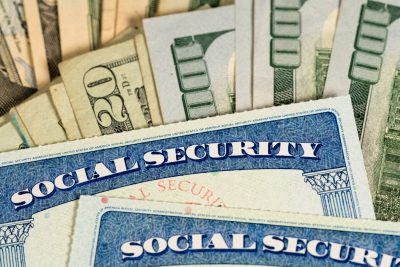
If You’re Rich, You May Not Get Social Security

Photo of Douglas A. McIntyre
By Douglas A. McIntyre Published

Quick Read

  • The Social Security Administration says it may run out of money.

  • The options to avoid this include reducing the benefits paid to affluent Americans.

This post may contain links from our sponsors and affiliates, and Flywheel Publishing may receive compensation for actions taken through them.
If You’re Rich, You May Not Get Social Security

© Deagreez / iStock via Getty Images

The Social Security Administration says it may run out of money in 2033. At that point, its management says the money it has available will be “sufficient to pay 79 percent of scheduled benefits.” Without an act of Congress, it is hard to say how this can be avoided. One solution is not paying people with high incomes or lowering their benefits.

If Social Security is to be paid at current levels, in addition to cost-of-living increases, the options to keep benefits at 100% are small. One is to raise the age at which people can get benefits by two years. For those who want payments when they are 62, the age would be pushed to 64. Those who plan to get their benefits at 70 would have to wait until 72.

The Congressional Budget Office has raised an alarm about paying benefits later. In a new report, it calls Social Security payments a “promise we cannot break”

The Wealth Argument

Andrew Burton / Getty Images News via Getty Images

Limiting Social Security benefits to the wealthy.

So what choices are left beyond lowering payments or pushing out the age at which people can pay them? Former New Jersey Governor Chris Christie gave his opinion in a presidential debate in 2023. He said Social Security was created to support people with low incomes. The rich, like Warren Buffett, should not be paid at all.

The “rich” argument raises several questions and controversies. The first is whether the measure of the rich should apply to passive income or to what people make when they are working as they hit the age of Social Security payout. Buffett has a paying job, so he should not get money at all.

Another question is whether people who have high incomes should get reduced benefits instead of losing them completely. The IRS, most likely, would need to collect the appropriate income data. And the payouts from Social Security would be tiered.

High earners who want to fight back against the idea of eliminating or reducing benefits have a simple counterargument. They paid into Social Security, and often paid for decades. They should get that money back no matter how much they make.

Eventually, Congress has to decide, even if that decision is to do nothing. If they do nothing, payments to the rich will be unaffected.

The 8 Most Common Money-Saving Moves Americans Plan to Do If Social Security Runs Out

Photo of Douglas A. McIntyre
About the Author Douglas A. McIntyre →

Douglas A. McIntyre is the co-founder, chief executive officer and editor in chief of 24/7 Wall St. and 24/7 Tempo. He has held these jobs since 2006.

McIntyre has written thousands of articles for 24/7 Wall St. He is an expert on corporate finance, the automotive industry, media companies and international finance. He has edited articles on national demographics, sports, personal income and travel.

His work has been quoted or mentioned in The New York Times, The Wall Street Journal, Los Angeles Times, The Washington Post, NBC News, Time, The New Yorker, HuffPost USA Today, Business Insider, Yahoo, AOL, MarketWatch, The Atlantic, Bloomberg, New York Post, Chicago Tribune, Forbes, The Guardian and many other major publications. McIntyre has been a guest on CNBC, the BBC and television and radio stations across the country.

A magna cum laude graduate of Harvard College, McIntyre also was president of The Harvard Advocate. Founded in 1866, the Advocate is the oldest college publication in the United States.

TheStreet.com, Comps.com and Edgar Online are some of the public companies for which McIntyre served on the board of directors. He was a Vicinity Corporation board member when the company was sold to Microsoft in 2002. He served on the audit committees of some of these companies.

McIntyre has been the CEO of FutureSource, a provider of trading terminals and news to commodities and futures traders. He was president of Switchboard, the online phone directory company. He served as chairman and CEO of On2 Technologies, the video compression company that provided video compression software for Adobe’s Flash. Google bought On2 in 2009.

Continue Reading

Top Gaining Stocks

CBOE Vol: 1,568,143
PSKY Vol: 12,285,993
STX Vol: 7,378,346
ORCL Vol: 26,317,675
DDOG Vol: 6,247,779

Top Losing Stocks

LKQ
LKQ Vol: 4,367,433
CLX Vol: 13,260,523
SYK Vol: 4,519,455
MHK Vol: 1,859,865
AMGN Vol: 3,818,618