



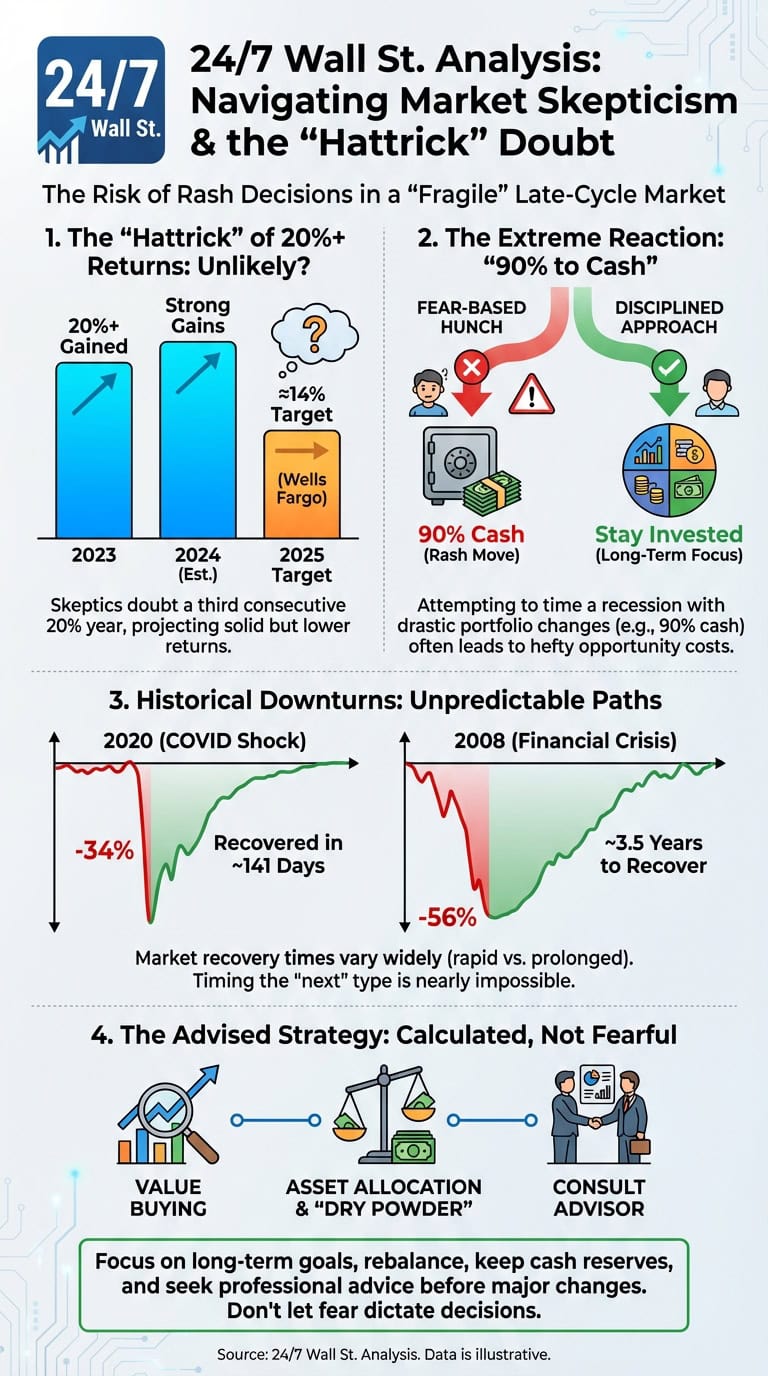
Some pundits and skeptics have serious doubts about the S&P 500’s ability to pull off the hattrick of 20% return years. Wells Fargo (NYSE:WFC | WFC Price Prediction) senior market strategist Scott Wren thinks that such a so-called “three-peat” is probably off the table, with a 6,800 target for 2025, which entails a return closer to 14%. Indeed, that’s still a pretty solid return, even if it doesn’t stack up to the previous two years.
As we head toward 2026, those doubts are getting louder, and expectations are rising just as fast, creating a market backdrop that feels both extended and fragile.
In this piece, we’ll examine the case of an individual who’s nervous about the market’s next steps, to say the least. The person who posted on r/fatFIRE thinks a recession is coming and wants to convert around 90% of their 401(k) into cash. That’s an extreme reaction on a hunch if you ask me.
And one that I wouldn’t advise unless something significant has changed with their personal financial situation (let’s say unexpected medical bills or any other expense that came from out of left field). Either way, if one needs the cash in a hurry to be ready for retirement, a financial advisor should be consulted before making any such rash decisions, especially those based on fear.
Heading into 2026, that discipline matters more than ever, as emotional decisions in late-cycle environments tend to have outsized consequences.
The stock market had a run. It’s okay to be skeptical.
Either way, I think it’s a bad idea to time the markets and conclude that 2026 will be a weak year just because the past few years were some of the best years we’ve had in recent memory. Looking at the three-year span, the pace of gains looks incredibly unsustainable unless, of course, it’s to end in some sort of painful correction, bear market, or bursting of the bubble of sorts. And while there’s no denying the momentum investors have enjoyed in the past few years, I do think that the magnitude of longer-term momentum largely depends on the timeframe you’re looking at.
Indeed, the past three years have seen a blistering market run that may mirror the run of the late 1990s. Stop me if you’ve heard someone saying this AI-driven rally reminds them of 1997, 1998, or even 1999. Since January 1, 2022 the market has risen 44%, but some legendary investors are fearful, including Warren Buffett whose Berkshire Hathaway recently sold tech shares and has amassed $360 billion in government T-bills.
Be more calculated, and don’t make moves when feeling fearful.
Either way, I wouldn’t make any rash decisions with your portfolio at this juncture just because you think a correction will eventually hit. By their nature, recessions and their timing are incredibly difficult to predict, even for seasoned economists. Even if one times the recession with precision, who knows how the stock market will even react? At the end of the day, the stock market is not the economy.
History also shows that not all downturns follow the same path. Rapid shocks like the 34 percent drop in 2020 recovered in about 141 days, while deeper crises like the 56 percent decline in 2008 took nearly three and a half years. Timing which type of downturn will happen next is close to impossible.
Does that mean one should be fully invested with the expectation of another 20% return year?
Of course not. Instead, investors should be investing for the long haul and strive to buy value where it can be found while offloading securities that are overvalued at any given time. With the right asset allocation and some dry powder for when the sell-off does finally hit, I do think investors need not resort to extreme moves such as liquidating all or most of their portfolios.
The bottom line
Timing the market is not advisable, even after a hot two-year run for the S&P 500. If your life circumstances change and you need the money, contact an advisor and take some profits off the table. As for making moves on recession hunches, I understand the hefty opportunity costs of doing so.












 Top Gaining Stocks
 Top Losing Stocks