



The nice thing about Social Security is that you can choose when to sign up for benefits. If you wait until full retirement age (FRA), you’ll get your complete monthly benefit without a reduction. If you file sooner, which you can do once you turn 62, your monthly benefit will be reduced.
There’s also the option to delay your Social Security claim past FRA for a larger monthly benefit. Specifically, for each month you hold off, your benefit grows about 2/3 of 1%. This amounts to an 8% boost for each year you delay your claim.
Unfortunately, Social Security won’t give you credit indefinitely for waiting to file. Once you turn 70, your monthly benefit won’t grow anymore, so it doesn’t pay to wait to file past that point.
But still, delaying Social Security could mean locking in a more generous monthly benefit for life. And here are three scenarios where it pays to wait.
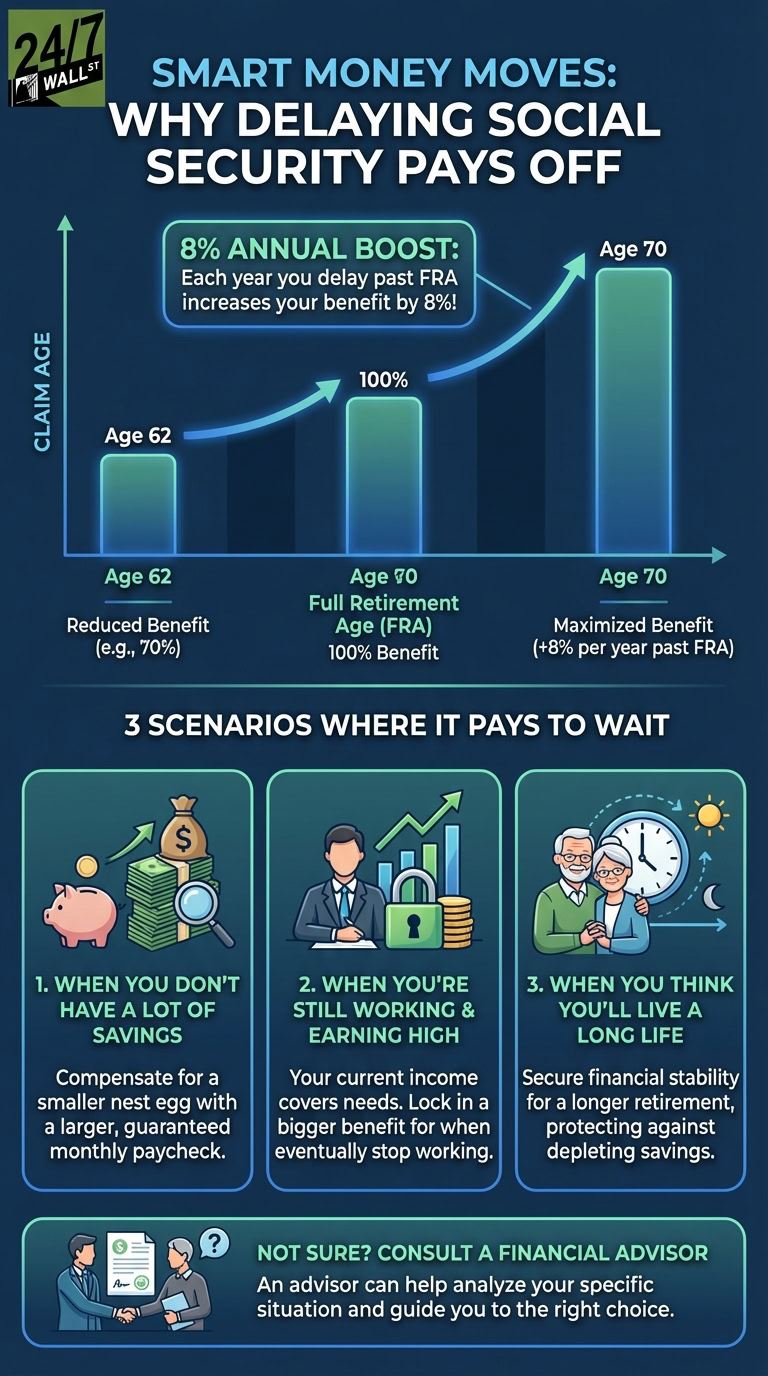
1. When you don’t have a lot of savings
Some people enter retirement with a few million dollars. Others barely manage to save anything at all.
If you’re closer to the latter camp, where you either don’t have savings or don’t have much, then delaying Social Security makes sense. Doing so gives you a larger paycheck to help compensate for a smaller nest egg.
2. When you’re still working and earning a lot of money
Some people retire in their early 60s because they grow tired of the daily grind and feel they can’t keep pushing. But some people work until age 70 or even beyond because they love what they do and their large paychecks make it worth it.
If you’re still working at FRA and earning a nice amount of money, your Social Security check probably won’t change your near-term finances. So in that case, you might as well keep plugging away at your job and wait on Social Security to lock in a larger monthly benefit for when you do stop working.
3. When you think you’ll live a long life
The upside of living a long life is getting to enjoy more time on the planet. The downside, though, is increasing your risk of running out of money.
But a delayed Social Security claim can help by giving you a larger benefit each month. That way, if your savings do get depleted, you’ll at least have a guaranteed monthly paycheck that’s more generous.
Of course, it’s pretty much impossible to predict how long you’ll live with certainty. But if you have a family history of longevity and you’re in very good health as your FRA approaches, it’s a sign that a longer life may be in your future. In that case, it could pay to delay Social Security and give yourself more money each month — and the peace of mind that comes with that.
If you’re not sure whether delaying Social Security makes sense for you, consult a financial advisor and get their input. An advisor can help you look at the decision from different angles and help you reach a choice you’re comfortable with.












 Top Gaining Stocks
 Top Losing Stocks