



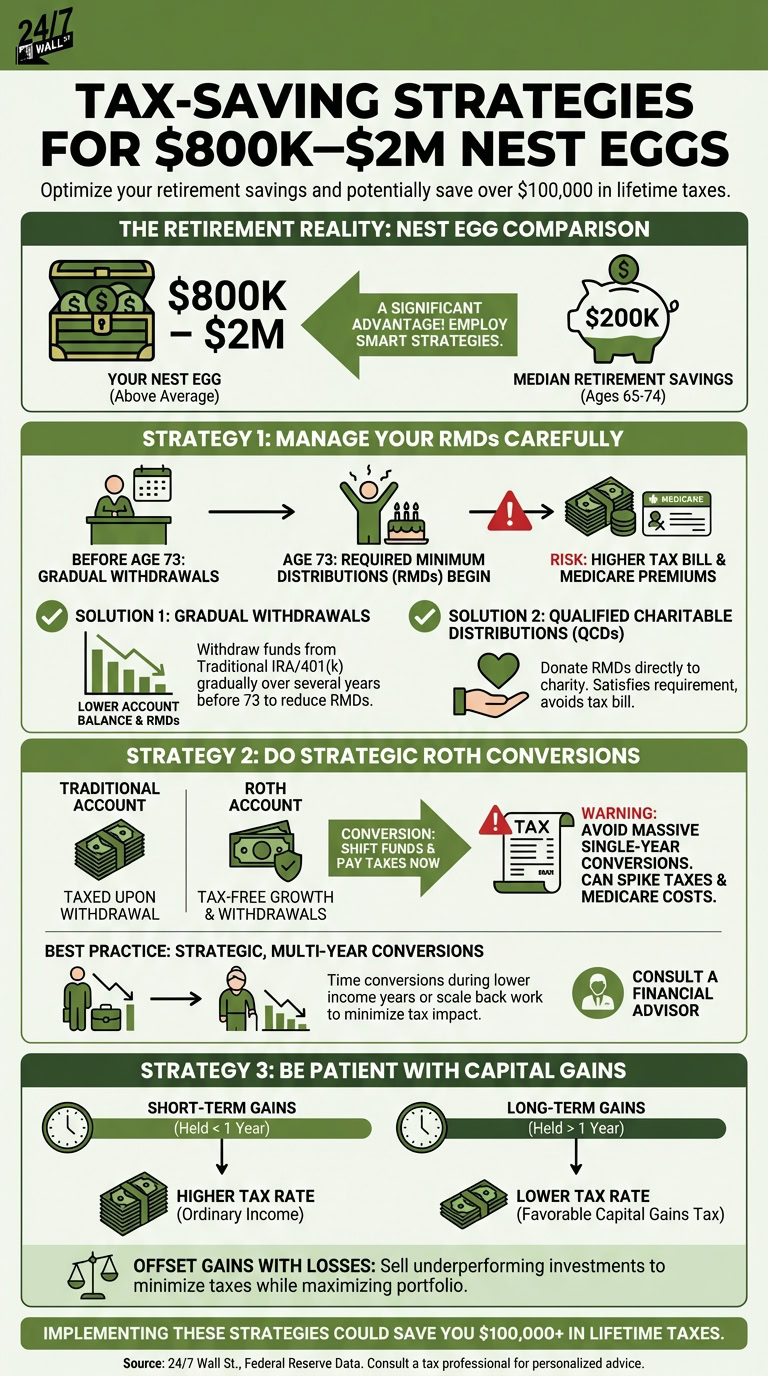
If you’ve built a retirement nest egg between $800,000 and $2 million, congratulations — you’re probably in a much better position than many of your peers.
The Federal Reserve puts median retirement savings for Americans ages 65 to 74 at just $200,000 as of 2022, the last year for which there’s data available. Even if we adjust that figure upward to account for a few years of market gains, it doesn’t come close to an $800,000 to $2 million nest egg.
But if you’re retiring with that level of savings, it’s important to employ the right tax strategies so you don’t end up overpaying the IRS. These three strategies could save you more than $100,000 in lifetime taxes — if you do them right.
Manage your RMDs carefully
If you’re retiring with $800,000 to $2 million, it likely means that you were a pretty high earner during your career. If so, it probably made more financial sense to fund a traditional retirement account than a Roth due to your tax bracket.
The problem with traditional retirement accounts, though, is that once you turn 73, you have to start taking required minimum distributions, or RMDs. Those RMDs could jack up your tax bill, not to mention have other consequences, like driving up your Medicare premiums.
The good news is that you can take steps to minimize the tax blow of RMDs. For one thing, you can gradually withdraw funds from a traditional IRA or 401(k) over several years before you turn 73 to lower your account balances and associated RMDs.
You can also donate your RMDs to charity directly via qualified charitable distributions. Doing so spares you a tax bill while satisfying your RMD requirement.
Do strategic Roth conversions
The more money you have in Roth retirement accounts going into retirement, the less taxable income you may have to worry about later on. It’s a good idea to do Roth conversions ahead of retirement to minimize your future tax bill. But you also have to time those conversions carefully.
Doing a massive conversion in a single year could cause your tax bill to spike. And depending on your age, it could also put you at risk of other consequences, like higher Medicare costs due to a sudden increase in your income.
A better bet is generally to work with a financial advisor or tax professional to do Roth conversions over the course of several years. If you scale back on work later in your career, leading to a lower income, that could be a good time to start doing conversions.
Be patient with taking gains in taxable accounts
You may have money in taxable investment accounts as part of your retirement nest egg. Capturing gains strategically could leave you on the hook for much lower taxes.
Long-term capital gains are taxed far more favorably than short-term gains. To get into the long-term category, you need to hold investments for at least a year and a day before unloading them.
If you can’t wait that long to take capital gains, you can also try offsetting those gains with losses. The key is to pay the IRS as little tax as possible while maximizing your portfolio.














 Top Gaining Stocks
 Top Losing Stocks