



A million dollars sounds like the finish line. For dividend investors in 2026, it is the starting point for a specific question: how much income does it generate, and is that enough to live on?
The answer depends entirely on where you put it. At the four major dividend ETFs most income investors consider, $1 million in Schwab U.S. Dividend Equity ETF (NYSEARCA:SCHD | SCHD Price Prediction) produces roughly $33,900 per year at its current 3.4% yield. That is not retirement income for most Americans. Understanding the gap, and how to close it, is the actual challenge.
The Three Yield Tiers and What They Cost You
Every dividend income strategy lives in one of three yield bands. Each solves the capital problem differently and creates a different set of risks.
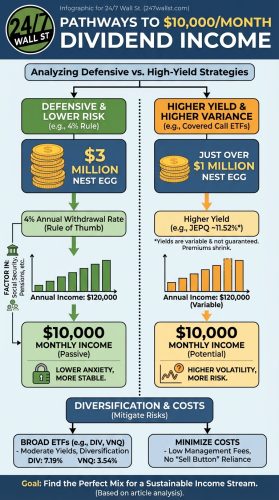
Conservative tier: 3% to 4% yield. This is the dividend growth range, anchored by broad equity funds holding blue-chip payers. SCHD at 3.4% and iShares Select Dividend ETF (NYSEARCA:DVY) at 3.8% sit here. At 3.5%, $1 million generates approximately $35,000 in annual income. At 4%, it generates $40,000.
The portfolio is diversified, underlying companies have long histories of raising dividends, and principal tends to appreciate over time. SCHD has returned 225% over the past ten years. DVY has returned 172% over the same period. You need more capital upfront, but the income stream is the most durable.
Moderate tier: 5% to 7% yield. This is where high-dividend equity funds and REITs operate. SPDR Portfolio S&P 500 High Dividend ETF (NYSEARCA:SPYD) yields 4.7%, generating roughly $47,200 annually on a $1 million investment. Covered call equity strategies and preferred share funds target 6% to 7%. At 6%, $1 million produces approximately $60,000 per year.
Dividend growth slows considerably here. SPYD’s heavy weighting toward real estate (22%), financials (17%), and consumer staples (16%) means income is real but the portfolio leans on sectors where payouts are sensitive to rate cycles. Covered call strategies also cap price upside in exchange for premium income.
Aggressive tier: 8% to 14% yield. Leveraged covered call funds, business development companies, and mortgage REITs occupy this space. Covered call ETFs in this category currently yield in the 11% to 12% range. At 10%, $1 million produces $100,000 per year. At 12%, it generates $120,000.
The cost is principal stability. These structures often distribute capital alongside income, meaning the fund’s net asset value can erode over time even as the yield looks attractive. The income is real today. Whether it remains real in ten years depends on market conditions and the fund’s ability to sustain distributions.
Why the Lower Yield Often Wins Over Time
A 3.5% yield that grows at 8% annually doubles the income in roughly nine years. On a $1 million investment, that means starting at $35,000 per year and reaching approximately $70,000 per year by year nine, without adding capital. SCHD’s dividend history illustrates this: the fund paid about $0.12 per share in its first quarter in late 2011 and about $0.26 in the first quarter of 2026, more than doubling the per-share payout over that period.
A 12% yield with no dividend growth stays flat in nominal terms and shrinks in real terms. Core PCE inflation has risen consistently over the past year, with the index reaching 128.86 as of February 2026. Fixed income streams lose purchasing power quietly. A dividend that grows 6% to 8% annually has a fighting chance of keeping pace.
The 10-year Treasury at 4.29% sets the baseline. Any dividend strategy in the conservative tier must offer something bonds cannot: growth. That is the entire case for accepting a lower starting yield.
Three Actions Before You Allocate
- Calculate what you actually spend, not what you earn. Many investors overestimate their income replacement target. If your real annual spending is $55,000, a $1 million portfolio at SPYD’s current yield gets you most of the way there without touching the aggressive tier. The gap between salary and actual spending is often the most valuable number in this exercise.
- Model the tax drag at each tier. With the Fed funds rate at 3.75% and qualified dividends taxed at capital gains rates, the conservative tier’s qualified dividends carry a meaningful tax advantage over ordinary income distributions common in high-yield bond funds and some BDC payouts. The after-tax yield gap between tiers is narrower than pre-tax numbers suggest.
- Compare ten-year total return, not just current yield. Vanguard High Dividend Yield ETF (NYSEARCA:VYM)’s 202% ten-year total return versus SPYD’s 130% over the same period shows that the lower-yielding, growth-oriented fund compounded meaningfully more total wealth. For investors with a long horizon, that difference in ending portfolio value matters as much as the annual payout.












 Top Gaining Stocks
 Top Losing Stocks