


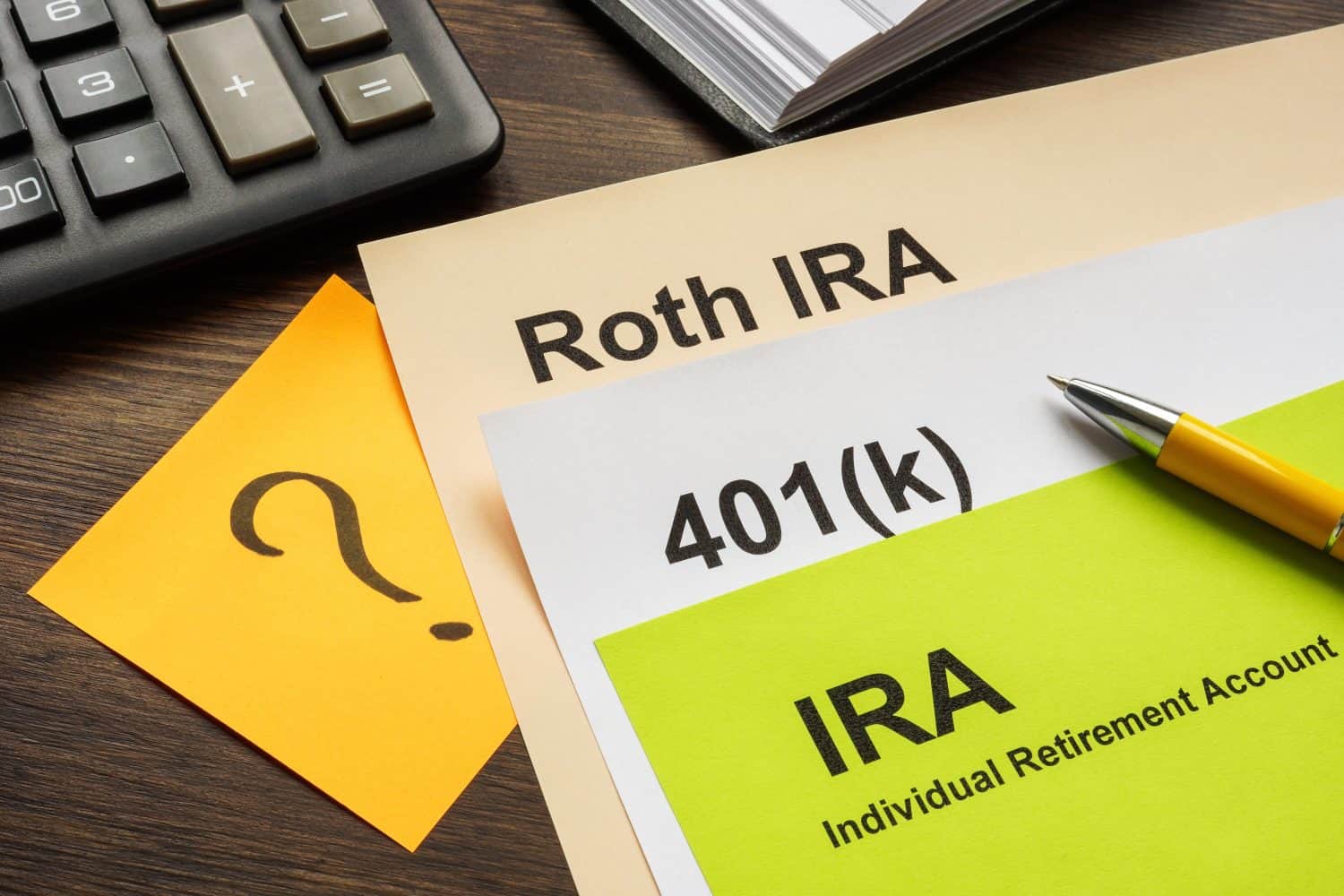
A 58-year-old earning $280,000 a year has already maxed their pre-tax 401(k) deferral. What most do not know is that their plan may allow them to contribute an additional $47,500 per year in after-tax dollars and convert it directly to Roth, completely bypassing the income limits that block them from a standard Roth IRA. The strategy is called the Mega Backdoor Roth, and it matters because a large traditional 401(k) creates a significant tax burden in retirement.
The Gap in the Tax Code
The IRS sets two separate ceilings for 401(k) plans. The employee deferral limit is $24,500 in 2026. A separate limit under Section 415(c) governs total contributions from all sources: your deferrals, employer match, and after-tax contributions combined. That ceiling is $72,000 in 2026. That gap is where after-tax contributions fit.
A participant who maxes their deferral at $24,500 and receives no employer match has $47,500 of remaining room under the 415(c) ceiling. That room can be filled with after-tax contributions. Once inside the plan, those dollars can be converted to Roth status through either an in-plan Roth conversion or an in-service withdrawal rolled to a Roth IRA. Employer match reduces the available space dollar for dollar: a $10,000 match leaves roughly $37,500 of after-tax room.
Direct Roth IRA contributions phase out completely for single filers above $168,000 and married filers above $252,000 in 2026. The Mega Backdoor Roth bypasses those income limits entirely because after-tax 401(k) contributions carry no income ceiling.
Why This Matters in Retirement
A traditional 401(k) balance of $1.5 million at retirement generates required minimum distributions starting at age 73. Those RMDs count as ordinary income. At a modest 4% distribution rate, that is $60,000 per year added to whatever else you earn, including Social Security and portfolio income.
Once combined income crosses $34,000 for single filers or $44,000 for married couples, up to 85% of Social Security benefits become taxable. That same income also triggers IRMAA, the Medicare premium surcharge calculated on a two-year lookback. The first IRMAA tier kicks in when MAGI exceeds $109,000 for single filers or $218,000 for joint filers in 2026. The combined Part B and Part D surcharge at that first tier runs $1,148 per person annually.
By Tier 3, at MAGI above $171,000 single or $342,000 joint, the annual surcharge reaches $4,620 per person, or $9,240 per couple.
A retiree in the 22% federal bracket who triggers both Social Security taxation and a mid-level IRMAA tier faces an effective marginal rate well above 30% on each additional dollar of traditional 401(k) withdrawal. Roth distributions do not count toward MAGI. They do not push Social Security benefits into taxable territory. They do not trip IRMAA surcharges. Every dollar sheltered in Roth now removes a future dollar from that cascade.
The Conversion Timing Problem
After-tax contributions inside a 401(k) earn returns, and those earnings carry pre-tax character. A $47,500 after-tax contribution converted to Roth immediately generates no taxable event. The same $47,500 left sitting for a year before conversion creates a taxable gain on whatever it earned, partially defeating the strategy. Convert monthly or quarterly, before earnings accumulate.
Two plan features must both exist for this to work. Your plan must permit after-tax contributions beyond the standard deferral limit, and it must also permit either in-plan Roth conversions or in-service distributions of those after-tax amounts. The answer is in your Summary Plan Description, which HR is legally required to provide on request.
What the Roth Shelter Is Worth Over Time
Consider a 55-year-old who contributes $47,500 in after-tax dollars annually for ten years and converts each tranche immediately to Roth. At a 7% illustrative annual return, that accumulation grows entirely tax-free. The distributions in retirement carry no ordinary income character, no MAGI impact, and no RMD obligation. Compared to the same dollars compounding inside a traditional 401(k) and later subject to a 22% to 32% bracket plus potential IRMAA surcharges, the after-tax value difference is meaningful: a 22% to 32% tax drag on every withdrawal versus zero.
For income in retirement, Roth accounts pair well with dividend-focused holdings. Schwab U.S. Dividend Equity ETF (NYSE:SCHD | SCHD Price Prediction) generating tax-free income inside a Roth without touching MAGI. JPMorgan Equity Premium Income ETF (NYSE:JEPI) is particularly effective inside a Roth where its option-premium income avoids ordinary income treatment at the federal level.















 Top Gaining Stocks
 Top Losing Stocks