



A $750,000 nest egg throwing off $41,700 a year in income works out to a blended yield near 5.6%. That income exceeds the median U.S. personal income of $40,480 reported by the Census Bureau in 2023. Structured well, a portfolio this size can pay more than what half of working Americans earn at a full-time job, without selling a single share.
The question is how to get there. Here’s the calculation: target income divided by yield equals capital required. The choices behind that yield are where everything interesting happens.
Three Ways to Hit $41,700
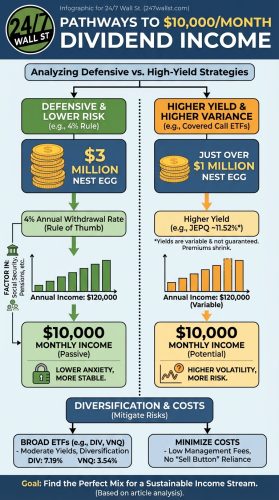
Every income portfolio sits on a spectrum. Lower yields demand more capital but tend to grow. Higher yields need less capital but often shrink the principal over time. With the 10-year Treasury near 4.4%, the bar for taking equity risk is real.
Conservative tier (3% to 4% yield). Broad dividend-growth ETFs and blue-chip equity funds live here. Schwab U.S. Dividend Equity ETF (NYSEARCA:SCHD | SCHD Price Prediction) is the textbook example, with a 0.06% expense ratio and holdings led by Bristol-Myers Squibb, Merck, ConocoPhillips, Lockheed Martin, and Chevron. At a 3.5% yield, replacing $41,700 takes roughly $1.19 million in capital. The reward for that extra capital: dividend growth, principal appreciation, and the fewest sleepless nights. SCHD has returned 229% over the past decade, illustrating what compounding does when payouts and prices both rise.
Moderate tier (5% to 7% yield). This is where REITs, preferred shares, high-dividend equity funds, and covered call ETFs sit. Realty Income (NYSE:O) anchors the category at a 5% yield, paid monthly, with a current roughly $0.27 monthly distribution and a track record of 27-plus years of uninterrupted payments. At 5.6%, $41,700 requires the headline $750,000. The catch: dividend growth slows, and some high-yield strategies cap upside in exchange for premium income.
Aggressive tier (8% to 14% yield). Leveraged covered call funds, business development companies, mortgage REITs, and high-yield bond funds populate this band. At 12%, $41,700 only takes about $347,500. The price tag for that efficiency is principal erosion, distribution cuts during stress, and an income stream that rarely keeps pace with inflation.
Why $750,000 Belongs in the Middle
At this portfolio size, protecting the principal matters just as much as generating income. One moderate approach would divide the money into four parts: 25% in SCHD, or $187,500; 30% in a covered call equity ETF, or $225,000; 20% in Realty Income, or $150,000; and 25% in an intermediate corporate bond ETF, or $187,500. SCHD and the bond allocation add stability. The covered call position drives yield. Realty Income adds monthly payments and real estate exposure. Together, the portfolio would produce a blended yield near 5.6%, or about $42,300 per year, equal to roughly $3,525 per month.
The Compounding Insight Most Income Investors Miss
Chasing the biggest yield does not always produce the strongest long-term income. A 3.5% yield that grows 8% annually can double in less than 10 years. A 12% yield that never grows remains flat in dollar terms and gradually loses buying power to inflation. With Core PCE sitting near the top of its 12-month range, that loss of purchasing power is a real concern, not just a spreadsheet problem.
If the moderate $750K portfolio appreciates just 3% a year while paying out 5.6%, the balance at year 10 is roughly $1,008,000 after collecting $423,000 in income over the decade. The portfolio grew while it paid you. That is the trick aggressive yield rarely pulls off.
Three Moves Worth Making This Week
- Pin down your real number. Replace your spending, not your salary. Many readers chasing $60,000 actually need $42,000 once payroll taxes, retirement contributions, and commuting costs vanish.
- Stress-test the yield. Pull the 10-year total return of a 3.5% dividend grower against a 10% high-yield fund. The compounding gap usually surprises people, and it should drive your tier mix.
- Model the tax bill. Qualified dividends, REIT distributions, and covered call income are taxed differently. In a high bracket, a 5.6% pretax yield can become 4% net. Run the numbers in your specific bracket before committing capital.












 Top Gaining Stocks
 Top Losing Stocks