



Conservative Tier: 3% to 4% Yield
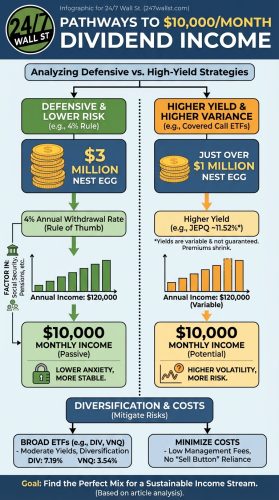
This is the dividend growth bucket. Broad dividend ETFs like Schwab U.S. Dividend Equity ETF (NYSEARCA:SCHD | SCHD Price Prediction) sit here, with $71.6 billion in net assets and an expense ratio of 6 basis points. Holdings are spread across healthcare, energy, telecom, and staples, with no single name above 4% of the fund.
At a 3.5% yield, $12,000 divided by 0.035 equals roughly $343,000 in capital. That is the highest upfront cost of the three tiers, and it buys the slowest current income. The trade is sleep at night: diversification, a payout that has historically grown each year, and a principal balance that tends to appreciate alongside the dividend.
Moderate Tier: 5% to 7% Yield
This bracket is where REITs, MLPs, and high-dividend equity funds live. Realty Income (NYSE:O) yields about 5%, pays monthly, and just declared its $0.2705 monthly distribution in April. The company has now logged 113 consecutive quarterly dividend increases. At that yield, $12,000 divided by 0.05 equals about $240,000.
Enterprise Products Partners (NYSE:EPD) yields roughly 5.8%, just raised its quarterly distribution to $0.55, and has grown the payout for 27 straight years. Capital required: around $208,000. The catch with EPD is the K-1 tax form, which complicates filing.
A blended moderate portfolio averaging 6% needs $200,000 to throw off $1,000 a month. Dividend growth slows compared with the conservative bucket, and REIT and MLP units tend to trade more on interest rates than on broad equity sentiment.
Aggressive Tier: 8% to 10% Yield
Ares Capital (NASDAQ:ARCC), the largest publicly traded business development company, yields about 10% and pays a $0.48 quarterly dividend that has held steady since 2023. At that yield, $12,000 divided by 0.0997 equals roughly $120,000, the lowest capital requirement of the three tiers.
The trade is principal risk. ARCC’s NAV slipped to about $19.60 from $19.90, and the non-accrual rate moved up to 2%. BDC distributions are taxed as ordinary income, and credit cycles can force dividend cuts. The flat $0.48 quarterly payout since 2023 also means no inflation hedge built into the income stream.
The Compounding Trap Most Income Hunters Miss
A 3.5% yield growing 8% a year roughly doubles in nine years. A flat 10% yield does not. Over a decade, that is the difference between $1,000 a month turning into $2,000 a month and $1,000 a month sitting still while inflation eats away at it.
SCHD’s 10-year total return of 229% versus ARCC’s 226% looks nearly identical at first glance. But ARCC distributed much more income along the way, while SCHD delivered stronger payment growth from a lower starting yield. Over longer periods, lower-yield assets with rising payouts can beat high-yield assets with static income.
If you cannot put $200,000 to work today, dollar-cost averaging is the fallback. Investing $750 a month at an 8% blended return gets you to roughly $500 a month in dividend income by year 12, $750 by year 15, and the full $1,000 by year 18.
Three Things to Do This Week
- Start with your actual annual spending rather than gross salary. Most retirees need to replace less income than they assume because payroll taxes and savings contributions disappear.
- Compare a dividend growth fund’s 10-year total return against a high-yield BDC or covered call fund over the same period. The compounding effect on payout and price is usually the deciding factor.
- Model the tax impact in your bracket. REIT and BDC distributions are ordinary income, MLPs issue K-1s, and qualified dividends from broad equity ETFs get the preferential rate. The after-tax yield is what funds your $1,000 a month.











 Top Gaining Stocks
 Top Losing Stocks