


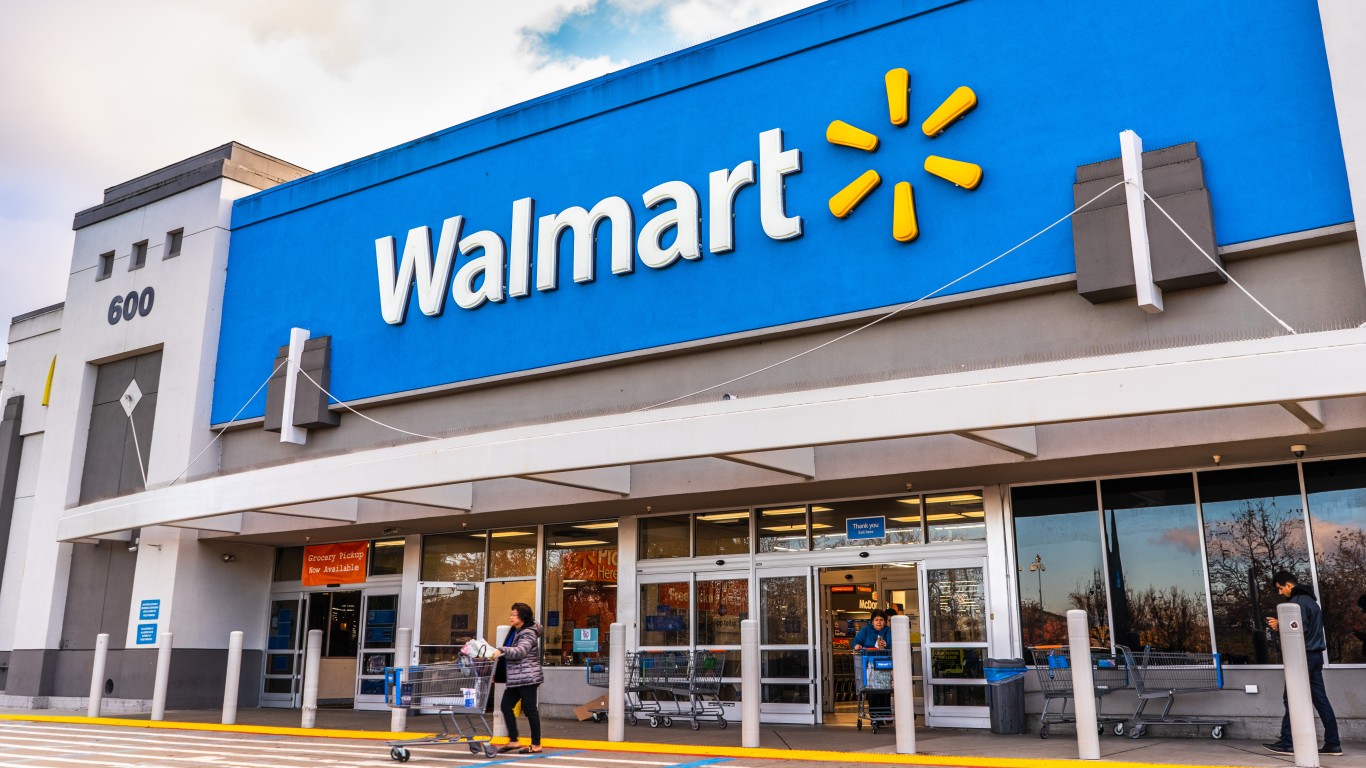
The new Wal-Mart (WMT) super-store in Columbia, Kentucky is longer than the aircraft carrier USS Enterprise which is docked on the West Side of Manhattan. The retail outlet’s ceilings are taller than those below the flight deck, probably forty feet from the floor. Wal-Mart is a ship of war all its own.
The location draws from five counties, bringing in people from as far away as 50 miles. That must hurt retailers in cities and towns from Russell Springs to Burkeville to Campbellsville. The LGA food supermarket in Columbia used to demand immodestly high prices. When the Wal-Mart came to town those prices came down.
The parking lot outside the store probably holds 800 cars. At 4 AM, it is partially full while a street cleaner works its way around the area to make sure that the roads and spaces are pristine. They are remarkably so, in a way the no other retailer could afford to manage.
Inside the Wal-Mart, there is a bank. 2 delicatessens, a pharmacy, and sections with fresh food, consumer electronics, sporting goods, furniture, clothing, toys, appliances, CDs, jewelry, and almost anything else a shopper would want or need. It would actually take hours to make it down all of the aisles and look at most of the items.
The first two impressions most people would have moving around the super-center is that almost all of the food and merchandise is of extremely high quality. The black Angus beef is fresh and is priced at less than half of what it would cost in most big cities. The 50 inch plasma TVs run well under $1,000. A good Acer PC goes for under $350.
Across almost every section of the store are signs that call attention to remarkable bargains. Looking through these, the promotions are no exaggeration. It is difficult to see how Wal-Mart makes any money on much of this merchandise.
A little less quickly a visitor will notice that almost all of the people in the super-center are working class, many lower-working class. There are probably not more than handful of cars in the parking lot that are worth more than $30,000. Almost no one is at the Wal-Mart there to “shop”. They don’t have the discretionary income. They are there to buy what is on a list and with a very modest budget. It is unlikely that most of the people are willing to spend more than a few dollars beyond what is on that list.
Wal-Mart does not need an apologist. Under CEO Lee Scott the company took plenty of PR beatings. Scott was never much good at defending Wal-Mart against claims that it put local retailers out of business or explaining why the firm kept workers from organizing into unions. He did a remarkably poor job of explaining why Wal-Mart tried to move “upscale” with more expensive clothing. A lot of what went on under Scott did not work very well. He is retiring now. The most important part of his legacy may be that Wal-Mart’s revenue went from $165 billion when he became CEO in 2000 to $375 billion last year. Usually, that part gets left out.
A lot of press and analysts believe that Wal-Mart has come into its own again recently. A recession drives the middle class and lower class alike to look for good stuff that costs as little as possible. As discretionary income disappears, “everyday low prices” take on a remarkable appeal. Wal-Mart did not back into its current success. It has been waiting for its natural customer base to expand. In any normal economy Wal-Mart would be viewed as a working class person’s dream store. When home prices were doubling every five years and home equity loans grew on trees, the value of the dollar got lost along the way.
Having met Sam Walton several times, it is easy to see why he was so successful. Walton was gracious enough, but all he really wanted to talk about was the company and he was forever on his way to get into his two-engine plane to travel to one or two stores a day for pep rallies with the “associates”. Lee Scott was never a big rally man. He is rich enough to have someone fly the plane when he wants to leave Bentonville.
A lot of small merchants, labor organizers, and local governments would like to see Lee Scott go to hell. He may. But, he will be joined there by all the mom and pop store-owners who used their mini-monopolies on prices and all the town councilmen who made a buck by picking up a few extra dollars for keeping the “big box” retailers out.
The people who can’t afford to shop somewhere other than Wal-Mart without having to walk out of the stores with junk don’t really care.
Douglas A. McIntyre






 Top Gaining Stocks
 Top Losing Stocks