


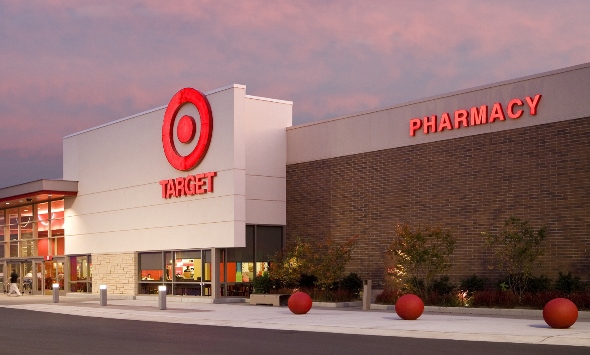
 Target Corp. (NYSE: TGT) announced its growth plans for 2015 Monday morning. The company said it will open 15 new stores: eight Target Express stores, six general merchandise stores and one City Target. About two weeks ago the company announced that it would close all 133 of its Canadian stores.
The company has traded more than 240 million square feet of retail space for about 160,000 square feet of new Express stores, 80,000 to 160,000 square feet of a City Target store and six stores that average around 130,000 square feet of retail space.
In 2013 Target opened 19 new stores and closed four. Net general merchandise store count fell from 391 at the end of fiscal year 2012 to 289. The company opened three new City Target stores in fiscal 2013.
Following the closure of its Canadian stores Target is left with stores only in the United States. To say that the growth of big-box retailers is slowing in the U.S. may be something of an understatement. And the situation could get worse.
ALSO READ: States Where the Middle Class Is Dying
Since 2010 more than two dozen enclosed shopping malls have closed in the United States, according to a recent report in The New York Times. Another 60 are said to be on life-support. And the villain is not online retail, but rather the rise in income inequality in the country. High-end malls are doing fine, but middle- and working-class malls are dying for lack of customers with money to spend.
Target may not be a typical mall store, but it cannot avoid the handwriting on the wall. Bigger is no longer automatically better. Thus, smaller, more personalized stores are becoming more attractive to the company because they “meet the needs of [customers] who are increasingly moving into urban centers,” according to Target’s press release Monday. It is hard to see how the company can build these stores fast enough.
The company’s dividend yield is currently 2.8%, higher than those of Walmart or Nordstrom or Kohl’s. That could explain a good portion of the allure for shareholders who want exposure to the retail sector. Like the shopping malls though, that dividend yield may not last forever.
ALSO READ: 5 Top Retail Stocks Boosted by Low Oil Prices
When Target announced that it was closing its Canadian stores, the reaction was mostly positive among analysts, but the stock price dropped and has bounced a bit lower ever since. Monday’s announcement has moved the stock only fractionally. Shares traded up less than 1% to $73.67, in a 52-week range of $54.66 to $77.75. Shares reached that high in early January.













 Top Gaining Stocks
 Top Losing Stocks