


Schwab U.S. Dividend Equity ETF (NYSEARCA: SCHD | SCHD Price Prediction) and Vanguard High Dividend Yield ETF (NYSEARCA: VYM) sit on most income investors’ shortlists. Both entered 2026 with fresh distributions and updated holdings. The two funds chase dividends through very different rule sets, and the gap between them is wider than the surface suggests.
Quality Screen vs. Yield Net: How Each Fund Builds Its Book
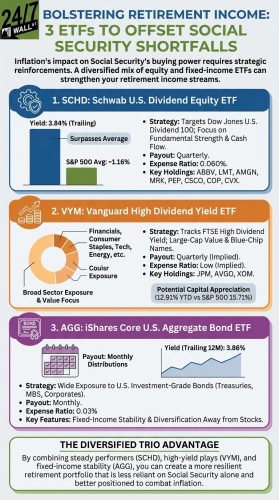
SCHD tracks the Dow Jones U.S. Dividend 100 Index, a quality-weighted screen that demands cash flow strength, return on equity, and a 10-year dividend record. The result is concentrated. Bristol-Myers Squibb sits at 4.26% of the fund, followed by Merck at 4.14% and ConocoPhillips at 4.10%. Healthcare names BMY, MRK, and ABBV anchor three of the top 10 slots, with energy and consumer staples doing most of the rest.
VYM casts a wider net. The fund tracks the FTSE High Dividend Yield Index, which sweeps in roughly 400 to 500 above-average yielders without strict quality gates. That breadth softens single-stock risk and tilts the portfolio toward financials and industrials that SCHD’s screen often filters out.
| Lens | SCHD | VYM |
| Expense Ratio | 0.06% | 0.04% |
| Net Assets | $71.6 billion | Not disclosed |
| Index Style | Quality + yield screen | Broad yield basket |
| Top Sector Tilt | Healthcare, Energy, Staples | Financials, Industrials, Healthcare |
The Distribution Trail Tells Two Stories
SCHD pays steady but smaller per-share checks. The March 2026 distribution came in at $0.2569, following $0.2782 in December 2025. VYM’s payouts run far larger per share. VYM’s March 2026 dividend was $0.8617, with the December 2025 payment at $0.9474. The dollar gap reflects share price, not yield. SCHD closed May 7, 2026, at $31.54, while VYM finished at $155.16.
Why the Returns Have Diverged
Performance has split sharply. VYM has returned 67.14% over five years, well ahead of SCHD’s 46.06%. Year to date: SCHD up 15.95% versus VYM up 8.7%. Over a decade, the leader flips: SCHD’s 229.46% beats VYM’s 204.10%. The quality screen wins long; the wider basket has won lately.
What I Am Watching Through Year End
I want to see whether SCHD’s healthcare-heavy book holds up if drug pricing pressure returns, and whether VYM’s financial weighting can keep adding to gains if the rate curve flattens. SCHD’s 2024 distributions were unusually large ($0.611 to $0.8241 per quarter), and 2025 looked like a reset, so the next four payouts will tell us what the new run rate is.
Why I Lean SCHD for Income, VYM for Total Return
For me, the choice depends on the job. If I want a focused, quality-screened dividend stream and I am comfortable with healthcare and energy concentration, SCHD reads cleaner. If I want broader exposure, slightly lower fees, and bigger recent capital gains, VYM is the practical pick. Retirees prioritizing predictable raises may favor SCHD. Investors who want yield without giving up market breadth will sleep better in VYM. I would not own both at full size. They overlap enough that one slot in a portfolio is plenty.











 Top Gaining Stocks
 Top Losing Stocks