



Typically certain subsectors of retail have been more dependent on lower- and middle-income customers who can get hurt by rising interest rates. The UBS team points out that auto parts and dollar stores, and the big mass merchandisers, fall into those categories. They also point to historical data that indicate that electronics, sporting good and office supply have weathered rate increases better. They also think that the top home improvement stores will continue to do well.
We screened the data for the stocks likely to continue to trade higher as the Federal Reserve begins raising interest rates, most likely this year.
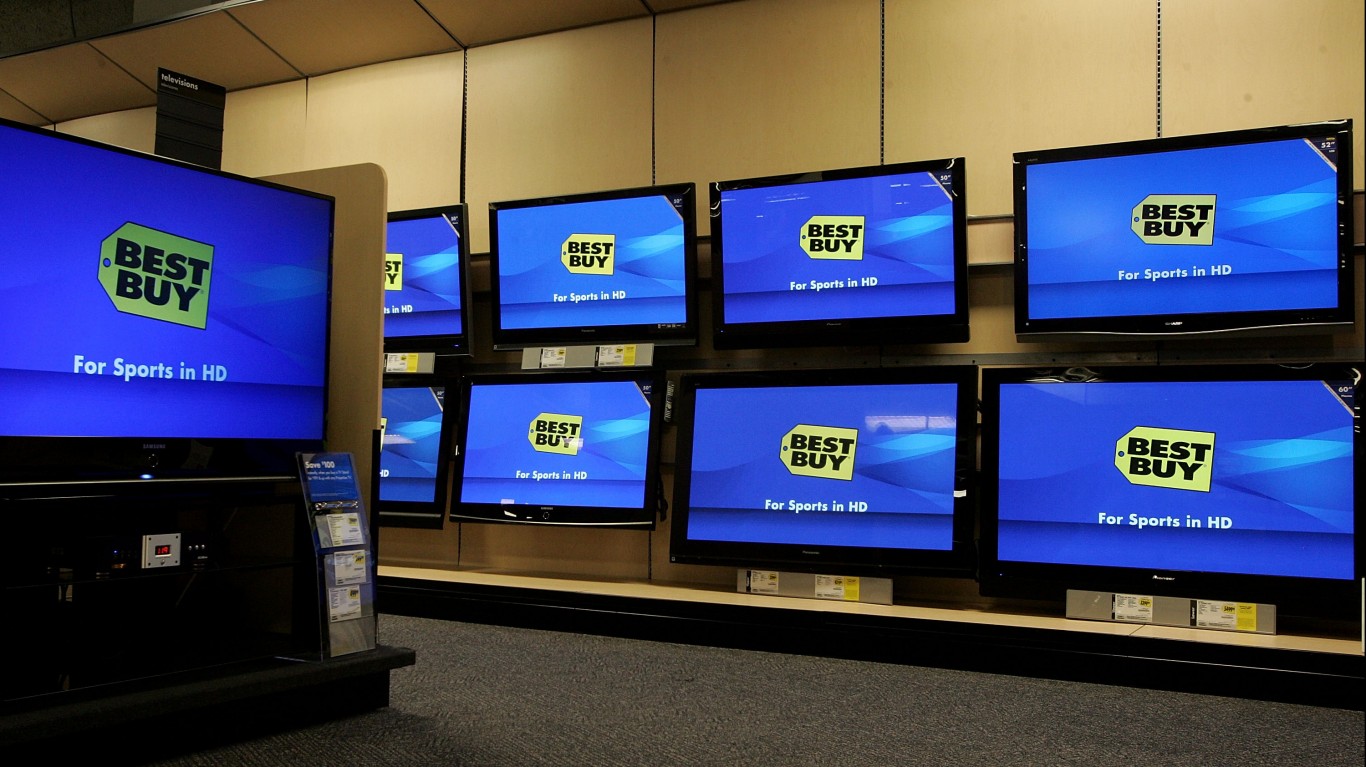
Best Buy
This company may be on the lookout for an acquisition to increase its footprint and customer base. Best Buy Co. Inc. (NYSE: BBY) has become the retail rags-to-riches story over the past three years as it not only have survived, but most of the big-box competition has gone to the graveyard, and the company has grown the brand smartly. Best Buy continues to combat challenging conditions by reducing costs, pricing competitively, optimizing stores and enhancing distribution. The store-within-store partnerships it has with suppliers like Samsung, Apple and Google are continuing to drive more store traffic and product sales. Best Buy’s online channel growth also looks very promising, as it continues to battle Amazon.com.
Best Buy is expected to grow 2015 earnings by a very solid 27%. One other huge tailwind for the electronics giant is lower gasoline prices that are continuing to put more money in consumers’ wallets. That could start to push discretionary buying even higher this year, as expected wage growth also kicks in. A new personal computer (PC) cycle led by Windows 10 could also provide a nice lift.
Best Buy investors are paid a solid 2.81% dividend. The Thomson/First Call price target for the stock is $42.71. Shares ended trading Tuesday at $32.61.
ALSO READ: How to Protect Yourself From a Summer Stock Market Correction
Dick’s Sporting Goods
This stock has become the top sporting goods chains story over the past few years. Dick’s Sporting Goods Inc. (NYSE: DKS) and is another company we featured that could be looking to make an acquisition to increase market share and store footprint. Dick’s is the largest U.S.-based, full-line omni-channel sporting goods retailer, and it offers an extensive assortment of authentic, high-quality sports equipment, apparel, footwear and accessories. As of May 2, 2015, the company operated more than 610 Dick’s Sporting Goods locations. The company also owns and operates Golf Galaxy, Field & Stream and True Runner specialty stores.
The UBS team cites sporting goods stores as a silo of hardline retail that typically survives higher interest rate moves reasonably well. An improving economy should also keep a tailwind behind what many consider to be the premier franchise in the industry.
Dicks Sporting Goods shareholders are paid a 1.07% dividend. The consensus price target is $61.37, and shares closed trading Tuesday at $51.77.
Home Depot
This company remains the undisputed leader in the home improvement retail category. Home Depot Inc. (NYSE: HD) is in the company’s calendar year sweet spot as summer projects and new home purchasing tend to reach a zenith this time of year.
While the company is well-known for the ubiquitous store presence across the country, Kevin Hofmann, senior vice president and president of the online business recently, mentioned at the Goldman Sachs dotCommerce Day 2015 that the ticket size for online sales is significantly higher than the average in-store spend. The ticket size for physical stores averages $55 to $65 per transaction. The average ticket size for e-commerce sales is apparently much higher, although the company has not disclosed that figure.
ALSO READ: 4 Stocks to Buy With Potentially Big Upcoming Catalysts
The UBS team points out that while multiples typically contract at home improvement stores during interest rate increases, they feel that the company can increase earnings that more than match any multiple declines.
Home Depot investors are paid a 2.13% dividend. The consensus price target is set at $123.46. Shares were at $111.13 when Tuesday’s trading session concluded.
Lowe’s
This is another home improvement company that the UBS team feels can leap past declining multiples as rates rise with higher earnings. Lowe’s Companies Inc. (NYSE: LOW) is a home improvement company that ranks very highly with consumers. The company serves approximately 16 million customers a week in the United States, Canada and Mexico through its stores and online. With fiscal year 2014 sales of $56.2 billion, Lowe’s has more than 1,840 home improvement and hardware stores and 265,000 employees.
Lowe’s was recently upgraded to Outperform from Market Perform by BMO Capital, and many Wall Street analysts continue to stay very positive on the company. As with Home Depot, this is the best time of year, as summer improvements and new and preexisting home sales jump.
Lowe’s shareholders are paid a 1.66% dividend. The consensus price target is $78.17, and shares closed trading Tuesday at $66.97.
ALSO READ: 4 Specialty Retail Takeover Deals That Make Sense
Greek turmoil aside, interest rate hikes are coming. The Federal Reserve has pushed the envelope by letting them stay this low for so long. The good news is that increases will be slow and very measured this cycle, which is a big departure from past periods of rate increases.







 Top Gaining Stocks
 Top Losing Stocks