


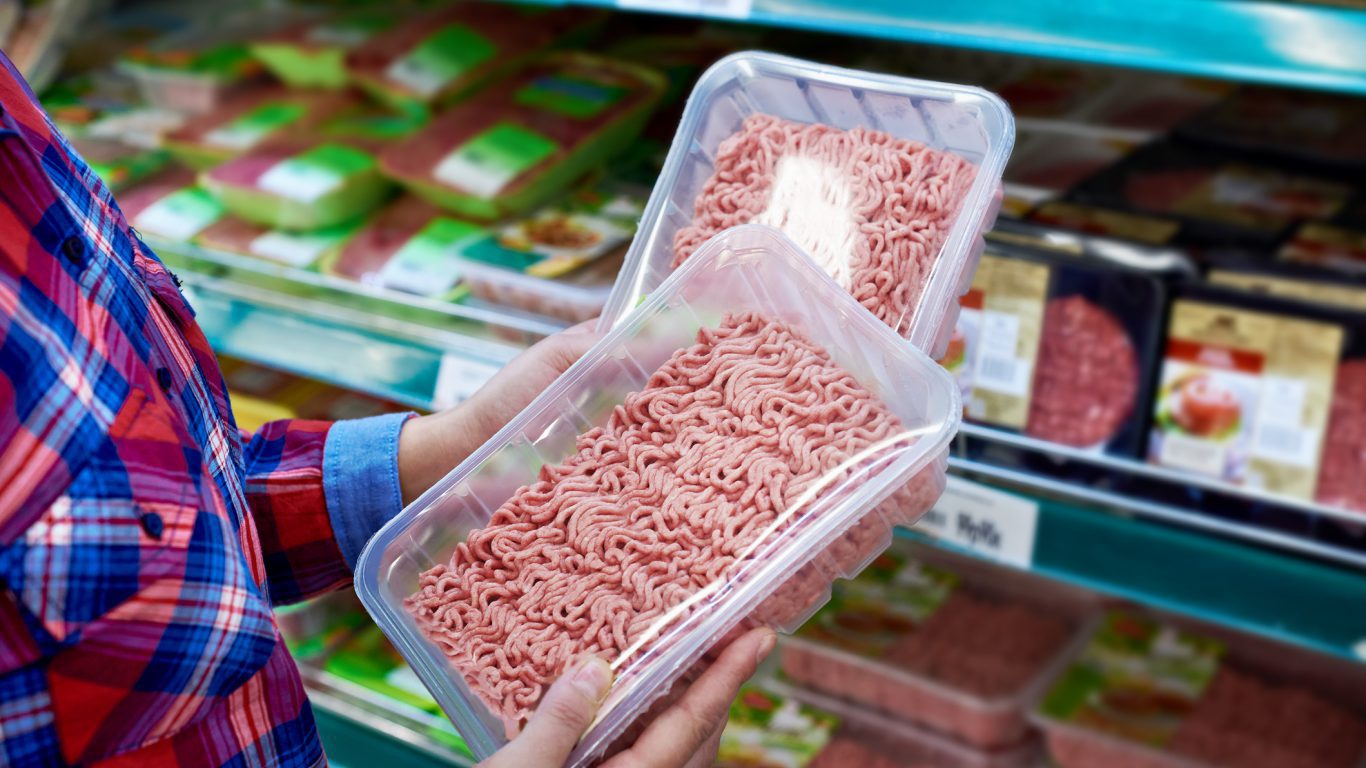
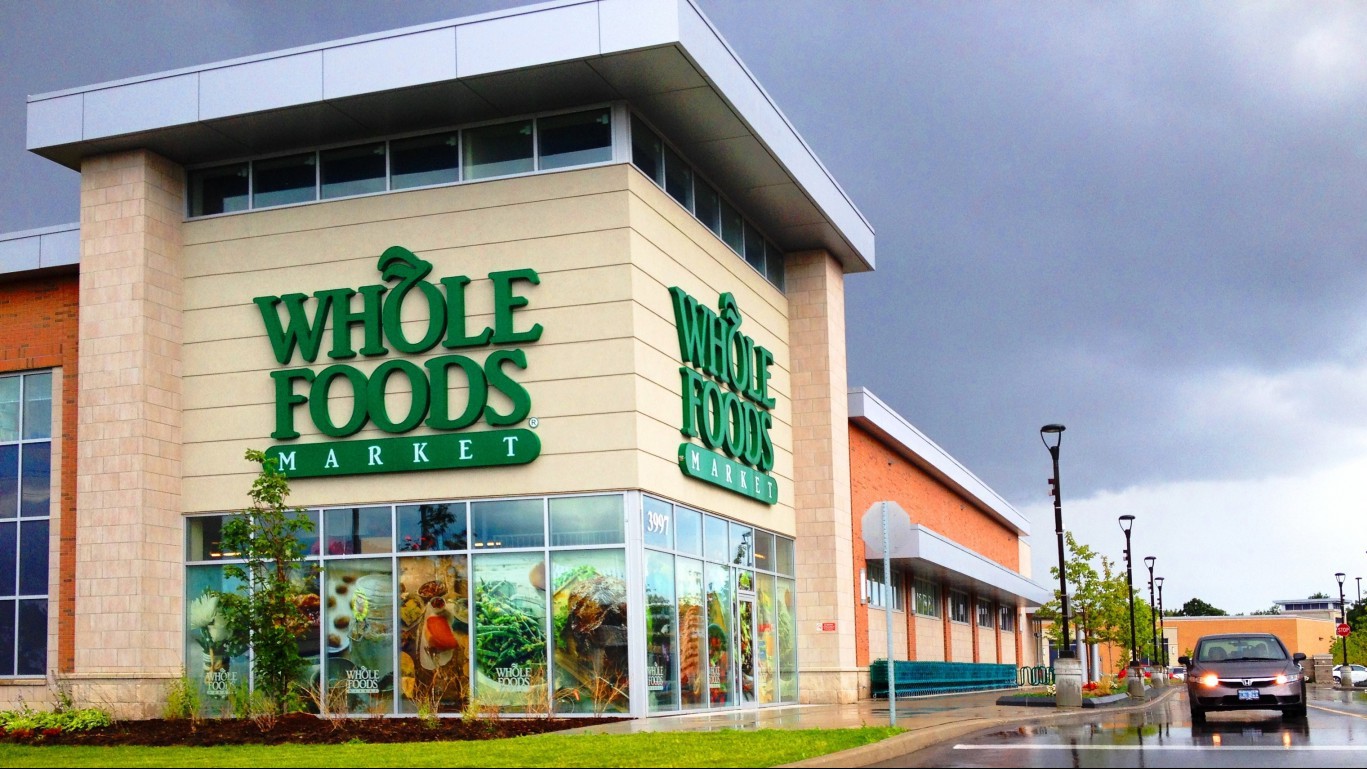
Part of Walmart Inc.’s (NYSE: WMT) earnings success was its ongoing surge in grocery sales. It continues to be a dominant force in the industry. One of its primary advantages over Amazon.com Inc. (NASDAQ: AMZN), which hopes to expand its food footprint via its purchase of Whole Foods, is that Walmart’s store count dwarfs the count of Whole Foods locations.
Management said as its released earnings:
Fresh food category sales were strong and led to the best grocery comp in 9 years. Customers continue to gravitate toward our selection of fresh produce, meat, and bakery items that offer great quality at low prices
[in-text-ad]
When 24/7 Wall St. had a look at the store count issue earlier this month, it pointed out that Amazon has a problem as it battles for market share in the grocery business. Its recent buyout of Whole Foods gave it ownership of an operation with only 487 stores in North America and the United Kingdom. This is nowhere near the number of locations of its primary rivals. It has trouble reaching enough customers to matter.
Whole Foods’ two primary rivals are Kroger Co. (NYSE: KR) and Walmart, which have 2,229 and 4,761 stores, respectively. Not all Walmart stores carry groceries, but most do. Grocery sales are among the largest components of Walmart’s U.S. operations.
[nativounit]
Whole Foods has its own credit cards; benefits for shoppers who are members of Amazon Prime, who number over 100 million around the world; grocery delivery; and a new in-store pickup plan. The number of people the services can reach is very modest
What Whole Foods offers is not terribly different from services from its two primary rivals. Walmart recently launched a service called Alphabot. According to the world’s largest retailer:
The Alphabot system, developed especially for Walmart, is being installed at the supercenter in Salem, New Hampshire, as a part of the store’s re-grand opening. A 20,000-square-foot extension connected to the store houses the new system and will serve as a dedicated grocery pickup point with drive-thru lanes for customers. When completed, automated mobile carts will retrieve ordered items – stored warehouse-style in this new space – then deliver them to our associates at one of four pick stations. Our personal shoppers will then pick, assemble and deliver orders to customers. The vast majority of grocery products we offer in-store will be fulfilled through this system, though our personal shoppers will still handpick produce and other fresh items.
Presumably, it will be in hundreds of stores soon.
[recirclink id=486448]
Kroger also announced a program that puts it into the e-commerce and pickup businesses. Its management announced:
The service offers competitive ecommerce pricing and fast and free doorstep delivery by a package carrier on orders over $35, otherwise shipping is $4.99 per order. Ship customers will experience exclusive money-saving opportunities, including promo codes and pricing deals along with the convenience of a set-and-save subscription model. During the launch phase, customers will receive free shipping—no minimum purchase required—and 15 percent off their order with a one-time-use promo code.
Are the Whole Foods programs better than those of Walmart and Kroger? They are similar enough for today. However, Whole Foods is outgunned with its plans. It has too few stores.
[wallst_email_signup]







 Top Gaining Stocks
 Top Losing Stocks