


Special from ZeroHedge
As the market closes at another all time high, the “recovery”, if only on paper, is again bypassing most Americans and it is starting to hit where it hurts the most. According to restaurant tracker NPD Group, traffic at U.S. fast-food restaurant fell 1% in the third quarter, the sector’s first traffic decline in five years. Unfortunately, the reason is not that many Americans have migrated to a higher wealth group and are now eating at more expensive venues, but a more familiar one, namely higher costs of eating out, changing consumer behavior and higher bills for items such as rent and drugs. In other words, America’s “main street” is so squeezed, it can’t even afford to eat out as much as it did just one year ago.
According to Bonnie Riggs of the NPD Group, “the term growing your business in a 1% world has become a popular mantra for the restaurant industry after six consecutive years of annual traffic gains of just 1%,” said NPD analyst Bonnie Riggs. “However, over the past six months, restaurant industry traffic growth has come to a standstill and quick-service restaurants, which have been the traffic growth drivers, are now experiencing a slowdown in visits.”
While inflation in wages is missing for most Americans, expect for those on minimum wages who most likely already work in said fast-food restaurants, inflation in food costs is all too prevalent and eating out has become more expensive, even as the cost of food purchased for home use has fallen 2.4% in the past year, according to the October consumer price index.
Curious, even as food costs have shrunk because of a global glut in farm products such as wheat, rice, soy and corn, the price of rapidly prepared food has risen as a result of managers passing on rising minimum wages to consumers, which in turn has pressured overall sales and traffic. As MarketWatch notes, the pressure was evident in third-quarter earnings, with companies bemoaning the shortage of growth drivers and fretting about weak consumer confidence and general unease about the state of the world. In November, Moody’s Investors Service weighed in by slashing its operating-profit-growth forecast for the restaurant sector and revising its outlook to stable from positive.
Underscoring the severity of the economic reality for most Americans, a recent NPD survey found 75% of respondents saying they have cut back on restaurant dining as they keep a closer tab on spending in most or all purchase categories, with many saying restaurant prices are too high.
Meanwhile, for the Fed which is now considering letting the economy “run hot” because there is not nearly enough inflation (except in rent, medical bills, college tuition and, of course, asset prices), the average restaurant bill has climbed 21% in the past decade, and the gap between eating in and eating out has consistently widened. In fact, from a nation of people “eating out”, the NPD estimates that 82% of all meals are now consumed at home.
Naturally, being an industry-funded organization, Riggs tried to spin the data: “the marketplace is changing, and despite improving economic indicators the consumer landscape is fundamentally reshaped,” she said. “What hasn’t changed and won’t change is the consumer’s need for food service; it saves them time and provides them with an experience.”
Or maybe, those “improving economic indicators” are really nothing more than a mirage, meant to boost the confidence of some Americans, if not those 95 million who are no longer in the labor force.
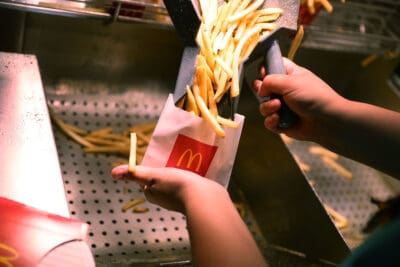
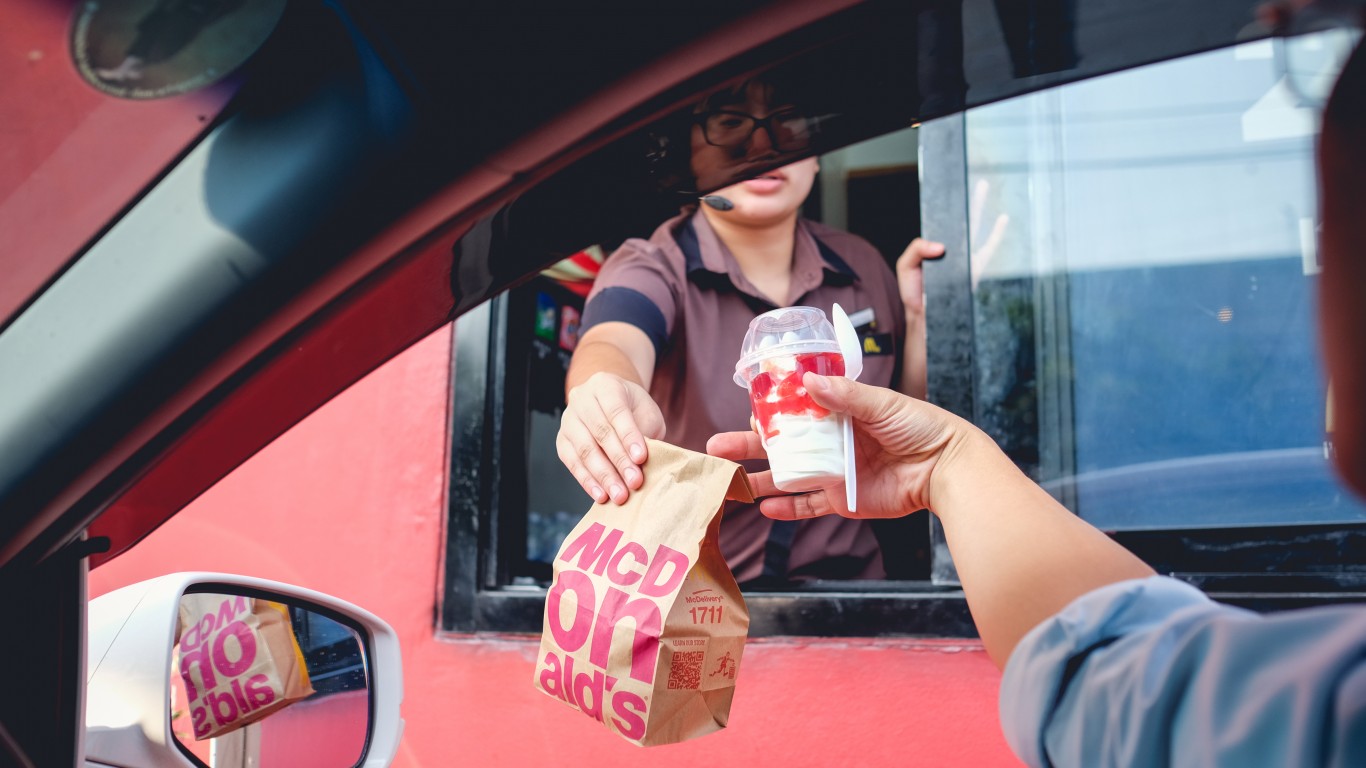
Meanwhile, fast food vendors are scrambling to come up with differentiation strategies in a field where there is tremendous saturation. For now, consumers are still drawn to new products and promotions, as well as competitive pricing, like “extensions” to the Big Mac and french fry line. No really, “We are impressed with McDonald’s potential product pipeline heading into 2017,” said Instinet analyst Mark Kalinowski. “Big Mac and french fry line extensions, platforms for customization, fresh beef and further menu innovation have been in test across multiple U.S. geographies.” McDonald’s is also planning to roll out a new mobile order-and-pay program in hopes of further driving traffic.
Now if only in addition to hip, cool, mobile apps, the fast food restaurants could also send some old-fashioned “money” to their cash-strapped customers, then the worst fast food market in 5 years might have a chance of turning around.
[wallst_email_signup]





 Top Gaining Stocks
 Top Losing Stocks