Chick-fil-A Price Jumps on Wage Rules

Photo of Douglas A. McIntyre
By Douglas A. McIntyre Updated Published
This post may contain links from our sponsors and affiliates, and Flywheel Publishing may receive compensation for actions taken through them.
Chick-fil-A Price Jumps on Wage Rules

© plherrera / iStock Unreleased via Getty Images

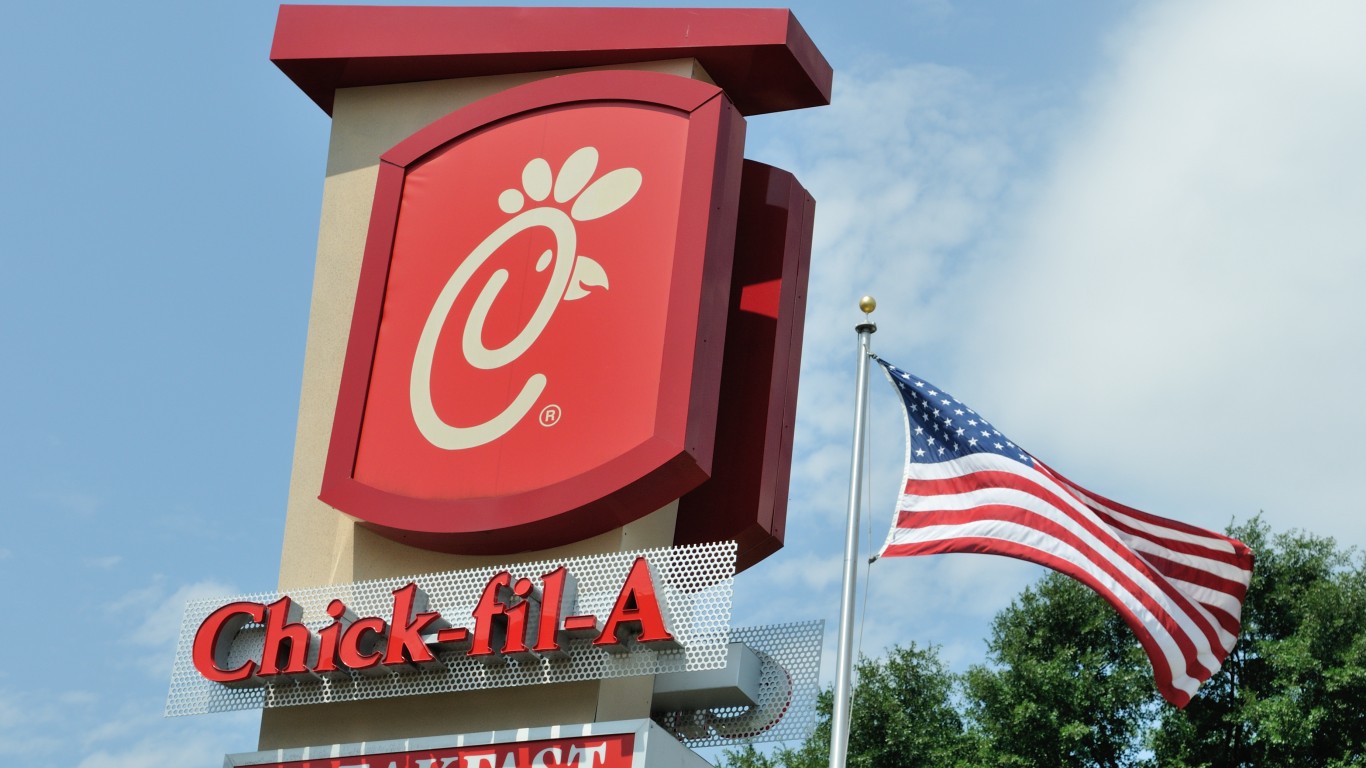
The economic theory about wage laws was that fast-food companies would face two options as the minimum hourly wage jumped sharply. Those two alternatives were to cut workers or raise prices. How much of the cost would the customer be willing to bear? Chick-fil-A has found out in California. It has raised prices on some of its meals by over 10%.

This month, California raised the minimum wage to $20 an hour. It had been $16, still one of the highest of any state in the country. Afterward, the Wall Street Journal published a description of one customer’s experience. “In Los Angeles on a recent April afternoon, Seth Amitin, a 39-year-old therapist, said his usual $16 meal that he picks up weekly at the Chick-fil-A in Hollywood, Calif., now costs $20.” Price increases vary. Research firm Gordon Hackett estimated some prices in California rose just over 11%. The newspaper points out that both figures were based on prices between mid-February and mid-April.

Chick-fil-A is a private company. So, there is no way to know what it plans to do with price or employee levels if the reaction to higher meal prices drives customers away. (Fast-food chains you should never eat at.)

Two large publicly held companies could face a California crisis. Each has a significant presence in America’s largest state by population, which is home to about 12% of the U.S. population. The effects of price increases will start to show in McDonald’s and Starbucks’ quarterly earnings. Additionally, minimum wages went up in several other states this year, and the list of states that have raised or will raise wages continues to grow.

Wage inflation is not the only form of inflation fast-food companies face. Chocolate prices, for example, have doubled in many parts of the country due to a lack of cocoa from the world’s largest producers in West Africa. Moreover, food is shipped to retail outlets by truck. The price of crude has pushed both diesel and gasoline prices higher.

In many places, fast food is not cheap food anymore.

Photo of Douglas A. McIntyre
About the Author Douglas A. McIntyre →

Douglas A. McIntyre is the co-founder, chief executive officer and editor in chief of 24/7 Wall St. and 24/7 Tempo. He has held these jobs since 2006.

McIntyre has written thousands of articles for 24/7 Wall St. He is an expert on corporate finance, the automotive industry, media companies and international finance. He has edited articles on national demographics, sports, personal income and travel.

His work has been quoted or mentioned in The New York Times, The Wall Street Journal, Los Angeles Times, The Washington Post, NBC News, Time, The New Yorker, HuffPost USA Today, Business Insider, Yahoo, AOL, MarketWatch, The Atlantic, Bloomberg, New York Post, Chicago Tribune, Forbes, The Guardian and many other major publications. McIntyre has been a guest on CNBC, the BBC and television and radio stations across the country.

A magna cum laude graduate of Harvard College, McIntyre also was president of The Harvard Advocate. Founded in 1866, the Advocate is the oldest college publication in the United States.

TheStreet.com, Comps.com and Edgar Online are some of the public companies for which McIntyre served on the board of directors. He was a Vicinity Corporation board member when the company was sold to Microsoft in 2002. He served on the audit committees of some of these companies.

McIntyre has been the CEO of FutureSource, a provider of trading terminals and news to commodities and futures traders. He was president of Switchboard, the online phone directory company. He served as chairman and CEO of On2 Technologies, the video compression company that provided video compression software for Adobe’s Flash. Google bought On2 in 2009.

Continue Reading

Top Gaining Stocks

CBOE Vol: 1,568,143
PSKY Vol: 12,285,993
STX Vol: 7,378,346
ORCL Vol: 26,317,675
DDOG Vol: 6,247,779

Top Losing Stocks

LKQ
LKQ Vol: 4,367,433
CLX Vol: 13,260,523
SYK Vol: 4,519,455
MHK Vol: 1,859,865
AMGN Vol: 3,818,618