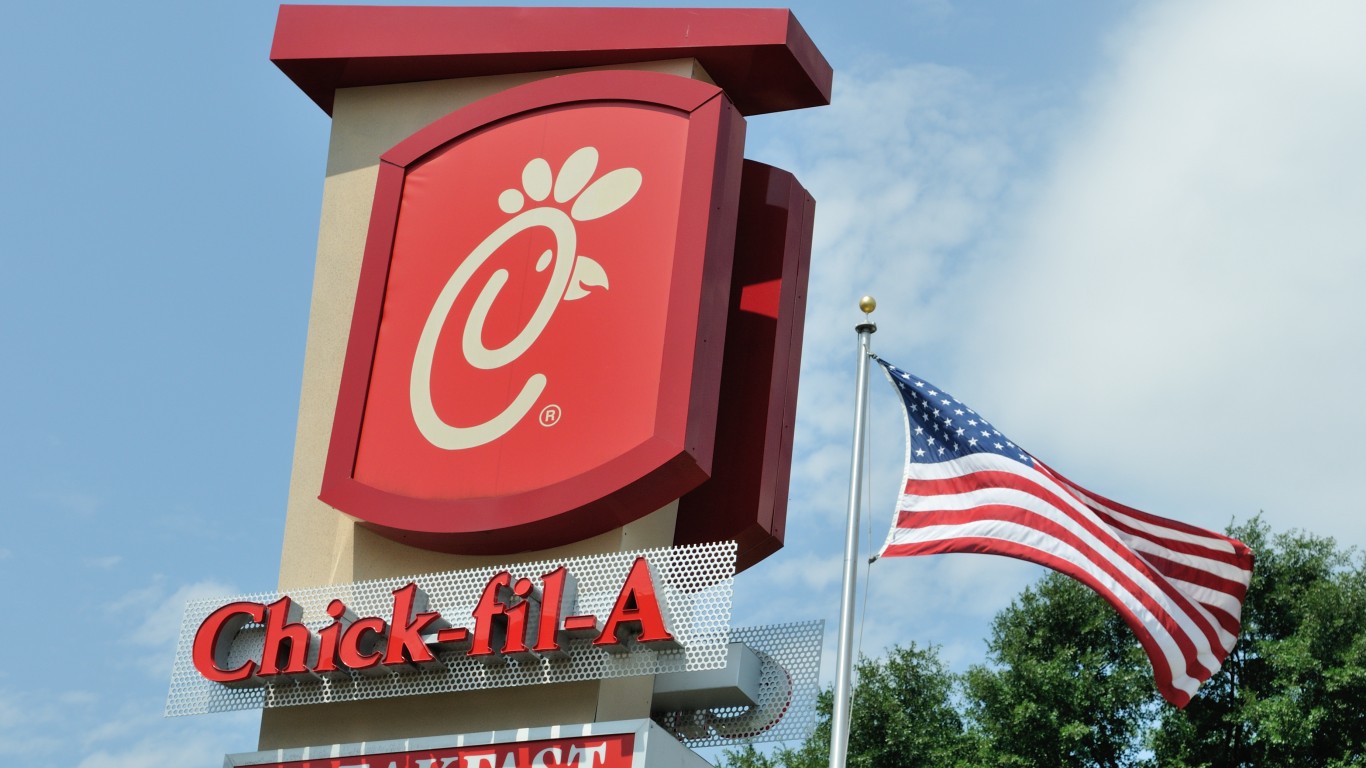
Increase In Minimum Wage Could Rocket Fast Food Prices Higher By 25%

Photo of Douglas A. McIntyre
By Douglas A. McIntyre Published
This post may contain links from our sponsors and affiliates, and Flywheel Publishing may receive compensation for actions taken through them.

What will happen if the minimum wage paid by companies which offer fast food moves to $15? Food prices charged by these companies to customers would rise modestly. If that wage goes to $22, the prices charged would soar as much as 25%, as portions dropped by as much as 70%. Logically, the number of workers employed by these firms will drop as well, as companies fight to increase margins. Along with that, higher price might cause a drop in store traffic

According to a study by the Purdue University’s School of Hospitality and Tourism Management, the math gets ugly:

Raising wages to $15 an hour for limited-service restaurant employees would lead to an estimated 4.3 percent increase in prices at those restaurants….

And, at “limited service” restaurants, the researcher found:

… the effect that higher wages and health-care benefits have on costs and prices in limited-service restaurants. In order to compensate for higher wages, prices would have to increase between 4% and 25% and/or product size would have to be scaled back between 12% and 70%.

The odds that the minimum was might go to $22 seems absurd. However, the odds that the figure would go to $15 were counted as absurd just a few years ago.

What the study does not tell is what the wage increases might do, financially, to the “limited service” restaurants. Their P&Ls would suffer devastating effects. The first deep trouble from this would be labor costs. Since the largest fast food chains have tens of million employees, profits would plunge. One of the ways to offset this, at least if economic history is an indication, is layoffs, some of which might be sizable. Advancements in automation already threatens many of these jobs.

READ MORE: 10 Jobs With The Most Security

The other effect may be a sharp decrease in store traffic. Increased prices and smaller portions will not be ignored by customers, who have the option of, say, eating at home

Among the debates over minimum wage increase is whether they will harm the economy on balance. If the Purdue University’s School of Hospitality and Tourism Management study is right, on balance, the results could be devastating for both workers and the companies which employ them


Photo of Douglas A. McIntyre
About the Author Douglas A. McIntyre →

Douglas A. McIntyre is the co-founder, chief executive officer and editor in chief of 24/7 Wall St. and 24/7 Tempo. He has held these jobs since 2006.

McIntyre has written thousands of articles for 24/7 Wall St. He is an expert on corporate finance, the automotive industry, media companies and international finance. He has edited articles on national demographics, sports, personal income and travel.

His work has been quoted or mentioned in The New York Times, The Wall Street Journal, Los Angeles Times, The Washington Post, NBC News, Time, The New Yorker, HuffPost USA Today, Business Insider, Yahoo, AOL, MarketWatch, The Atlantic, Bloomberg, New York Post, Chicago Tribune, Forbes, The Guardian and many other major publications. McIntyre has been a guest on CNBC, the BBC and television and radio stations across the country.

A magna cum laude graduate of Harvard College, McIntyre also was president of The Harvard Advocate. Founded in 1866, the Advocate is the oldest college publication in the United States.

TheStreet.com, Comps.com and Edgar Online are some of the public companies for which McIntyre served on the board of directors. He was a Vicinity Corporation board member when the company was sold to Microsoft in 2002. He served on the audit committees of some of these companies.

McIntyre has been the CEO of FutureSource, a provider of trading terminals and news to commodities and futures traders. He was president of Switchboard, the online phone directory company. He served as chairman and CEO of On2 Technologies, the video compression company that provided video compression software for Adobe’s Flash. Google bought On2 in 2009.

Continue Reading

Top Gaining Stocks

CBOE Vol: 1,568,143
PSKY Vol: 12,285,993
STX Vol: 7,378,346
ORCL Vol: 26,317,675
DDOG Vol: 6,247,779

Top Losing Stocks

LKQ
LKQ Vol: 4,367,433
CLX Vol: 13,260,523
SYK Vol: 4,519,455
MHK Vol: 1,859,865
AMGN Vol: 3,818,618