


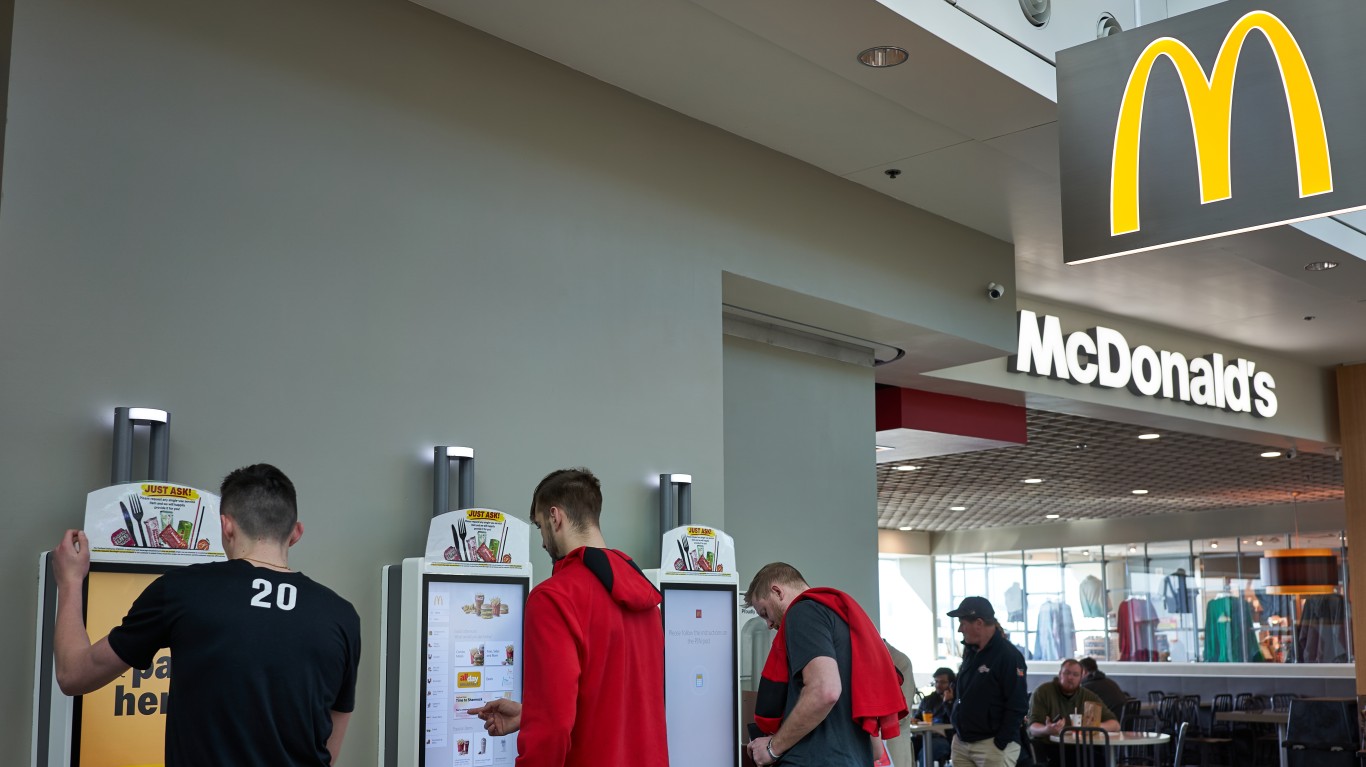
Last month, McDonald’s Corp. (NYSE: MCD) announced that it would roll out digital self-order kiosks at the company’s 14,000 U.S. stores. Customers would use the giant touchscreens to place their orders and store employees would deliver the orders to the customers tables. The company insisted more than a year ago that this was not a scheme to cut jobs but rather a response to the popularity of the giant screens with younger customers in several test cities.
At the same time, McDonald’s is also experimenting with delivery service. On Thursday the company announced a test with ride-sharing start-up Uber and its UberEats service. Customers in three Florida cities will be able to place their orders online from their desktops or using a mobile app. An UberEats courier would then deliver the food for a $5 charge. McDonald’s already has deals with third-party delivery services like DoorDash and Postmates.
The delivery service essentially extends the drive-through business that already accounts for some two-thirds of sales. McDonald’s must see this as an opportunity for incremental revenue with little downside risk.
[nativounit]
The kiosks may be more important, though, because they offer both incremental business and the potential to reduce staffing costs. Regardless of what the company says about maintaining staffing levels, if the kiosks are as popular as McDonald’s thinks they’ll be, staffing levels will certainly drop. Worker demands for $15 an hour could be effectively neutralized.
Research in the first decade of the 21st century discovered that kiosks generated a 30% increase in a McDonald’s order and that 20% more customers would order a drink when the machine offered one. The kiosk never forgets to ask if you want fries with that order either.
An order placed at a kiosk was typically a dollar more than one placed at the counter and also resulted in order times that were seven seconds faster than dealing with a person. Seemingly a scant time savings, those seven seconds could add up to a market share increase of 1% to 3%, which is anything but scant in the restaurant business.
McDonald’s stock traded up about 0.9% Friday morning, at $123.44 in a 52-week range of $110.33 to $131.96. The consensus price target on the stock is $127.76.
[wallst_email_signup]









 Top Gaining Stocks
 Top Losing Stocks