US Postal Service Continues Poor Results

Photo of Douglas A. McIntyre
By Douglas A. McIntyre Published
This post may contain links from our sponsors and affiliates, and Flywheel Publishing may receive compensation for actions taken through them.
US Postal Service Continues Poor Results

© hedidwhat / iStock via Getty Images

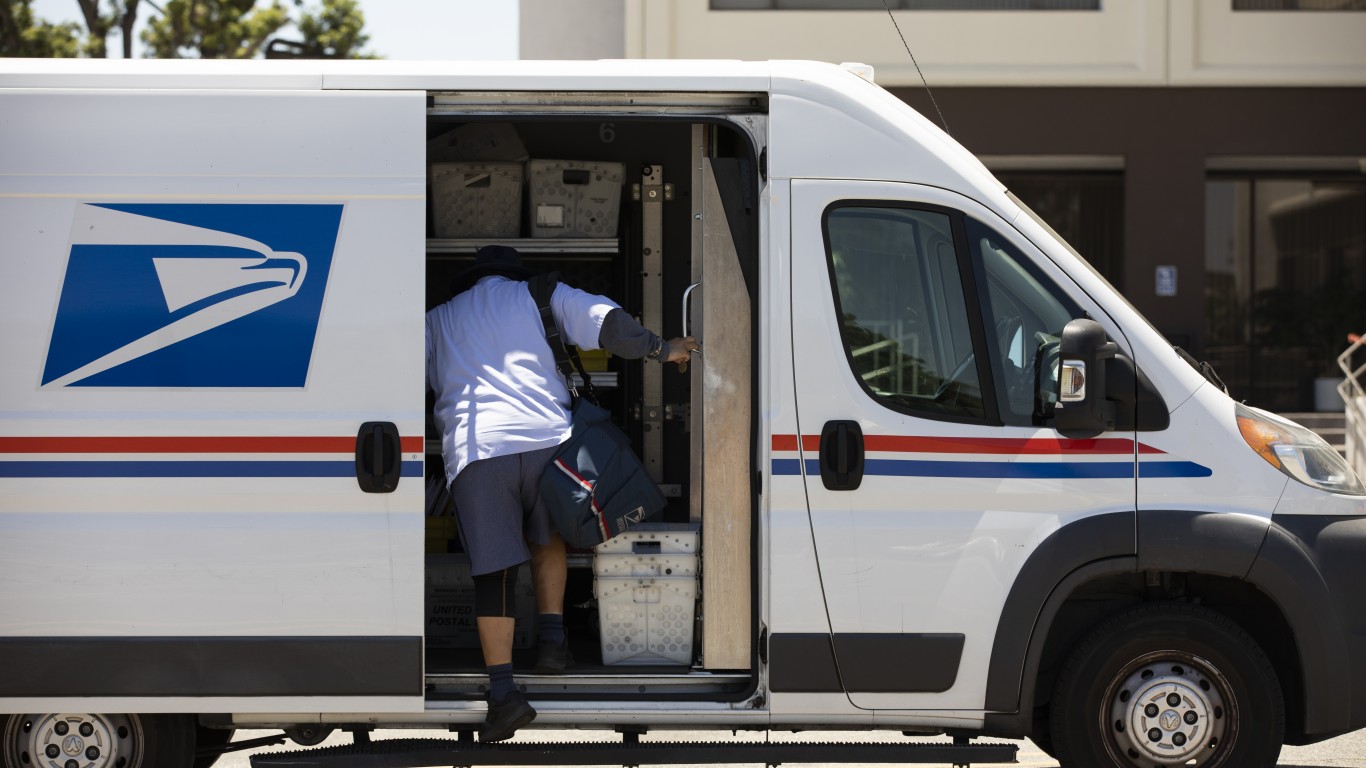
The U.S. Postal Service (USPS) continues to post poor delivery-time results as part of the progress of its 10-year “Delivering for America” plan. A portion of the plan is to make faster deliveries six days a week, which is an anachronism. On its way to this target endpoint, its delivery rate reached an average time of 2.5 days for the final week of its fiscal first quarter.
[in-text-ad]
For the most part, UPS and FedEx are faster and operate successfully in a world where the package delivery private sector makes a great deal of money. In the most recently reported fiscal year, the USPS lost $473 million on revenue of $78.5 billion. (However, see 18 less obvious ways the Post Office helps Americans.)
[nativounit]
The USPS spends too much across several metrics. It has over 600,000 employees and 34,000 locations. Much of its delivery volume is junk mail, which marketers should be forced to deliver electronically. In the age of email, e-commerce, online payments and electronic delivery of documents, there is no reason the USPS should be as large as it is.
[wallst_email_signup]
The USPS cannot possibly justify its 34,000 locations. Many are in small downs, which have only a few thousand households. Nevertheless, many of these have at least half a dozen staff, many of whom are not busy during their time at work. Thousands of these locations could be closed.
[recirclink id=1194031]
As another sign the USPS plans to continue at its current size, it announced that it would buy 45,000 new electric trucks. This is on top of thousands with traditional engines. These probably have lifespans of at least 10 years. That puts fixed transportation expenses at current levels well into the next decade. (Among the advantages of these trucks is that they have air conditioning.)

Unfortunately, there is no sign the USPS will downsize. The United States will be left with a business that was appropriately sized two decades ago but no longer is.

Photo of Douglas A. McIntyre
About the Author Douglas A. McIntyre →

Douglas A. McIntyre is the co-founder, chief executive officer and editor in chief of 24/7 Wall St. and 24/7 Tempo. He has held these jobs since 2006.

McIntyre has written thousands of articles for 24/7 Wall St. He is an expert on corporate finance, the automotive industry, media companies and international finance. He has edited articles on national demographics, sports, personal income and travel.

His work has been quoted or mentioned in The New York Times, The Wall Street Journal, Los Angeles Times, The Washington Post, NBC News, Time, The New Yorker, HuffPost USA Today, Business Insider, Yahoo, AOL, MarketWatch, The Atlantic, Bloomberg, New York Post, Chicago Tribune, Forbes, The Guardian and many other major publications. McIntyre has been a guest on CNBC, the BBC and television and radio stations across the country.

A magna cum laude graduate of Harvard College, McIntyre also was president of The Harvard Advocate. Founded in 1866, the Advocate is the oldest college publication in the United States.

TheStreet.com, Comps.com and Edgar Online are some of the public companies for which McIntyre served on the board of directors. He was a Vicinity Corporation board member when the company was sold to Microsoft in 2002. He served on the audit committees of some of these companies.

McIntyre has been the CEO of FutureSource, a provider of trading terminals and news to commodities and futures traders. He was president of Switchboard, the online phone directory company. He served as chairman and CEO of On2 Technologies, the video compression company that provided video compression software for Adobe’s Flash. Google bought On2 in 2009.

Featured Reads

Our top personal finance-related articles today. Your wallet will thank you later.

Continue Reading

Top Gaining Stocks

CBOE Vol: 1,568,143
PSKY Vol: 12,285,993
STX Vol: 7,378,346
ORCL Vol: 26,317,675
DDOG Vol: 6,247,779

Top Losing Stocks

LKQ
LKQ Vol: 4,367,433
CLX Vol: 13,260,523
SYK Vol: 4,519,455
MHK Vol: 1,859,865
AMGN Vol: 3,818,618