



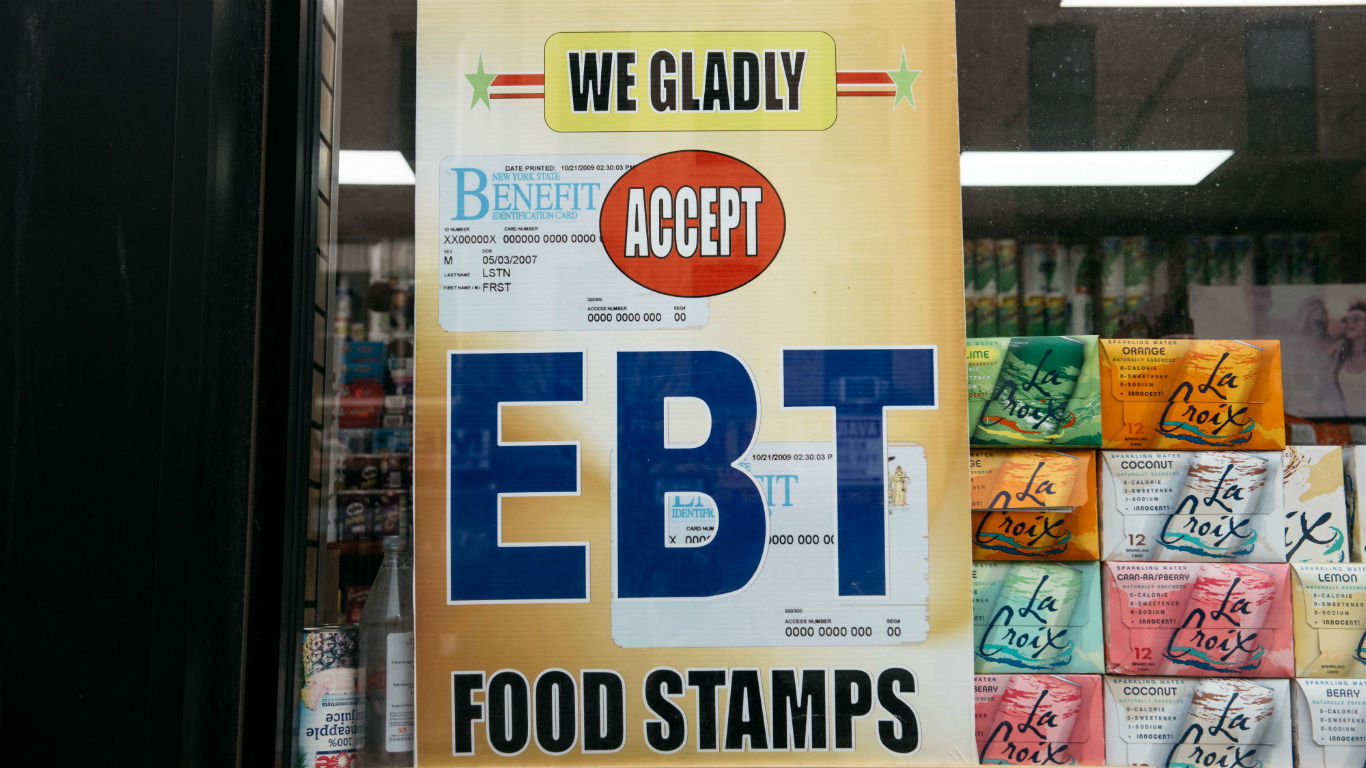
In June, California announced it would be sending $1,050 checks to approximately 23 million residents to combat the devastating effects inflation has had on state residents. Since then, a number of other states have followed suit with some form of check or tax rebate. Should even more states follow suit and release their own relief, the checks would likely still not be enough on their own for needy families. One long-standing program that millions of Americans rely on is the government’s food assistance benefits, the Supplemental Nutrition Assistance Program.
As of 2020, roughly 13.8 million U.S. households received SNAP benefits, formerly known as food stamps. To find the metro with the lowest SNAP recipiency rate in every state, 24/7 Wall St. reviewed five-year estimates of the share of households that received SNAP benefits in the 12 months prior to the survey from the U.S. Census Bureau’s 2020 American Community Survey.
As of 2020, 11.4% of U.S. households received SNAP benefits. In 46 of the 50 states, there is at least one major metro area where a lower share of households receive nutrition assistance. Among the metro areas in each state with the lowest SNAP recipiency rate, that figure ranges from 6.7% to 28.4%. There are four states with only one metropolitan area — Delaware, New Hampshire, Rhode Island, and Vermont. The single metropolitan area in each state appears on this list by default.
While factors such as assets and household composition impact whether a household qualifies for the benefit, SNAP recipiency is primarily determined by income. The majority of the metros with the lowest SNAP recipiency rate in each state also have the lowest poverty rate in their respective states. The Fairbanks, Alaska, metropolitan area has a SNAP recipiency rate of 5.7% and a poverty rate of 6.5%, the lowest poverty rate in the country. These are the states where the most children live in Poverty.
Because income is the primary determinant for SNAP recipiency, unemployment is strongly linked to how many people receive benefits, as those workers who are out of a job are likely to have little to no income. More than two-thirds of the metro areas with the lowest SNAP recipiency rate in their state also have a five-year unemployment rate lower than their respective state’s figure. This includes the Bismarck, North Dakota metro area, which has an unemployment rate of 2.4% the lowest of any metropolitan area in the country. These are the states with the worst spikes in unemployment since the pandemic began.
Click here to see the big city where the fewest people use food stamps in every state.
Click here to read our detailed methodology.

Alabama: Daphne-Fairhope-Foley
> Households receiving SNAP benefits: 6.9% (Alabama: 13.4%)
> Poverty rate: 9.2% (Alabama: 16.0%)
> Median household income: $61,756 (Alabama: $52,035)
> Unemployment rate: 3.9% (Alabama: 5.5%)
> No. of metros considered in ranking: 12
[in-text-ad]

Alaska: Fairbanks
> Households receiving SNAP benefits: 5.7% (Alaska: 10.3%)
> Poverty rate: 6.5% (Alaska: 10.3%)
> Median household income: $76,464 (Alaska: $77,790)
> Unemployment rate: 6.2% (Alaska: 6.8%)
> No. of metros considered in ranking: 2
[recirclink id=1112369]

Arizona: Prescott Valley-Prescott
> Households receiving SNAP benefits: 8.2% (Arizona: 10.5%)
> Poverty rate: 12.6% (Arizona: 14.1%)
> Median household income: $53,329 (Arizona: $61,529)
> Unemployment rate: 5.8% (Arizona: 5.8%)
> No. of metros considered in ranking: 7

Arkansas: Fayetteville-Springdale-Rogers
> Households receiving SNAP benefits: 6.1% (Arkansas: 11.7%)
> Poverty rate: 12.1% (Arkansas: 16.1%)
> Median household income: $61,761 (Arkansas: $49,475)
> Unemployment rate: 3.5% (Arkansas: 5.2%)
> No. of metros considered in ranking: 6
[in-text-ad-2]

California: Napa
> Households receiving SNAP benefits: 4.1% (California: 9.0%)
> Poverty rate: 7.5% (California: 12.6%)
> Median household income: $92,219 (California: $78,672)
> Unemployment rate: 4.5% (California: 6.1%)
> No. of metros considered in ranking: 26

Colorado: Boulder
> Households receiving SNAP benefits: 4.7% (Colorado: 7.2%)
> Poverty rate: 11.2% (Colorado: 9.8%)
> Median household income: $87,476 (Colorado: $75,231)
> Unemployment rate: 4.5% (Colorado: 4.6%)
> No. of metros considered in ranking: 7
[in-text-ad]

Connecticut: Bridgeport-Stamford-Norwalk
> Households receiving SNAP benefits: 8.3% (Connecticut: 11.6%)
> Poverty rate: 8.9% (Connecticut: 9.8%)
> Median household income: $97,539 (Connecticut: $79,855)
> Unemployment rate: 6.6% (Connecticut: 6.0%)
> No. of metros considered in ranking: 4
[recirclink id=1111559]

Delaware: Dover*
> Households receiving SNAP benefits: 14.8% (Delaware: 10.6%)
> Poverty rate: 13.2% (Delaware: 11.4%)
> Median household income: $60,117 (Delaware: $69,110)
> Unemployment rate: 6.0% (Delaware: 5.8%)
> No. of metros considered in ranking: 1
*Because Dover is the only eligible metro in Delaware, it is the metro with the lowest SNAP recipiency rate by default.
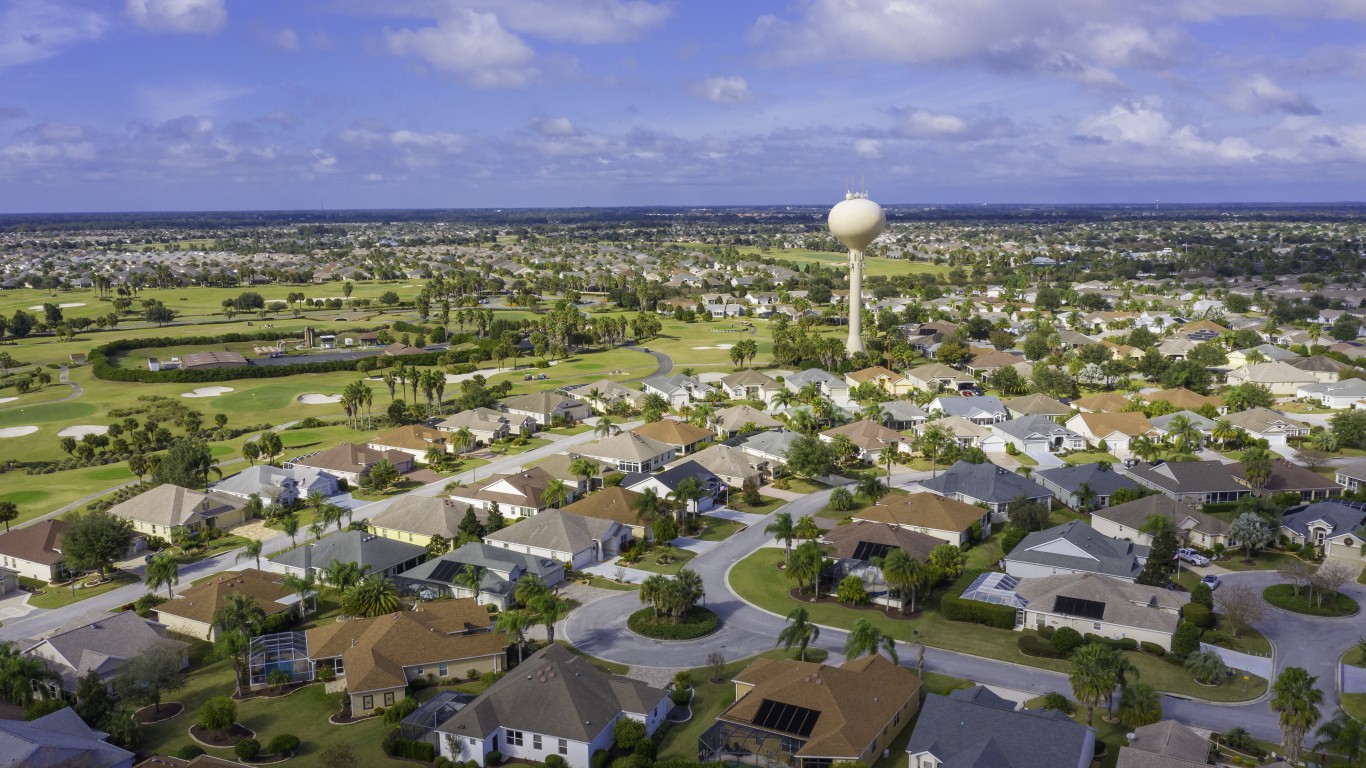
Florida: The Villages
> Households receiving SNAP benefits: 5.0% (Florida: 13.2%)
> Poverty rate: 8.8% (Florida: 13.3%)
> Median household income: $59,618 (Florida: $57,703)
> Unemployment rate: 4.7% (Florida: 5.4%)
> No. of metros considered in ranking: 22
[in-text-ad-2]

Georgia: Gainesville
> Households receiving SNAP benefits: 9.4% (Georgia: 12.2%)
> Poverty rate: 14.0% (Georgia: 14.3%)
> Median household income: $63,651 (Georgia: $61,224)
> Unemployment rate: 3.5% (Georgia: 5.5%)
> No. of metros considered in ranking: 14

Hawaii: Kahului-Wailuku-Lahaina
> Households receiving SNAP benefits: 8.9% (Hawaii: 10.7%)
> Poverty rate: 9.0% (Hawaii: 9.3%)
> Median household income: $84,363 (Hawaii: $83,173)
> Unemployment rate: 5.1% (Hawaii: 4.3%)
> No. of metros considered in ranking: 2
[in-text-ad]

Idaho: Boise City
> Households receiving SNAP benefits: 8.1% (Idaho: 9.0%)
> Poverty rate: 10.5% (Idaho: 11.9%)
> Median household income: $64,717 (Idaho: $58,915)
> Unemployment rate: 4.0% (Idaho: 4.2%)
> No. of metros considered in ranking: 6
[recirclink id=1047662]

Illinois: Bloomington
> Households receiving SNAP benefits: 9.4% (Illinois: 12.4%)
> Poverty rate: 15.2% (Illinois: 12.0%)
> Median household income: $68,037 (Illinois: $68,428)
> Unemployment rate: 3.3% (Illinois: 5.9%)
> No. of metros considered in ranking: 10

Indiana: Lafayette-West Lafayette
> Households receiving SNAP benefits: 7.0% (Indiana: 9.3%)
> Poverty rate: 17.4% (Indiana: 12.9%)
> Median household income: $52,826 (Indiana: $58,235)
> Unemployment rate: 3.8% (Indiana: 4.7%)
> No. of metros considered in ranking: 12
[in-text-ad-2]

Iowa: Ames
> Households receiving SNAP benefits: 6.0% (Iowa: 9.8%)
> Poverty rate: 17.0% (Iowa: 11.1%)
> Median household income: $60,442 (Iowa: $61,836)
> Unemployment rate: 5.0% (Iowa: 3.9%)
> No. of metros considered in ranking: 8

Kansas: Lawrence
> Households receiving SNAP benefits: 5.3% (Kansas: 7.2%)
> Poverty rate: 16.5% (Kansas: 11.4%)
> Median household income: $61,020 (Kansas: $61,091)
> Unemployment rate: 4.3% (Kansas: 4.0%)
> No. of metros considered in ranking: 4
[in-text-ad]

Kentucky: Elizabethtown-Fort Knox
> Households receiving SNAP benefits: 9.1% (Kentucky: 13.0%)
> Poverty rate: 12.1% (Kentucky: 16.6%)
> Median household income: $56,680 (Kentucky: $52,238)
> Unemployment rate: 5.7% (Kentucky: 5.3%)
> No. of metros considered in ranking: 5
[recirclink id=1104870]

Louisiana: Lake Charles
> Households receiving SNAP benefits: 12.9% (Louisiana: 15.3%)
> Poverty rate: 16.5% (Louisiana: 18.6%)
> Median household income: $52,986 (Louisiana: $50,800)
> Unemployment rate: 5.7% (Louisiana: 6.5%)
> No. of metros considered in ranking: 9

Maine: Portland-South Portland
> Households receiving SNAP benefits: 8.6% (Maine: 12.6%)
> Poverty rate: 8.1% (Maine: 11.1%)
> Median household income: $72,552 (Maine: $59,489)
> Unemployment rate: 3.4% (Maine: 4.0%)
> No. of metros considered in ranking: 3
[in-text-ad-2]
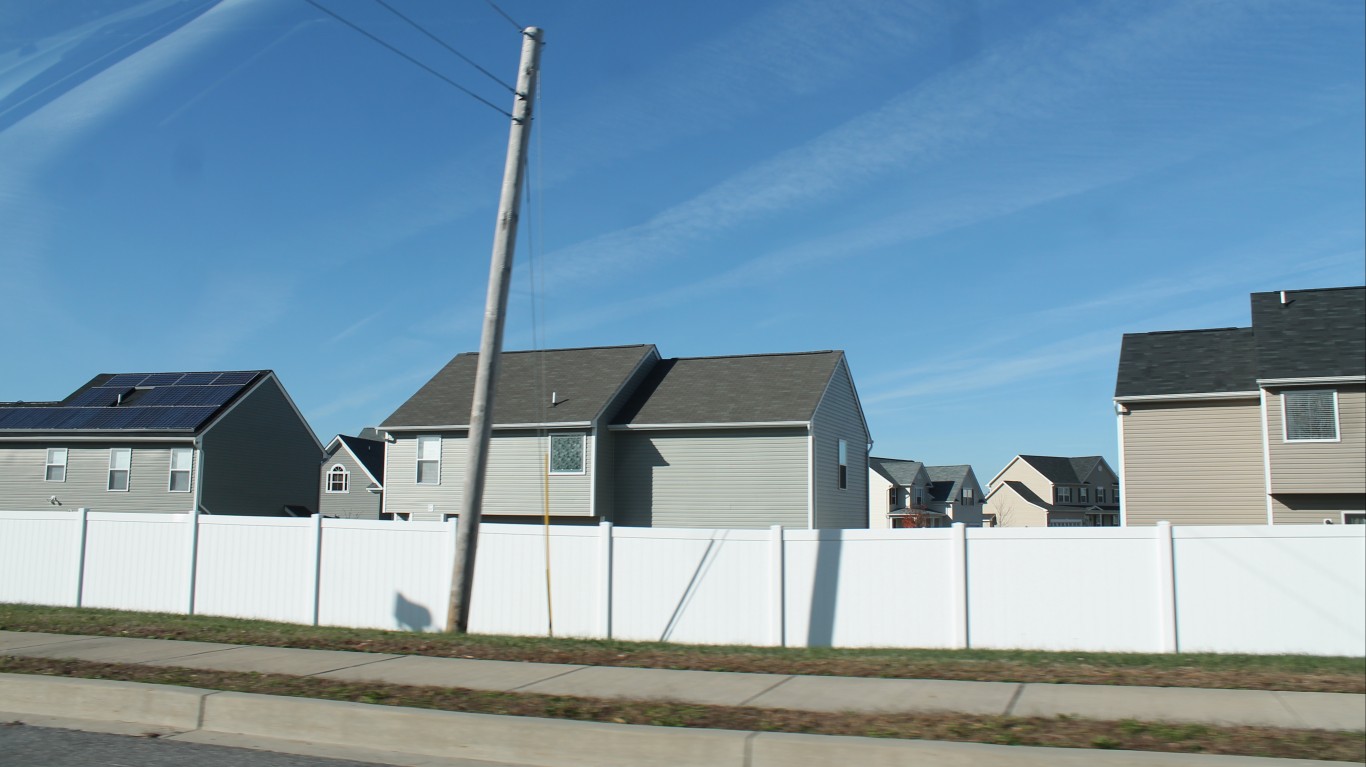
Maryland: California-Lexington Park
> Households receiving SNAP benefits: 10.7% (Maryland: 10.1%)
> Poverty rate: 8.0% (Maryland: 9.0%)
> Median household income: $95,864 (Maryland: $87,063)
> Unemployment rate: 3.4% (Maryland: 5.1%)
> No. of metros considered in ranking: 5

Massachusetts: Barnstable Town
> Households receiving SNAP benefits: 6.9% (Massachusetts: 11.6%)
> Poverty rate: 6.7% (Massachusetts: 9.8%)
> Median household income: $76,863 (Massachusetts: $84,385)
> Unemployment rate: 4.0% (Massachusetts: 5.1%)
> No. of metros considered in ranking: 5
[in-text-ad]

Michigan: Ann Arbor
> Households receiving SNAP benefits: 7.0% (Michigan: 12.7%)
> Poverty rate: 13.9% (Michigan: 13.7%)
> Median household income: $75,730 (Michigan: $59,234)
> Unemployment rate: 4.5% (Michigan: 6.0%)
> No. of metros considered in ranking: 14
[recirclink id=1100321]

Minnesota: Rochester
> Households receiving SNAP benefits: 6.2% (Minnesota: 7.5%)
> Poverty rate: 7.8% (Minnesota: 9.3%)
> Median household income: $76,787 (Minnesota: $73,382)
> Unemployment rate: 3.3% (Minnesota: 3.8%)
> No. of metros considered in ranking: 5

Mississippi: Jackson
> Households receiving SNAP benefits: 12.6% (Mississippi: 14.6%)
> Poverty rate: 16.7% (Mississippi: 19.6%)
> Median household income: $53,639 (Mississippi: $46,511)
> Unemployment rate: 7.2% (Mississippi: 7.1%)
> No. of metros considered in ranking: 3
[in-text-ad-2]

Missouri: Kansas City
> Households receiving SNAP benefits: 7.4% (Missouri: 10.5%)
> Poverty rate: 9.9% (Missouri: 13.0%)
> Median household income: $69,240 (Missouri: $57,290)
> Unemployment rate: 4.2% (Missouri: 4.5%)
> No. of metros considered in ranking: 8

Montana: Billings
> Households receiving SNAP benefits: 8.0% (Montana: 9.3%)
> Poverty rate: 9.5% (Montana: 12.8%)
> Median household income: $62,722 (Montana: $56,539)
> Unemployment rate: 3.5% (Montana: 4.1%)
> No. of metros considered in ranking: 3
[in-text-ad]

Nebraska: Lincoln
> Households receiving SNAP benefits: 7.7% (Nebraska: 8.1%)
> Poverty rate: 11.6% (Nebraska: 10.4%)
> Median household income: $62,883 (Nebraska: $63,015)
> Unemployment rate: 3.3% (Nebraska: 3.4%)
> No. of metros considered in ranking: 3
[recirclink id=1112369]

Nevada: Carson City
> Households receiving SNAP benefits: 9.2% (Nevada: 11.6%)
> Poverty rate: 10.0% (Nevada: 12.8%)
> Median household income: $58,305 (Nevada: $62,043)
> Unemployment rate: 4.6% (Nevada: 6.5%)
> No. of metros considered in ranking: 3

New Hampshire: Manchester-Nashua*
> Households receiving SNAP benefits: 6.8% (New Hampshire: 6.4%)
> Poverty rate: 7.4% (New Hampshire: 7.4%)
> Median household income: $82,099 (New Hampshire: $77,923)
> Unemployment rate: 4.0% (New Hampshire: 3.7%)
> No. of metros considered in ranking: 1
*Because Manchester-Nashua is the only eligible metro in New Hampshire, it is the metro with the lowest SNAP recipiency rate by default.
[in-text-ad-2]
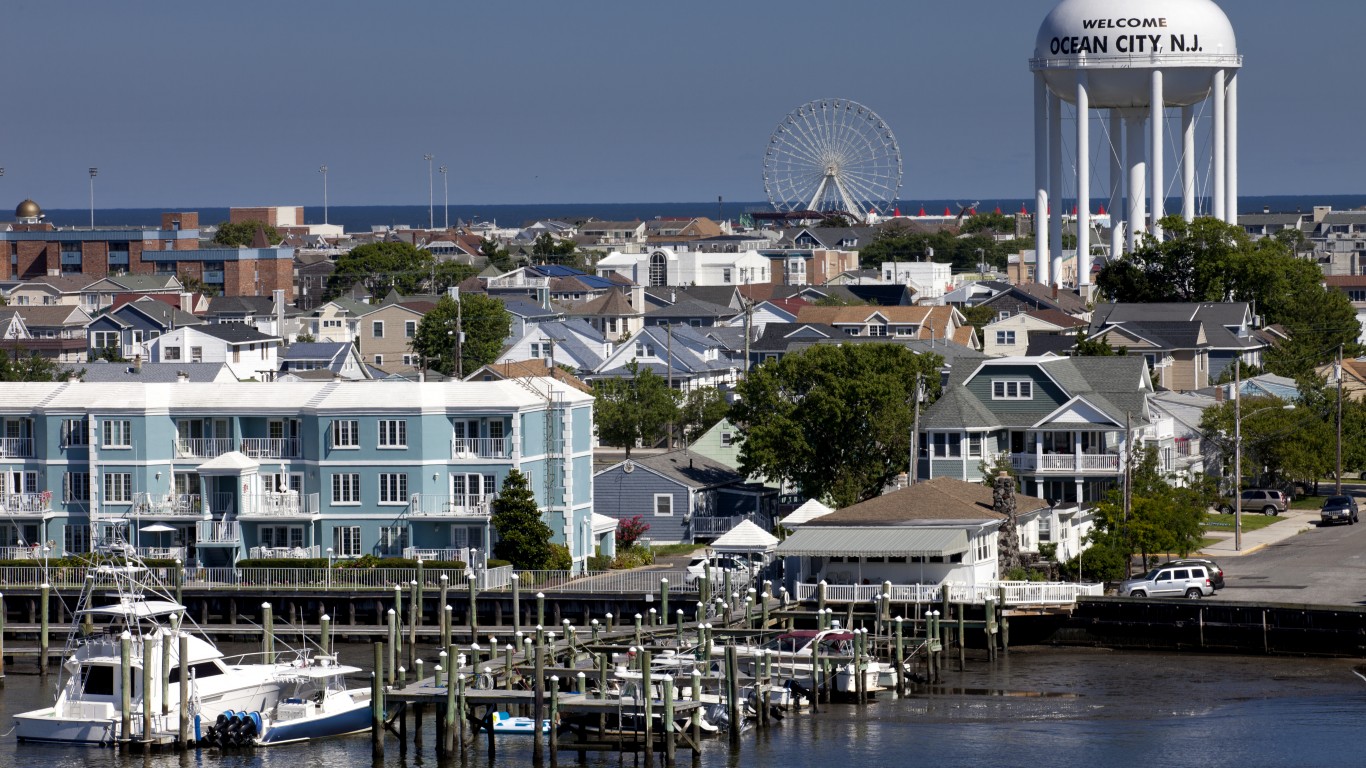
New Jersey: Ocean City
> Households receiving SNAP benefits: 6.6% (New Jersey: 8.4%)
> Poverty rate: 9.9% (New Jersey: 9.7%)
> Median household income: $72,385 (New Jersey: $85,245)
> Unemployment rate: 6.5% (New Jersey: 5.8%)
> No. of metros considered in ranking: 4

New Mexico: Santa Fe
> Households receiving SNAP benefits: 10.6% (New Mexico: 17.0%)
> Poverty rate: 13.0% (New Mexico: 18.6%)
> Median household income: $60,668 (New Mexico: $51,243)
> Unemployment rate: 4.9% (New Mexico: 6.5%)
> No. of metros considered in ranking: 4
[in-text-ad]

New York: Poughkeepsie-Newburgh-Middletown
> Households receiving SNAP benefits: 8.6% (New York: 14.3%)
> Poverty rate: 10.3% (New York: 13.6%)
> Median household income: $81,331 (New York: $71,117)
> Unemployment rate: 4.8% (New York: 5.7%)
> No. of metros considered in ranking: 13
[recirclink id=1111559]

North Carolina: Raleigh-Cary
> Households receiving SNAP benefits: 7.2% (North Carolina: 12.0%)
> Poverty rate: 9.2% (North Carolina: 14.0%)
> Median household income: $78,706 (North Carolina: $56,642)
> Unemployment rate: 4.3% (North Carolina: 5.3%)
> No. of metros considered in ranking: 15

North Dakota: Bismarck
> Households receiving SNAP benefits: 5.6% (North Dakota: 6.6%)
> Poverty rate: 7.6% (North Dakota: 10.5%)
> Median household income: $72,886 (North Dakota: $65,315)
> Unemployment rate: 2.4% (North Dakota: 3.0%)
> No. of metros considered in ranking: 3
[in-text-ad-2]

Ohio: Cincinnati
> Households receiving SNAP benefits: 9.4% (Ohio: 12.6%)
> Poverty rate: 11.7% (Ohio: 13.6%)
> Median household income: $66,435 (Ohio: $58,116)
> Unemployment rate: 4.6% (Ohio: 5.3%)
> No. of metros considered in ranking: 11

Oklahoma: Oklahoma City
> Households receiving SNAP benefits: 10.8% (Oklahoma: 12.6%)
> Poverty rate: 13.5% (Oklahoma: 15.3%)
> Median household income: $60,476 (Oklahoma: $53,840)
> Unemployment rate: 4.5% (Oklahoma: 5.0%)
> No. of metros considered in ranking: 4
[in-text-ad]

Oregon: Corvallis
> Households receiving SNAP benefits: 10.1% (Oregon: 15.0%)
> Poverty rate: 18.6% (Oregon: 12.4%)
> Median household income: $65,142 (Oregon: $65,667)
> Unemployment rate: 6.1% (Oregon: 5.4%)
> No. of metros considered in ranking: 8
[recirclink id=1047662]

Pennsylvania: State College
> Households receiving SNAP benefits: 6.2% (Pennsylvania: 13.1%)
> Poverty rate: 17.8% (Pennsylvania: 12.0%)
> Median household income: $61,921 (Pennsylvania: $63,627)
> Unemployment rate: 4.1% (Pennsylvania: 5.3%)
> No. of metros considered in ranking: 18

Rhode Island: Providence-Warwick*
> Households receiving SNAP benefits: 15.2% (Rhode Island: 14.8%)
> Poverty rate: 11.3% (Rhode Island: 11.6%)
> Median household income: $70,676 (Rhode Island: $70,305)
> Unemployment rate: 5.5% (Rhode Island: 5.5%)
> No. of metros considered in ranking: 1
*Because Providence-Warwick is the only eligible metro in Rhode Island, it is the metro with the lowest SNAP recipiency rate by default.
[in-text-ad-2]

South Carolina: Hilton Head Island-Bluffton
> Households receiving SNAP benefits: 6.4% (South Carolina: 11.2%)
> Poverty rate: 10.6% (South Carolina: 14.7%)
> Median household income: $67,723 (South Carolina: $54,864)
> Unemployment rate: 4.7% (South Carolina: 5.5%)
> No. of metros considered in ranking: 8

South Dakota: Sioux Falls
> Households receiving SNAP benefits: 7.8% (South Dakota: 8.7%)
> Poverty rate: 8.2% (South Dakota: 12.8%)
> Median household income: $67,713 (South Dakota: $59,896)
> Unemployment rate: 2.6% (South Dakota: 3.5%)
> No. of metros considered in ranking: 2
[in-text-ad]

Tennessee: Nashville-Davidson–Murfreesboro–Franklin
> Households receiving SNAP benefits: 8.3% (Tennessee: 12.6%)
> Poverty rate: 11.0% (Tennessee: 14.6%)
> Median household income: $68,406 (Tennessee: $54,833)
> Unemployment rate: 4.0% (Tennessee: 5.3%)
> No. of metros considered in ranking: 10
[recirclink id=1104870]

Texas: Midland
> Households receiving SNAP benefits: 5.8% (Texas: 11.5%)
> Poverty rate: 9.8% (Texas: 14.2%)
> Median household income: $82,768 (Texas: $63,826)
> Unemployment rate: 3.4% (Texas: 5.3%)
> No. of metros considered in ranking: 25

Utah: Provo-Orem
> Households receiving SNAP benefits: 5.2% (Utah: 6.2%)
> Poverty rate: 10.1% (Utah: 9.1%)
> Median household income: $76,864 (Utah: $74,197)
> Unemployment rate: 3.7% (Utah: 3.6%)
> No. of metros considered in ranking: 5
[in-text-ad-2]

Vermont: Burlington-South Burlington*
> Households receiving SNAP benefits: 8.2% (Vermont: 10.6%)
> Poverty rate: 10.7% (Vermont: 10.8%)
> Median household income: $73,447 (Vermont: $63,477)
> Unemployment rate: 3.8% (Vermont: 3.8%)
> No. of metros considered in ranking: 1
*Because Burlington-South Burlington is the only eligible metro in Vermont, it is the metro with the lowest SNAP recipiency rate by default.

Virginia: Charlottesville
> Households receiving SNAP benefits: 5.2% (Virginia: 7.9%)
> Poverty rate: 11.1% (Virginia: 10.0%)
> Median household income: $75,176 (Virginia: $76,398)
> Unemployment rate: 3.5% (Virginia: 4.5%)
> No. of metros considered in ranking: 9
[in-text-ad]

Washington: Seattle-Tacoma-Bellevue
> Households receiving SNAP benefits: 9.0% (Washington: 11.1%)
> Poverty rate: 8.4% (Washington: 10.2%)
> Median household income: $90,790 (Washington: $77,006)
> Unemployment rate: 4.3% (Washington: 4.8%)
> No. of metros considered in ranking: 11
[recirclink id=1100321]

West Virginia: Morgantown
> Households receiving SNAP benefits: 11.2% (West Virginia: 16.5%)
> Poverty rate: 19.1% (West Virginia: 17.1%)
> Median household income: $53,681 (West Virginia: $48,037)
> Unemployment rate: 7.1% (West Virginia: 6.5%)
> No. of metros considered in ranking: 7

Wisconsin: Appleton
> Households receiving SNAP benefits: 6.2% (Wisconsin: 10.2%)
> Poverty rate: 6.8% (Wisconsin: 11.0%)
> Median household income: $70,261 (Wisconsin: $63,293)
> Unemployment rate: 3.0% (Wisconsin: 3.5%)
> No. of metros considered in ranking: 12
[in-text-ad-2]

Wyoming: Cheyenne
> Households receiving SNAP benefits: 6.3% (Wyoming: 5.3%)
> Poverty rate: 8.9% (Wyoming: 10.8%)
> Median household income: $69,369 (Wyoming: $65,304)
> Unemployment rate: 4.6% (Wyoming: 4.3%)
> No. of metros considered in ranking: 2
To determine the metro with the lowest SNAP recipiency rate in every state, 24/7 Wall St. reviewed five-year estimates of the share of households that received SNAP benefits in the 12 months prior to the survey from the U.S. Census Bureau’s 2020 American Community Survey.
We used the 384 metropolitan statistical areas as delineated by the United States Office of Management and Budget and used by the Census Bureau as our definition of metros.
Metros were excluded if the SNAP recipiency rate was not available in the 2020 ACS, if there were fewer than 500 households, or if the sampling error associated with a metro’s data was deemed too high.
The sampling error was defined as too high if the coefficient of variation — a statistical assessment of how reliable an estimate is — for a metro’s SNAP recipiency rate was above 15% and greater than two standard deviations above the mean CV for all metros’ SNAP recipiency rates. We similarly excluded metros that had a sampling error too high for their population, using the same definition.
Metros were ranked based on the share of households that received SNAP benefits in the past 12 months. To break ties, we used the number of households that received SNAP benefits in the past 12 months.
Additional information on poverty rate, median household income, and unemployment rate are also five-year estimates from the 2020 ACS. Because the Census Bureau didn’t release one-year estimates for 2020 due to data collection issues caused by the COVID-19 pandemic, all ACS data are five-year estimates.













 Top Gaining Stocks
 Top Losing Stocks