



[cnxvideo id=”506321″ placement=”ros”]We aren’t quite ready to travel like the Jetsons, but one thing is for sure, the autonomous or self-driving cars of the future are starting to knock on our investment doors now, and now is the time to look at the semiconductor stocks that will benefit. While true autonomous cars becoming ubiquitous are still some years off, the technology is there, and despite the recent crash of a Tesla model, the progress is notable.
A new JPMorgan report focuses on some top chip stocks that are big players in the automotive market, not only in the self-driving arena, but also in advanced driver-assistance systems (ADAS), which are systems to help the driver in the driving process. ADAS is great for things like blind spot monitoring, lane change assistance and forward collision warnings.
The JPMorgan analysts expect a huge total addressable market for the autonomous driving market by 2025, and combined with the giant ADAS potential, the future is bright with the possibility for $300 to $400 in sales per car for ADAS alone. We picked four stocks from those highlighted for investors to consider.
Cypress Semiconductor
This stock is still down 20% from highs posted in 2015. Cypress Semiconductor Corp. (NASDAQ: CY) produces high-performance, high-quality solutions for some of the most advanced embedded systems, from automotive, industrial and networking platforms to highly interactive consumer and mobile devices.
The broad, differentiated product portfolio that includes NOR flash memories, F-RAM and SRAM, Traveo microcontrollers, the industry’s only programmable system-on-chip (PSoC) solutions, analog and power management integrated circuits (PMICs), CapSense capacitive touch-sensing controllers and Wireless BLE Bluetooth low-energy and USB connectivity solutions.
The company announced late last year an expansion of its automotive portfolio that will help enable manufacturers to bring high-tech automotive systems historically available only in luxury models to mainstream vehicles. Leveraging a wide range of differentiated products that includes microcontrollers (MCUs), PMICs, memories and touch-sensing solutions, the portfolio enables value-added systems for Cypress’s top tier automotive customers.
The analysts note that while ADAS applications remain a smaller portion of Cypress’s automotive business, the company expects to see revenues from ADAS applications grow at a mid-teens rate over the near term.
Cypress shareholders receive a big 3.91% dividend. The JPMorgan price target for the Neutral-rated stock is $10. The Wall Street consensus price target is $11.22. Shares closed trading on Friday at $11.30.
[nativounit]
Mobileye
This company stands to be one of the leading beneficiaries of the autonomous driving revolution. Mobileye N.V. (NYSE: MBLY) develops computer vision and machine learning, data analysis and localization and mapping for ADAS and autonomous driving technologies, primarily in Israel. It operates through two segments, Original Equipment Manufacturing and Aftermarket.
The company offers Roadbook, a localized drivable paths and visual landmarks using its proprietary REM technology through crowd sourcing, and proprietary software algorithms and EyeQ chips that perform detailed interpretations of the visual field to anticipate possible collisions with other vehicles, pedestrians, cyclists, animals, debris and other obstacles.
The company’s products also detect roadway markings, such as lanes, road boundaries, barriers and related items, and they identify and read traffic signs, directional signs and traffic lights. In addition, the company provides enhanced cruise control, pre-lighting of brake lights and Bluetooth connectivity, as well as related smartphone application.
The analysts note in their report:
Mobileye has already announced four contract awards for semi-autonomous driving starting 2018 and announced its intention to have a fully-autonomous highway driving vehicle in serial production in cooperation with BMW and Intel in 2021.
JPMorgan has a Neutral rating and a $55 price target. The Wall Street consensus target is $57.69. The shares ended the week at $49.60.
NXP Semiconductors
This company is considered a top play for investors looking for a chip stock with Internet of Things exposure, and it is down a stunning 12% since early June and is the top pick at many Wall Street firms we cover. The NXP Semiconductors N.V. (NASDAQ: NXPI) merger with Freescale Semiconductor was widely applauded on Wall Street, and many analysts believe the merger is transforming the company into a powerhouse. It made NXP the fourth largest semiconductor company in the industry.
It is also important to note that the combined company has become the number one supplier in auto semiconductors, number one supplier in global microcontrollers, as well as a dominant supplier in mobile payments.
NXP is getting its chips into high-growth areas such as contactless mobile payments, the Internet of Things, mobile-phone charging, increased cellular data consumption and LED lighting. With shares trading at solid discount to some of its peers, many analysts are very positive on the faster earnings growth potential relative to the competition.
JPMorgan says the company expects its addressable market for ADAS to grow from $800 million last year to a stunning $3.5 billion by 2025. That translates to an incredible compounded annual growth rate of about 15%.
The $97 JPMorgan price target comes with a Neutral rating. The consensus target is $107.13, and the stock closed on Friday at $84.40.
NVIDIA
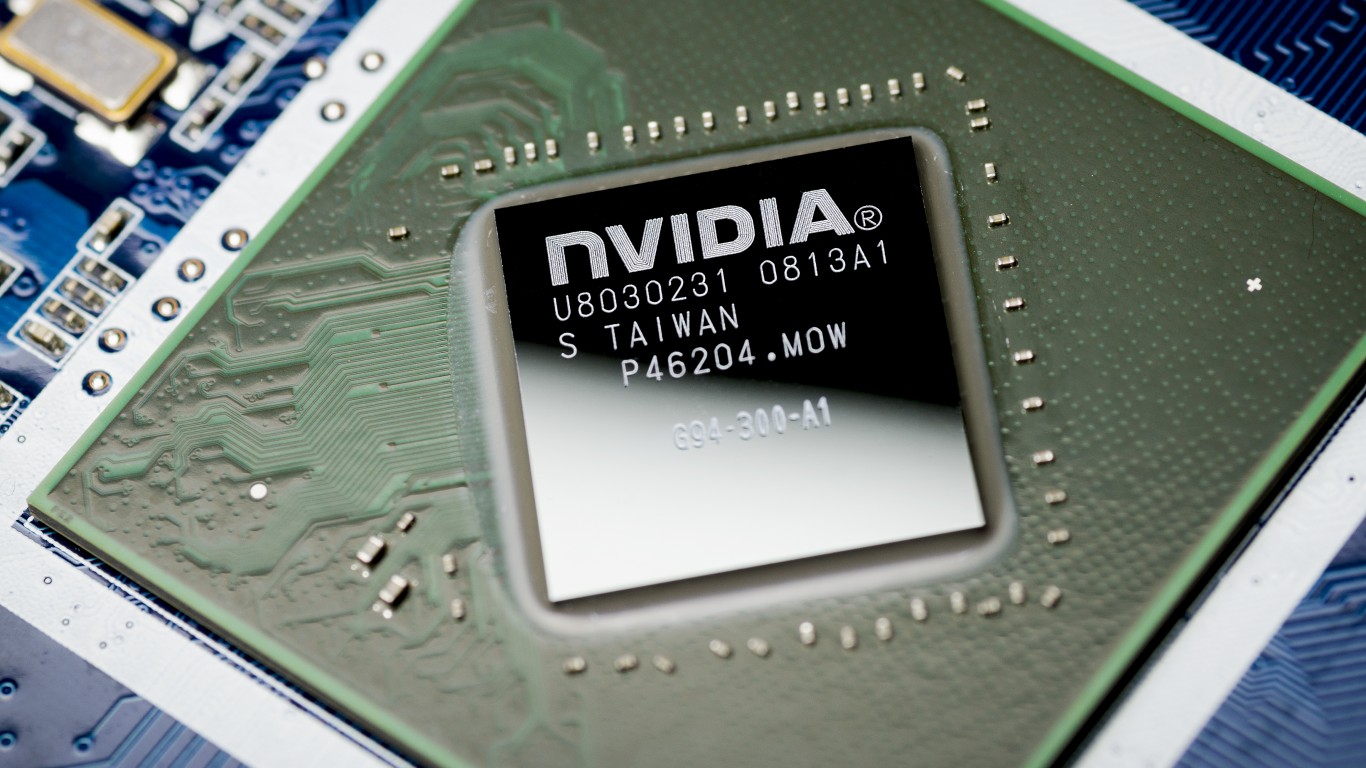
This is a top chip stock that reported stellar earnings in May. NVIDIA Corp. (NASDAQ: NVDA) is one of the leaders when it comes to supplying graphics processing technology for the 3D graphics market, including desktop graphics processors and gaming consoles.
NVIDIA is also moving into visual computing chips for cars, mobile devices and supercomputers. The company has a technology partnership with electric car maker Tesla Motors. It has been able to use its ability to leverage past investments, with a more controlled spending structure ahead on unified, which enables strong cash flow that is allowing a focus on capital return, which is currently estimated to be $1 billion next year.
Top Wall Street analysts feel the stock is maturing to a platform company from a pure chip company, and they see the stock continuing to benefit from four secular trends: virtual reality, PC gaming, chips in the automobile industry and graphic processing units (GPUs) in the cloud.
The JPMorgan report notes that the company estimated at its analysts day the opportunity for the self-driving car market will jump to between $4 billion and $8 billion per year. That assumes approximately 100 million units per year being produced. The company is partnering with Volvo for the initial roll-out of their DRIVE PX2 technology.
NVIDIA investors receive a 0.85% dividend. The $39 JPMorgan price objective is lower than the consensus target of $47.03, as well as Friday’s closing share price of $54.67.
[wallst_email_signup]
One would think the JPMorgan Neutral ratings are in place as the chip sector has been on fire and the firm is watching valuations. One thing is obvious: the car companies that perfect and offer self-driving cars that are safe will be in an incredible position with consumers.












 Top Gaining Stocks
 Top Losing Stocks